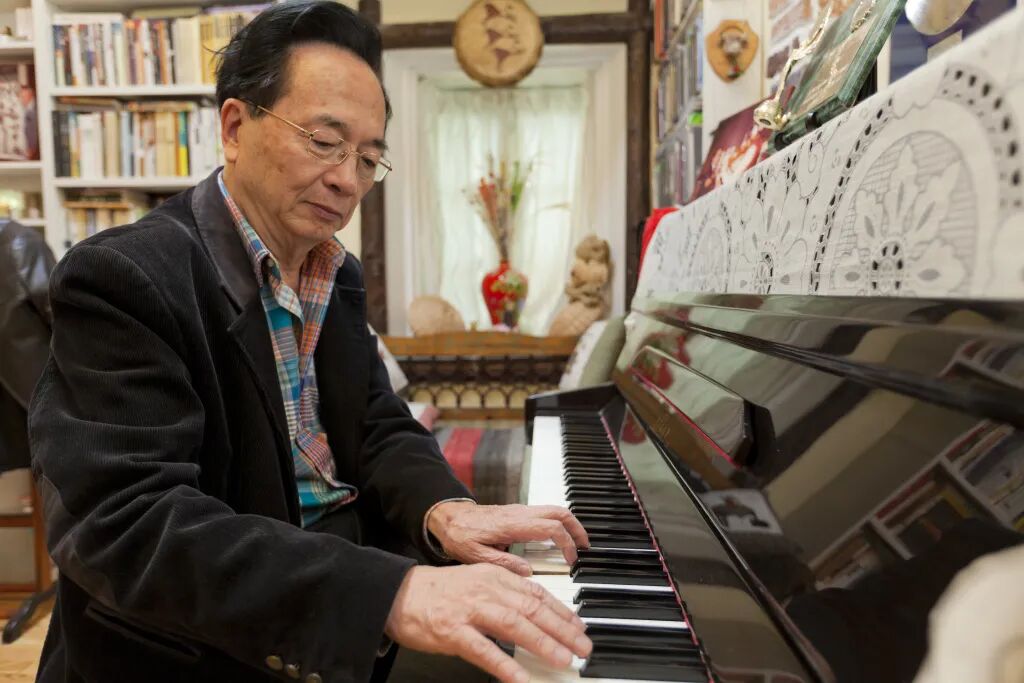
The composer of the “Tchaikovsky Violin Concerto of the East” has died. Chen Gang’s most famous work, “The Butterfly Lovers Concerto,” was an enormous success at its premiere in 1959.
Frequently co-credited to He Zhanhao, who was the soloist on that occasion (and who is said to have contributed the opening theme), the concerto suffered a reversal of fortune during the Cultural Revolution, when it was condemned by the Chinese Communist Party for its Western tendencies.
Part of the issue was the program, an ancient Chinese Romeo and Juliet story about the daughter of a rich landlord, who disguises herself as a boy in order to get an education. When her secret is discovered by a classmate, the two fall in love. However, the girl has been promised in marriage to a wealthy man. The boy dies of grief, and on the day of her wedding, the girl hurls herself into his tomb. The lovers emerge as butterflies fluttering freely in the air.
The music was blasted too, for its stylistic cosmopolitanism and bourgeois decadence.
For their celebration of redemptive love and liberation and their embrace of Western classical forms, the composers were publicly accused of crimes worse than murder, and everyone associated with the work was imprisoned.
Chen was incarcerated for two years, then was placed under house arrest at the Shanghai Conservatory, with manual labor in the mornings and self-criticism sessions in the afternoons.
It was after the Cultural Revolution that “The Butterfly Lovers” took flight. Though still far from being universally recognized in the West, it is unquestionably a crowd-pleaser. I can’t vouch for the assertion, but it has been said that it is now among the most performed concertos of the 20th century.
Chen died on Saturday at the age of 91.
Tag: China
-
“Butterfly Lovers” Composer Had His Wings Clipped by Repressive Regime, Only to See His Condemned Concerto Take Flight
-
Ormandy, China, and Forgotten American Music
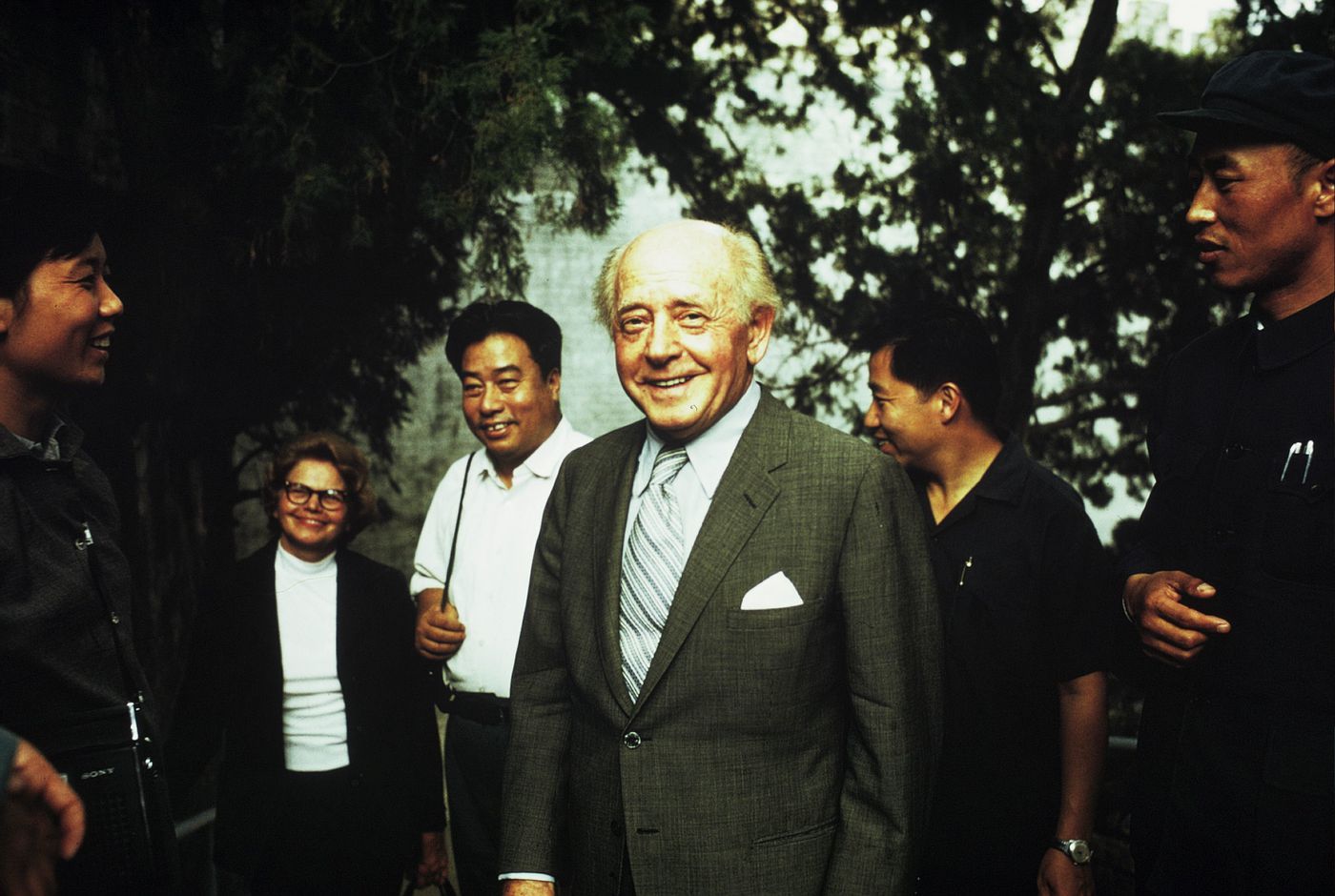
When Eugene Ormandy took the Philadelphia Orchestra to China in September of 1973, he was sure to include, alongside Mozart and Brahms, some music from the American Heartland.
Roy Harris (1898-1979) was born in a log cabin, in Lincoln County, Oklahoma, on Lincoln’s birthday. If that doesn’t imbue a composer with a sense of destiny, I don’t know what will. Harris went on to became one of our great American symphonists. In particular, his Symphony No. 3 of 1939 has been much beloved and frequently performed. Unfortunately, we don’t hear all that much of his music anymore. And that’s a damned shame.
Philadelphia would be the first American orchestra to perform in China (the London and Vienna Philharmonic Orchestras had appeared earlier the same year), having received an invitation in response to Nixon’s historic visit in 1972. According to first-hand accounts, audience reactions to the performances were difficult to decipher. On the street, people were curious, but stand-offish. Red banners and likenesses of Mao, Lenin, and Stalin festooned Tiananmen Square. The local orchestra played Western music (Beethoven), but only in rehearsal, for training purposes. In summer, musicians pruned trees.
Here are some interesting, balanced impressions, from a diary kept by one of the Philadelphians:
https://www.inquirer.com/arts/philadelphia-orchestra-china-tour-1973-mao-beijing-20190509.html
In all, the orchestra played six concerts. This was the trip on which Philadelphia performed the notorious “Yellow River Concerto,” a piano concerto written by committee and overseen by Madame Mao herself. Interesting that a country that did its damnedest to suppress decadent Western influence would shamelessly pilfer from the Western Romantics. As an encore, the pianist played a set of variations on “Home on the Range,” apparently a concession to Nixon. According to the diarist, Madame Mao did not care for “The Pines of Rome.” Mao himself was a no-show.
Also included on the programs were “The Stars and Stripes Forever” and the “Chinese Worker’s March.” Again, the Beijing audience seemed impassive. Performances were received with more enthusiasm in Shanghai.
While I haven’t been able to locate any recordings of the Chinese concerts, here’s Ormandy and the Philadelphians playing Harris in Russia in 1958. Additional American offerings included Samuel Barber’s “Adagio for Strings” and George Gershwin’s “An American in Paris,” which were played alongside Igor Stravinsky’s “The Firebird.” You can hear the tepid applause in Russia, when following the link:
If you’re interested in hearing the “Yellow River Concerto,” there are a number of performances posted on YouTube. However, the audio for the Philadelphia/Ormandy album, with Daniel Epstein – which I’ve got somewhere in my own collection – for some reason has not been posted online. If you’ve got a sweet tooth, by all means, feel free to explore. Me, I’d rather not risk a trip to the dentist’s office in time of COVID.
Tag Cloud
Aaron Copland (94) Beethoven (95) Composer (114) Film Music (149) Film Score (143) Film Scores (255) Halloween (97) John Williams (197) KWAX (232) Leonard Bernstein (105) Marlboro Music Festival (125) Movie Music (164) Mozart (91) Opera (215) Philadelphia Orchestra (90) Picture Perfect (174) Princeton Symphony Orchestra (110) Radio (90) Ross Amico (244) Roy's Tie-Dye Sci-Fi Corner (290) The Classical Network (101) The Lost Chord (269) Vaughan Williams (107) WPRB (397) WWFM (881)