Tag: Christmas Carol

  • The Sound of Silence, Christmas Eve Edition

    The Sound of Silence, Christmas Eve Edition

    Christmas Eve, already.

    On this date in 1818, the Christmas carol “Silent Night” was first sung at St. Nicholas Church in Obendorf, Austria. The words were from a poem, “Stille Nacht,” written by a young Catholic priest, Joseph Mohr, in the aftermath of the Napoleonic Wars. It’s said that Mohr was inspired in part by a walk he took, on which he was impressed by the quiet, wintry aspect of his town at peace.

    He handed the words off to the church’s choir director, Franz Xaver Gruber, who wrote the melody with a deadline looming for that evening’s mass. The carol was introduced on Christmas Eve, its creators singing it in duet, with Mohr on the guitar. (St. Nicholas Church was prone to flooding, which may have damaged the organ. Eventually, the church would be replaced by Silent Night Chapel.)

    An organ builder and repairman heard the carol and took it with him back to his own village, where it was picked up by two separate families of traveling folk singers, the Strassers and the Rainers. The Rainers performed it before the King of Prussia and Tsar Alexander I and sang it for the first time in the United States, where they introduced it at the Alexander Hamilton Monument outside Trinity Church in New York City.

    Nearly two centuries before social media, the carol went viral. You’d be hard-pressed to find anyone who doesn’t know it. It’s been recorded over 137,000 times, for the first time back in 1905.

    Even given the irresistibly Romantic story of a priest introducing the carol to his congregation on a guitar on Christmas Eve, there had been speculation over the years attributing its creation to starrier names. It was only in 1994 that the original manuscript was discovered in Mohr’s hand. Scholars now believe that two years elapsed between the actual writing of the poem in 1816 and Gruber’s last-minute contribution of the indelible melody.

    If this is true, it does nothing to take away from the carol’s magic, and the rare alchemy between poet and composer.

    ———-

    Stained glass from Silent Night Chapel, reinforcing the legend of Gruber (as opposed to Mohr) on the guitar



  • Roy’s Sci-Fi: Christmas Carol, Star Trek, Wonka

    We’ll be taking off this weekend, since Roy is involved with Country Gate Players’ virtual performances of “The Christmas Carol Murders,” Saturday at 8 pm & Sunday at 2 pm. These Zoomed entertainments are free, but registration is required, at billscurato.com.

    Before you misattribute your Seasonal Affective Disorder to “Roy’s Tie-Dye Sci-Fi” separation anxiety, here’s the video of last Sunday’s show, all about “Star Trek: The Motion Picture” (1979). Just a few minutes should be enough to cure you of any romantic delusions.

    We’ll be back next Friday, to take a bite out of “Willy Wonka and the Chocolate Factory” (1971), and next Sunday, to choose-up sides for “Santa Claus Conquers the Martians” (1964).

    You’ll want to be on the winning team. Roy’s Tie-Dye Sci-Fi Corner livestreams on Facebook most Fridays & Sundays at 7pm EST.

    https://www.facebook.com/roystiedyescificorner

  • O Little Town of Bethlehem’s Philly Roots

    O Little Town of Bethlehem’s Philly Roots

    As we anticipate the annual live broadcast of “A Festival of Nine Lessons and Carols” from King’s College, Cambridge (on WWFM – The Classical Network and wwfm.org, at 10:00 this morning EST), here’s a spot of trivia for you: Did you know that one of the most famous of all Christmas carols has its roots in Philadelphia?

    Philip Brooks was an Episcopal priest and rector of Church of the Holy Trinity (located on the northwest corner of Rittenhouse Square) at the time he jotted down a poem, in 1868, inspired by a trip he had taken to the Holy Land. He conceived the text for a Sunday school service and requested that his organist, Lewis Redner, come up with a suitable melody.

    For whatever reason, the task wasn’t at the top of Redner’s list of priorities. When Brooks checked in with him on his progress on the Friday before the service, Redner still hadn’t done anything with it. Of course, the organist assured him it would be done by Sunday, but it wasn’t until Saturday night, Christmas Eve, that he sat down and devoted any thought to it at all. Alas, his Muse was as lackadaisical as he. Redner wound up surrendering to Morpheus before he could settle on a worthwhile idea.

    “I thought more about my Sunday-school lesson that I did about the music,” Redner later recollected. “But I was roused from sleep late in the night hearing an angel-strain whispering in my ear, and seizing a piece of music paper I jotted down the treble of the tune as we now have it, and on Sunday morning before going to church I filled in the harmony.”

    The carol was first printed as a leaflet by Richard McCauley, a bookseller on Chestnut Street, west of 13th. One of these found its way to the rector of All Saints’ Church in Worcester, MA, who asked to be able to include it in a hymnal titled “The Church Porch.” He christened the piece “St. Louis.” We know it better by the address of its opening, “O Little Town of Bethlehem.”

    In the UK, the text was sung to the hymn tune “Forest Green,’ which had been adapted by Ralph Vaughan Williams from an existing folksong, “The Ploughboy’s Dream.” Vaughan Williams had notated the song while doing fieldwork in Surrey in 1903 and published it three years later in “The English Hymnal.”

    H. Walford Davies also set the text, in two versions, as a hymn known as “Wengen” and for choir as “Christmas Carol.” The latter is frequently sung on the Christmas Eve broadcast of Nine Lessons and Carols from King’s College, Cambridge, heard annually all over the world.

    It may be the case that Brooks’ original poem is more familiar on the other side of the pond in its settings by these two venerable English composers, but in the United States, Redner’s melody remains one of the most recognizable of the incessantly sung Christmas carols.

    Both Brooks and Redner were astonished by the popularity of their creation, which they had intended as a modest one-off for children. Never underestimate the power of procrastination! With a little help from those “angel whispers,” Philadelphia, for once, managed to live up to Penn’s vision of a City of Brotherly Love.

    The Church of the Holy Trinity, Rittenhouse Square


    Brooks & Redner’s “O Little Town of Bethlehem”:

    The Vaughan Williams version (from King’s College, directed by the late Stephen Cleobury):

    https://www.youtube.com/watch?v=Hsul9A3dU40

    H. Walford Davies:

  • Sibelius’ Christmas Carol Day 9 Advent

    Sibelius’ Christmas Carol Day 9 Advent

    ADVENT CAROL – DAY 9

    Sibelius wrote five Christmas songs between 1897 and 1913. These were published as his Opus 1. This is the best known of the bunch, “En Etsi Valtaa Loistoa” (“I seek not power, glory or gold”), which he composed in 1909, on a text of Zacharias Topelius.


    I seek not power, glory or gold,
    I wish for the light of Heaven and peace on Earth.
    Let Christmas bring happiness and put us in mind of heavenly things.
    Neither power nor gold but peace on Earth.

    May the wonder of Christmas come to both poor and rich;
    Into Earth’s darkness bring the light of Heaven.
    For you I yearn, you I await, Lord of Earth and Heaven,
    Now bring sweet Christmas to poor and rich.


    Since today is Sibelius’ birthday, I’m including it in my Advent calendar.

    Also, one by contemporary Finnish composer Einojuhani Rautavaara:

  • Boar’s Head Carol: A Festive Christmas Tradition

    Boar’s Head Carol: A Festive Christmas Tradition

    ADVENT CALENDAR – DAY 5

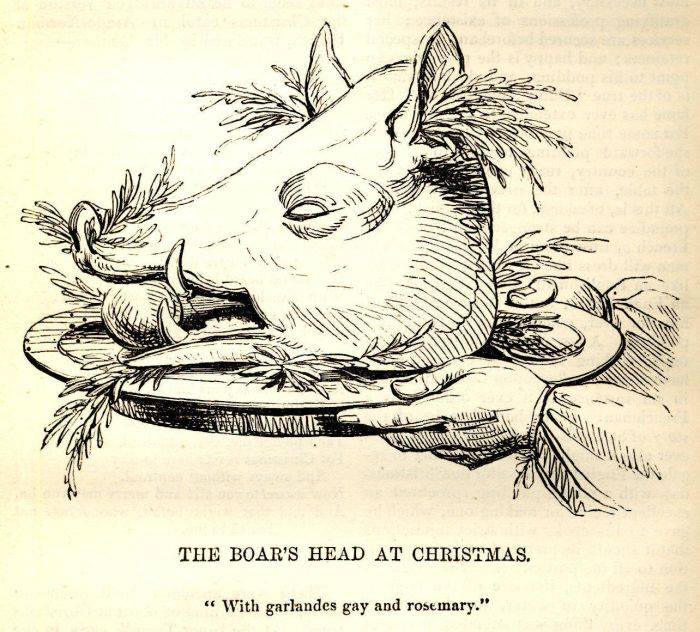
    What’s my favorite Christmas carol? There are several, certainly, but near the top of the list must be “The Boar’s Head Carol.” Why? Because what’s more festive than a steaming head of boar? I also love the fact that half of the thing is in Latin, so I have no idea what I am singing about.

    The carol dates from the 15th century and grew out of the ancient custom of sacrificing a boar for the Yuletide feast. Like so many of the arcane Christmas traditions, it can be traced to the Northern folk, who sacrificed a boar to Freyr, the god of virility and prosperity, to bless the New Year.

    With the advent of Christianity, St. Stephen stepped up as the deliverer of boar to the Yuletide banquet, and Christmas ham has been with us ever since. The presentation of the boar’s head has become symbolic of the Christ Child’s triumph over sin.

    The carol also has academic associations, not only because of the refrains (which are sung in Latin), but because of an enduring ceremony at Oxford, among other institutions of higher learning.

    Tradition holds that an Oxford student was out strolling in the forest one day, immersed in Aristotle, when he was set upon by a wild boar. Thinking quickly, the student thrust the volume into the boar’s mouth and cried, “Græcum est!” (“With compliments of the Greeks!”), there at the boar was choked to death.

    A celebratory feast held at Queen’s College involves three chefs bearing the boar’s head into the hall, with a solo singer accompanied by torch bearers and choir. During each of the verses the procession halts, then proceeds again with the chorus. At the high table, the Provost distributes the dish’s herbs to the choir and bestows an orange, which is held in the boar’s jaw, to the solo singer.

    The carol goes something like this:

    The boar’s head in hand bear I,
    Bedeck’d with bays and rosemary.
    And I pray you, my masters, be merry
    Quot estis in convivio (Translation: As many as are in the feast)

    CHORUS
    Caput apri defero (Translation: The boar’s head I offer)
    Reddens laudes Domino (Translation: Giving praises to the Lord)

    The boar’s head, as I understand,
    Is the rarest dish in all this land,
    Which thus bedeck’d with a gay garland
    Let us servire cantico. (Translation: Let us serve with a song)

    CHORUS

    Our steward hath provided this
    In honor of the King of Bliss;
    Which on this day to be servèd is
    In Reginesi atrio. (Translation: In the hall of Queen’s [College, Oxford])

    CHORUS


    Here it is, in an early version known as “The Borys Hede”:

    https://www.youtube.com/watch?v=PgYkie0Rv4k

    More commonly, it goes something like this:

    Finally, John Langstaff, from “The Christmas Revels”:

    https://www.youtube.com/watch?v=ZSzccYxYVEg

    A whole lot more on the carol and ceremony:

    http://www.hymnsandcarolsofchristmas.com/Hymns_and_Carols/Notes_On_Carols/The%20Boar’s%20Head%20Carols/boars_head_carols.htm

Tag Cloud

Aaron Copland (92) Beethoven (95) Composer (114) Film Music (120) Film Score (143) Film Scores (255) Halloween (94) John Williams (185) KWAX (229) Leonard Bernstein (100) Marlboro Music Festival (125) Movie Music (135) Opera (198) Philadelphia Orchestra (88) Picture Perfect (174) Princeton Symphony Orchestra (106) Radio (87) Ralph Vaughan Williams (85) Ross Amico (244) Roy's Tie-Dye Sci-Fi Corner (290) The Classical Network (101) The Lost Chord (268) Vaughan Williams (103) WPRB (396) WWFM (881)

DON’T MISS A BEAT

Receive a weekly digest every Sunday at noon by signing up here


RECENT POSTS