Tag: Clair de Lune

  • Debussy Clair de Lune Remembering Margaret

    Debussy Clair de Lune Remembering Margaret

    On Claude Debussy’s birthday anniversary, I remember one of my radio listeners, now no longer with us, and her fondness for “Clair de lune.”

    The station I was with at the time had offered, as a fundraising incentive during one of its pledge drives, opportunities for contributors to select a host with whom to co-present two hours of their favorite music. That’s how I met Margaret. Margaret was a retired high school English teacher of 24 years. She was in her early 80s then. It’s been my experience that I get along very well with 80-year-olds. One of her selected pieces was “Clair de lune,” which she said reminded her of her mother, since her mother used to play it on the piano.

    We had a lot in common, including the fact that she lived in my hometown of Easton, PA, and the shared experience of the radio show began a four-year friendship, during which she wrote to me frequently. I responded a little less frequently, but not shamefully so, as can sometimes be the case. She would send me photos of her garden, and the animals that visited, and relate her experiences and impressions of the seasons and her favorite places. She was a delightful person. It was a good, old-fashioned, snail-mail correspondence, nothing electronic. I wasn’t even on Facebook yet.

    The last time I saw her was on a visit to her home in 2012, after she was diagnosed with a terminal illness. She tried to encourage me to take whatever I wanted, but I had a hard time with it. I was not in an acquisitive mood. Also, I felt as if I took something it would be an admission that it really was the end. Finally, after having been urged repeatedly, I selected a rolled-up copy of a poster of a panoramic view of Easton in autumn, of which she had several. She enjoyed quite a view from the window of her living room herself.

    Margaret died nine days later, in December 2012. I still have her letters and a mug she gave me, with a reproduction of Franz Marc’s “The Dream.” We were both fans of the Blue Rider school and had visited an exhibition, separately, at the Philadelphia Museum of Art. Ironically, my mother is buried probably within a mile of her home.

    This is no reflection on Margaret (and I think she would find that aside amusing), but here’s an abridged version of Debussy’s enduring piano piece, played for an 80-year-old elephant.

    This was the version we played on the show.

    Deleted segment from Disney’s “Fantasia,” with an orchestral version conducted by Leopold Stokowski

    Happy birthday, Claude Debussy, and thinking of you, Margaret, wherever you are.
  • Debussy’s Clair de lune and André Caplet

    Debussy’s Clair de lune and André Caplet

    “Clair de lune” – Debussy, right?

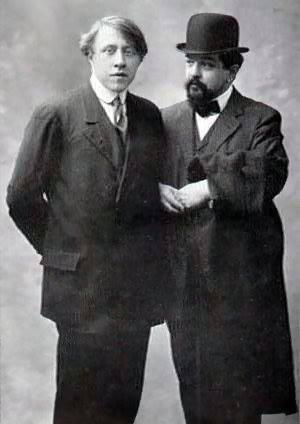
    The work began as a piano piece, one of the movements from Debussy’s “Suite bergamasque.” However, the lovely orchestral version was produced by André Caplet.

    One of the reasons superior sorts tend to look down their noses at film music is that the composers frequently work with orchestrators (though the better composers are very meticulous about notating their requirements). However, the practice is not exclusive to Hollywood.

    The Dutch masters were not always responsible for all the elements in the paintings attributed to them. For a famous example, see Rubens’ “Prometheus Bound” (which you can view in person, if you are reading this locally, at the Philadelphia Museum of Art). Similarly, successful authors sometimes set up studios, kind of like architects, with anonymous collaborators doing a lot of the heavy lifting. The practice dates back to at least Alexandre Dumas, who churned out novels at a dizzying rate.

    In classical music, many of the orchestral works of Grieg and Liszt received ample assistance from others (though Liszt gained confidence – and autonomy – as time went on). Charles Koechlin worked behind the scenes with Debussy and Gabriel Fauré.

    Caplet, a winner of the esteemed Prix de Rome, provided orchestrations for Debussy’s “Children’s Corner,” “Clair de lune,” “The Martyrdom of Saint Sebastian” and “La Boiîte à joujoux.”

    He directed the Boston Opera from 1910 to 1914. While serving in the First World War, he was caught in a gas attack, which resulted in the pleurisy that plagued him for the remainder of his short life. Caplet died in 1925, at the age of 44.

    Why is it so important to us, I wonder, that a work of art emerge seemingly from a single source – the “auteur,” as it were? While most of Caplet’s own music languishes in obscurity, his work for Debussy lives on.

    Happy birthday, André Caplet!


    Caplet’s orchestration of “Clair de lune”:

    His own “Septuor” for string quartet and three female voices:

    Rubens’ “Prometheus Unbound”:

    http://www.philamuseum.org/collections/permanent/104468.html

    PHOTO: Caplet (left) with Debussy

Tag Cloud

Aaron Copland (92) Beethoven (95) Composer (114) Film Music (120) Film Score (143) Film Scores (255) Halloween (94) John Williams (185) KWAX (229) Leonard Bernstein (100) Marlboro Music Festival (125) Movie Music (135) Opera (198) Philadelphia Orchestra (88) Picture Perfect (174) Princeton Symphony Orchestra (106) Radio (87) Ralph Vaughan Williams (85) Ross Amico (244) Roy's Tie-Dye Sci-Fi Corner (290) The Classical Network (101) The Lost Chord (268) Vaughan Williams (103) WPRB (396) WWFM (881)

DON’T MISS A BEAT

Receive a weekly digest every Sunday at noon by signing up here


RECENT POSTS