In 1978, Jimmy Carter invited Vladimir Horowitz to play at the White House. As noted by Jim Lehrer, this was not for some special state occasion, but rather because of Carter’s genuine appreciation for the pianist, whose records he once scrimped to purchase back when he was a young man serving in the U.S. Navy.
It was not Horowitz’s first appearance at the White House. He was invited for the first time by Herbert Hoover in 1931. In 1986, he returned to play for President Reagan. He also allowed some encores to be broadcast from a Carnegie Hall recital, in honor of FDR’s birthday, in 1942.
I provide two links to the Carter recital below. The second is far and away of better quality, but the first includes the president’s opening remarks, which last a little over two minutes.
Carter had an affection for all kinds of music and strove to celebrate it over the course of his presidency. You can tell he held Horowitz particularly dear.
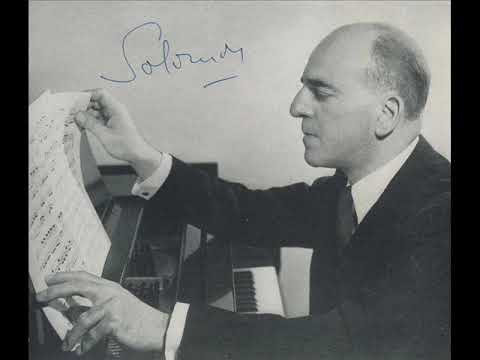
While no doubt wise, this is really Solomon the poet. Solomon of the Song of Songs.
Solomon Cutner was one of those rare classical musicians to be recognized by a single name. A child prodigy who studied with Mathilde Verne, herself a pupil of Clara Schumann, Solomon made his London debut at the age of eight. Verne pushed him hard – perhaps too hard – so that at nine, he was playing Beethoven’s Piano Concerto No. 3 and Liszt’s “Hungarian Fantasy.” At twelve, he appeared on no less than six Prom concerts, as soloist in concertos by, among others, Grieg and Tchaikovsky. The concertos of Schumann and Brahms followed.
Eventually, Verne’s motives were called into question. As the head of her own piano school, she stood to profit from the boy’s preternatural success. However, the relentless pace drove Solomon to exhaustion, anxiety, and a nervous breakdown. Once his five-year contract with her expired, he refused to have any contact with her ever again. In his 70s, he would reflect on how miserable his childhood had been.
Simon Rumschinsky, a pupil of Theodor Leschetizky, helped Solomon to rebuild his technique – and his confidence – so that he was able to pursue further studies in Paris and relaunch his adult career. Solomon’s acclaimed recitals took him far from his native London, to the United States, Australia, South Africa, South America, and Japan. Perhaps he never totally shook the specter of Verne, since he continued to practice for eight or nine hours a day.
Solomon gave the world premiere of Sir Arthur Bliss’ Piano Concerto at Carnegie Hall in 1939 (on the same program that introduced Vaughan Williams’ “Five Variants of Dives and Lazarus” and Sir Arnold Bax’s Symphony No. 7). The concert was presented in conjunction with “British Week” at the New York World’s Fair. He also entertained British troops throughout World War II, in such far-flung locations as North Africa, Palestine, India, Singapore, and Bangkok.
As an interpreter, he was particularly renowned for his Beethoven. Sadly, while in the midst of recording a complete cycle of the sonatas, in 1956, he suffered a stroke that deprived him of the use of his right arm. Though he lived another 32 years, Solomon never recorded or performed in public again. For a pianist who died as recently as 1988, it’s sobering to reflect, little of his repertoire was documented in stereo.
Broadly speaking, Solomon’s was a non-interventionist approach. It was his desire not to place himself too much between the composer and the audience. Therefore, his interpretations can sometimes come across as having more polish than personality. But at his best, he was a great poet of the keyboard.
Here, Solomon performs possibly my favorite Beethoven piano sonata, and an appropriate one, I think, for a late-summer afternoon. I’ve always been particularly fond of the exquisite third movement.