An old pro, performing one of his classic routines. Happy birthday, Victor Borge!
Tag: Comedy
-

Victor Borge Birthday Laughs & Classic Comedy
For some, it may be difficult to leave the holidays behind and face the prospect of a long, bleak winter. That would not be me.
But if it describes you, here are some classic Victor Borge sketches to brighten your day. The “Unmelancholy Dane” was born on this date in 1909.
Borge always proved to be quick on his feet, comfortable in his own skin, and unusually personable. Born into a family of Jewish musicians in Copenhagen (his birth name was Børge Rosenbaum), he was already before the public, giving recitals at the age of 8. He received a scholarship to the Royal Danish Academy of Music, and later studied with pupils of both Liszt (Frederic Lamond) and Busoni (Egon Petri).
After a few years of presenting straight classical concerts, he began to develop his act. His mix of music and comedy proved to be popular in Scandinavia, but some of his gibes didn’t exactly sit well with Hitler. When German forces occupied Denmark, Borge hopped a U.S. Army transport out of Finland – though he would return, not long after, disguised as a sailor, to visit his dying mother.
He arrived in the United States in 1940, with 20 dollars in his pocket and no understanding of English. But he was a fast learner, and he taught himself the language by going to American movies.
By 1941, he was already appearing with Rudy Valee and Bing Crosby, and adapting his jokes for U.S. audiences. In 1942, he was named “best new radio performer of the year.” By 1946, he had his own radio show and developed many of his signature routines.
He became a naturalized American citizen in 1948. His Broadway show, “Comedy in Music,” entered the Guinness Book for its unprecedented run, from 1953 to 1956. In the 1960s, he was the highest-paid entertainer in the world.
Borge continued to expand his popularity through appearances on television programs ranging from “What’s My Line?” to “The Muppet Show.” He continued to entertain to a ripe old age. He died in 2000, a few days shy of his 92nd birthday.
As he was fond of observing, “Laughter is the closest distance between two people.”
Happy birthday, Victor Borge.
A Mozart opera
With Lauritz Melchior
From an appearance on “The Dean Martin Show”
Playing the Hungarian Rhapsody No. 2
His first appearance on film, playing eight pianos, in 1937
-
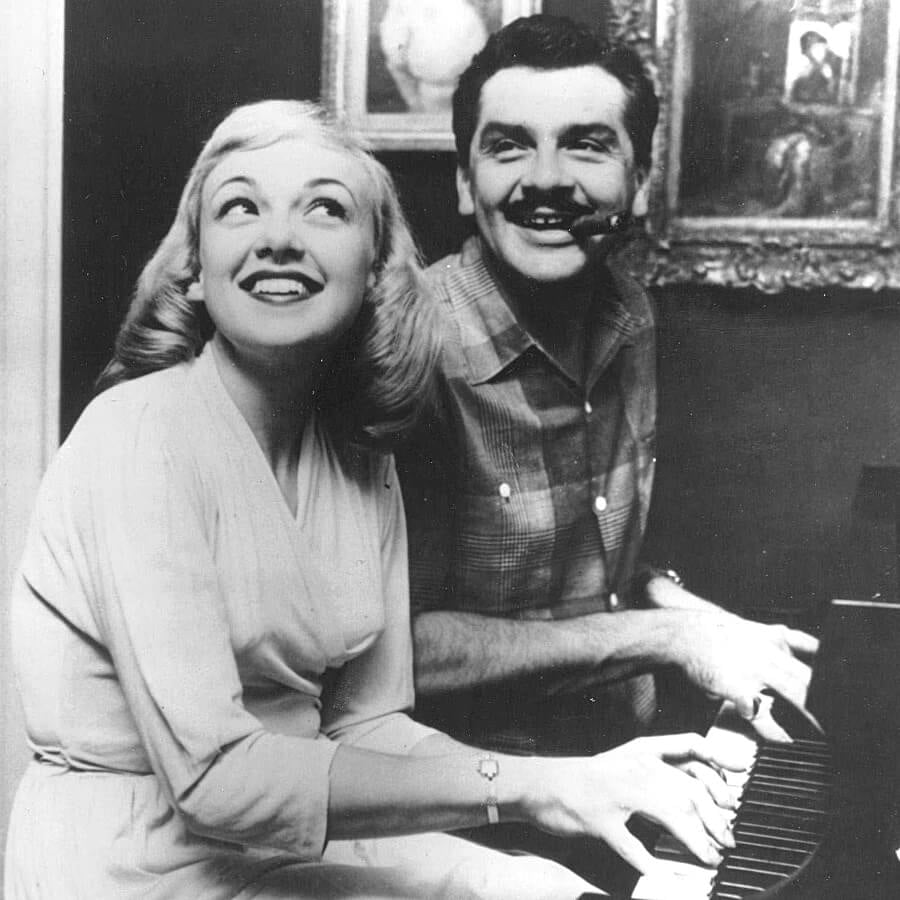
Ernie Kovacs Surreal TV Genius
Yesterday I shared Ernie Kovacs’ irreverent demolition of Victor Herbert at the hands of an inexperienced Italian television crew (on “Enna-B-C,” no less), with an orchestra of improbable musical instruments, like a Gerard Hoffnung cartoon brought to life.
Kovacs was born in Trenton, New Jersey, in 1919. He got his start in radio there, on WTTM, in 1941. It was in Philadelphia that he first broke into television, at WPTZ, in 1950. It wasn’t long before he moved into the New York and national markets. Though none of his shows seemed to last very long (the network quashed his morning show to make way for “Today”), it seems like he was everywhere at once, reincarnated on show after show, doing freeform television specials, appearing as a panelist on “What’s My Line,” and filling in for Steve Allen on “The Tonight Show.” There was no one zanier or more surreal on American television.
As a young man doing summer stock in Vermont, in 1939, Kovacs became seriously ill with pneumonia and pleurisy – so ill, in fact, that he was not expected to survive. During his convalescence, he developed a lifelong love of classical music, thanks to broadcasts over the radio. Kovacs would go on to use or parody the classics in many of his silent skits and abstract visual routines.
Here, Ernie puts some of the zing back into Tchaikovsky’s “1812 Overture”:
PHOTO: Kovacs with Edie Adams, his wife
-

Remembering Carl Reiner: A Comedy Legend
In common, I suppose, with just about anyone familiar his work – which would be anyone with any kind of familiarity with American popular culture since 1950 – I was saddened to learn of the passing of Carl Reiner, who died on Monday at the age of 98.
As a writer, producer, director, and actor, Reiner earned 11 Emmy Awards, including two for his work on “Your Show of Shows” and five for his own creation, “The Dick Van Dyke Show.” He acted in “It’s a Mad Mad Mad Mad World” and “The Russians Are Coming, the Russians Are Coming.” He directed “Where’s Poppa?” with Ruth Gordon and “Oh, God!” with George Burns.
In his later years, he appeared in the “Ocean’s Eleven” films, with George Clooney and Brad Pitt, had recurring roles on the sitcoms “Two and a Half Men” and “Hot in Cleveland,’ and did voice work for animated shows such as “Family Guy” and “King of the Hill.”
On top of everything else – his work in movies, television, Broadway, and print – Reiner directed four of Steve Martin’s funniest comedies: “The Jerk” (1979), “Dead Men Don’t Wear Plaid” (1982), “The Man with Two Brains” (1983), and “All of Me” (1984).
“The Jerk” gets all the love (it had the most quotable lines), but “Dead Men Don’t Wear Plaid” is a cinematic valentine for classic movie buffs. The film’s conceit – concocted over lunch by Martin, Reiner, and screenwriter George Gipe – was to construct a new story around scenes culled from movies of the 1940s, employing insert shots and trick photography so that Martin, as hardboiled detective Rigby Reardon, interacts onscreen with Barbara Stanwyck, Veronica Lake, Humphrey Bogart, and other luminaries of Hollywood’s golden age.
Gimmicky? Sure! But for 90 minutes, I’ll take it. Reiner himself turns up fairly late in the game as a Nazi fugitive operating out of Peru.
“Dead Men Don’t Wear Plaid” went to great lengths to imbue its pastiche with a sense of verisimilitude. To this end, Reiner secured legendary costume designer Edith Head, who had worked in Hollywood since the 1920s. (A number of her movies – including “The Glass Key,” “Double Indemnity,” “The Lost Weekend,” and “Sorry, Wrong Number” – were sampled for the new project). It would be Head’s final film. The production designer, John DeCuir, had also been active since the 1930s.
But the real masterstroke was the hiring of film composer Miklós Rózsa, whose career flourished during the heyday of noir, having provided scores for “Double Indemnity,” “The Lost Weekend,” and “The Killers,” scenes from which were also recreated in Reiner’s film. This was meta before meta was cool. Sadly, it would also turn out to be Rózsa’s final film. But what a way to go!
Of course, I haven’t seen the movie in years – we’re now as far away from “Dead Men Don’t Wear Plaid” as “Dead Men Don’t Wear Plaid” was from “Double Indemnity” – but I remember being mightily entertained as a 15 year-old. I’m sure I was well below the demographic that would have gotten most of the references. But then, I was a rather unusual child.
Sadly, plaid is no longer among Reiner’s wardrobe options. I’ve also been thinking a lot about Mel Brooks, Reiner’s best friend for 70 years. The two men met while working with Sid Caesar and Imogene Coca on “Your Show of Shows” in 1950, and have been inseparable companions throughout their golden years. According to Reiner, their daily routine involved having dinner, watching “Jeopardy” (taped), and then Mel falling asleep while watching a movie.
Reiner and Brooks formulated their classic “2000 Year Old-Man” routine when goofing around behind the scenes on “Your Show of Shows.” By 1960, they were recording it. Their final collaboration, “The 2000 Year-Old Man in 2000,” released in 1998, received a Grammy Award for Spoken Comedy Album.
It’s always especially sad to lose a comedian. Comedians should not age (except perhaps to 2000). They never really grow old, so there should be an exemption. Here’s hoping there’s a special place in heaven for those who make us laugh.
PHOTO: Reiner, channeling Erich von Stroheim in “Dead Men Don’t Wear Plaid”
-

Laurel & Hardy Marlboro Music Comedy
Our regular Wednesday feature, “Music from Marlboro,” may be on hiatus from WWFM – The Classical Network, as we all continue to do our part to Flatten the Curve, but here’s a little something hopefully to keep you smiling. Only two genii of silent comedy could send up chamber music performance in pantomime like this. It’s the only time the pair would ever appear together on film.
https://www.youtube.com/watch?v=aPRW1VQxmTs
Marlboro School of Music and Festival: Official Page
Tag Cloud
Aaron Copland (93) Beethoven (95) Composer (114) Film Music (144) Film Score (143) Film Scores (255) Halloween (94) John Williams (195) KWAX (229) Leonard Bernstein (104) Marlboro Music Festival (125) Movie Music (159) Mozart (90) Opera (212) Philadelphia Orchestra (89) Picture Perfect (174) Princeton Symphony Orchestra (109) Radio (88) Ross Amico (244) Roy's Tie-Dye Sci-Fi Corner (290) The Classical Network (101) The Lost Chord (269) Vaughan Williams (105) WPRB (397) WWFM (881)