Franz Kafka (1883-1924) and Leoš Janáček (1854-1928) were both born on this date. The two apparently never met, but beyond their common nationality (Czech), they shared an association with Max Brod. Brod was Kafka’s friend and literary executor, who ignored the writer’s explicit instructions to burn his work, opting instead to have it published. He also did much to promote Janáček and disseminate his music. He translated the libretti for some of the composer’s operas and wrote the first Janáček biography. Here Brod memorializes Janáček in an obituary he wrote in 1928:
A fragment of a film inspired by Kafka’s “The Metamorphosis” by Philadelphia-born University of the Arts graduates, the Brothers Quay, set to music by Janáček:
More about the project from the Museum of Modern Art:
The Czech writer Milan Kundera has died. His father was concert pianist and musicologist Ludvik Kundera, a colleague of Leoš Janáček. Ludvik headed the Janáček Music Academy in Brno from 1948 to 1961.
Milan himself had considered a career in music, but instead gravitated toward literature. After he was busted down by the Communist Party for his subversive views, he supplemented his income as a jazz musician. He eventually fled Czechoslovakia in 1975 to make Paris his home.
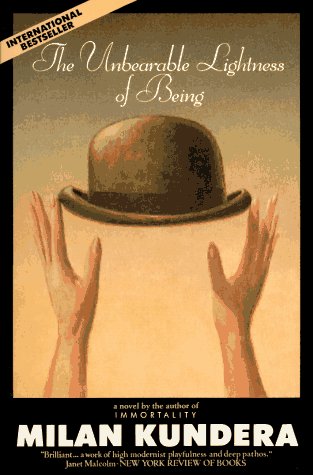
There was plenty of Janáček on the soundtrack of Philip Kaufman’s film adaptation of Kundera’s most famous novel, “The Unbearable Lightness of Being,” which starred Daniel Day Lewis, Juliette Binoche, and Lena Olin. Kundera described his novels as polyphonic symphonies, and he likened “The Book of Laughter and Forgetting” to a set of Beethoven variations.
For a time, he taught film theory at Prague’s Academy of Performing Arts. Among his students was Miloš Forman, who would go on to direct the Academy Award winning adaptation of Peter Schaffer’s play, “Amadeus.”
“They [human lives] are composed like music,” Kundera observes in “The Unbearable Lightness of Being.” “Guided by his sense of beauty, an individual transforms a fortuitous occurrence (Beethoven’s music, death under a train) into a motif, which then assumes a permanent place in the composition of the individual’s life. Anna could have chosen another way to take her life. But the motif of death and the railway station, unforgettably bound to the birth of love, enticed her in her hour of despair with its dark beauty. Without realizing it, the individual composes his life according to the laws of beauty even in times of greatest distress.
“It is wrong, then, to chide the novel for being fascinated by mysterious coincidences (like the meeting of Anna, Vronsky, the railway station, and death or the meeting of Beethoven, Tomas, Tereza, and the cognac), but it is right to chide man for being blind to such coincidences in his daily life. For he thereby deprives his life of a dimension of beauty.”
At the time of his death, Kundera was 94-years-old.
Happy Mother’s Day! Perhaps it’s a good thing I am not a parent; otherwise I would scare the bejesus out of my kids with stories from Karel Jaromir Erben’s “Kytice,” or “Bouquet.”
Like the Brothers Grimm in Germany, Erben synthesized native folk tales into often gruesome fairy stories. In doing so, he became an important figure in the establishment of a Czech national identity. His stories are recited by Czech schoolchildren and recalled proudly by the Czech people. Despite its influence, “Kytice” did not appear in a complete English translation until 2013.
Antonin Dvořák was particularly fond of Erben’s tales. In 1896, he composed a series of symphonic poems after Erben ballads, including “The Water Goblin,” “The Noon Witch” and “The Wood Dove.” Erben’s influence also hangs over Dvořák’s most famous opera, “Rusalka.”
This Sunday night on “The Lost Chord,” we salute Erben with two Dvořák works: the symphonic poem “The Golden Spinning Wheel,” and the final scene from the dramatic cantata “The Spectre’s Bride.”
“The Golden Spinning Wheel” is a Cinderella story gone very, very wrong, as a wicked stepmother and stepsister not only murder but dismember an unfortunate maiden favored by the king. Not to give too much away, but the titular appliance proves their undoing.
“The Spectre’s Bride” is another in the seemingly infinite variations on the tale of a young woman being swept off by the ghost of her lover. The climax of Dvořák’s cantata places the heroine in a cottage besieged by howling spirits, as a corpse on the table, prepared for burial, stirs to do their bidding.
Forget Dvořák’s “Songs My Mother Taught Me.” Join me for “Erben Legends,” as we celebrate Karel Jaromir Erben, this Mother’s Day at 10 ET, with a repeat Thursday at 11, or listen to it later as a webcast at http://www.wwfm.org.