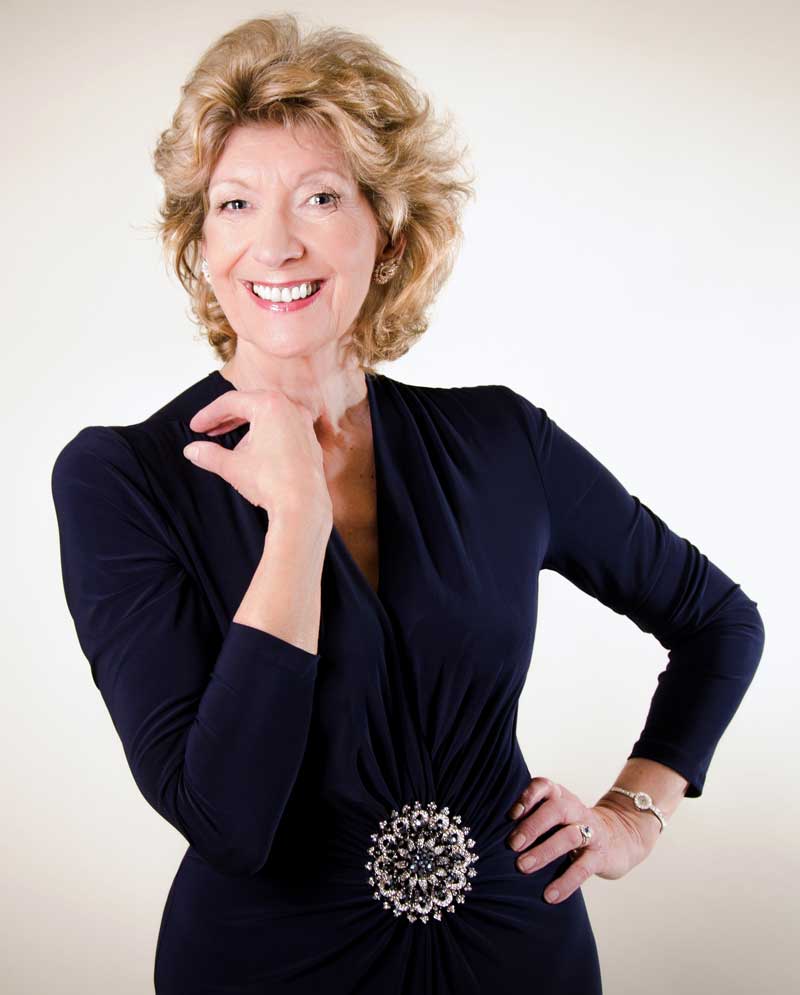
I am saddened to learn of the death of Dame Felicity Lott.
I never saw the English soprano live, and yet somehow from her recordings, performance videos, and vivacious interviews, I came to adore her. She seemed like a genuinely nice person and an inextinguishable spirit. Now, only days after revealing a terminal cancer diagnosis, she is gone.
“Flott,” as she was known to her colleagues and fans, earned her BA in French and Latin from Royal Holloway, University of London. During the course of her studies, she spent a year in France – and she certainly put it to good use, as she was always very much at home in French chansons.
She also excelled in Britten and Richard Strauss, in opera and recital, in drama and comedy. It seemed there was nothing she could not do well. Often, she performed in tandem with Graham Johnson, her accompanist since her student years.
Lott died on Friday at the age of 79. Only a few days before, she gave an interview on BBC Four, exuding her usual warmth, candor, humor and grace, in which she shared her terminal status. She said she had known about it for nearly a year.
“I’m just so happy at the moment,” she said. “I don’t want anybody to be sad, because I’m having a ball. I can’t understand it, because I’m not very well.
“I’ve known about being ill for almost a year and, my goodness, it was a shock. But here I am for a bit longer, and I’ve had time to look back and think, “Golly, you lucky thing… you’ve met all these wonderful people and had a wonderful life. You’ve been all over the world!”
Time and again, critics and admirers have cited the beauty and humanity of her characterization of the Marschallin in Strauss’ “Der Rosenkavalier.”
Of her many recordings I have broadcast over the years, this is one of my favorites. Ernest Chausson’s “Poèmes de l’amour et de la mer” (“Poems of Love and the Sea”) incorporates two texts by Maurice Bouchor. The poems, “The Flowers of the Waters” and “The Death of Love,” are separated by a brief orchestral interlude.
I’ve said it before, and I’ll say it again: often on significant musical anniversaries, I’ll do a search of my Facebook posts from past years, and I’ll find that I am actually intimidated by my own work. I realize it may come across as a rather conceited observation, but I offer it in all modesty. Against those times when the muse was so clearly with me, how can I possibly compete?
Such is the case on the anniversary of the birth of Richard Strauss. Just look at what I wrote in 2021.
And it’s not the only fine post I’ve written about this composer.
What’s an aging classical music fanatic to do? As the tiny demon inside me compels me to write, I offer this, as a sequel of sorts.
In his late 70s and in variable health, Strauss retreated to his vacation villa in Garmisch, in the Bavarian Alps, to wait out the remainder of the war. Garmisch, recognized for the excellence of its skiing conditions, had been the site of the 1936 Winter Olympics, which preceded by five months the notorious Summer Games mentioned in my post at the link above.
On May 1, 1945, the day after American troops occupied the town, and only a week before VE Day, jeeps rolled into Strauss’ driveway. As the largest house in town, his residence had been singled out as the optimal location for a makeshift command center. When an officer entered the house to deliver the news, the 81 year-old occupant is said to have come down the stairs and introduced himself, “I am Richard Strauss, the composer of ‘Rosenkavalier’ and ‘Salome.’”
The officer, Lt. Milton Weiss, happened to be a musician and decided to find another house.
A few hours later, a second contingent arrived. This time the squad was led by Maj. John Kramers of the 103rd Infantry Division’s military-government branch. He told the Strausses they had 15 minutes to pack up their things. A short while later, Strauss walked down the drive to Kramers’ jeep carrying two documents. One was a paper that certified Strauss as an honorary citizen of Morgantown, West Virginia. The other was the manuscript of “Der Rosenkavalier.” Strauss said, “I am Richard Strauss, the composer.”
Kramers, a Strauss fan, was stunned. After shaking the composer’s hand, he had a sign installed on the front lawn stating that the house was off limits. The Strauss house was spared, and the composer enjoyed a special status with the occupying troops.
One of these was a 24 year-old intelligence office named John de Lancie, who heard about what had transpired at the Strauss villa and determined to become a regular visitor of the composer. Before the war, de Lancie had been principal oboist with the Pittsburgh Symphony under Fritz Reiner. After the war, he would join the Philadelphia Orchestra (in 1946). Later, he became director of the Curtis Institute of Music (1977-1985). It was on one of his visits that de Lancie asked Strauss if he had ever considered writing an oboe concerto. Out of hand, the composer said no.
Six months later, after the war, de Lancie was surprised to learn Strauss had published an oboe concerto. The autograph score bore the inscription: “Oboe Concerto/1945/suggested by an American soldier.”
That Strauss had seen to it to assign him the rights of the first U.S. performance had to have been bittersweet for the oboist. Although de Lancie would one day assume the position of principal in Philadelphia, at the time, he was just a rank and file section oboist. Under orchestra protocol, he would be unable to perform as soloist, as Marcel Tabuteau (who happened to be de Lancie’s teacher) had seniority as the current principal. De Lancie therefore passed the rights on to a young oboist friend at the CBS Symphony, Mitch Miller – later of “Sing Along with Mitch” fame – who gave the concerto its American debut.
De Lancie would be promoted to principal oboist in Philadelphia in 1954 and held the position until 1977. His only public performance of the piece was when the orchestra played it for the first time, on August 30, 1964, at Michigan’s Interlochen Center for the Arts. De Lancie didn’t get around to recording it until 1987, with Max Wilcox the conductor. By then, the oboist was 65 years-old. It had been over four decades since he had planted the seed for one of Strauss’ late masterpieces.
Listen to de Lancie perform Strauss’ Oboe Concerto here:
Strauss died in Garmisch at the age of 85. And yes, de Lancie’s son, who also bore his name, appeared in many incarnations of “Star Trek.”
At 83, Strauss quipped, with humorous self-deprecation, “I may not be a first-rate composer, but I am a first-class second-rate composer.”
Along those lines, I offer, “I may not be a first-rate writer, but I am a first-class Facebook poster.”
Happy birthday, Richard Strauss.
At the link, see footage of Strauss conducting “Der Rosenkavalier” at 85, with commentary by Sir Georg Solti and narration by Sir John Gielgud. Solti conducted the work’s valedictory trio at the composer’s funeral. He recalls, “Marianne Schech sang the part of the Marschallin, Maud Cunitz was Octavian, and Gerda Sommerschuh was Sophie. One after the other, each singer broke down in tears and dropped out of the ensemble, but they recovered themselves and we all ended together.”