Tag: Dolores Ferraro

  • Cascarino’s Lost “Epitaph for a Soldier”

    Cascarino’s Lost “Epitaph for a Soldier”

    Philadelphia composer Romeo Cascarino wrote “Epitaph for a Soldier” in 1942-43, when he was around 20-years-old and serving in the U.S. Army.

    The recipient of two Guggenheim Fellowships, Cascarino taught for many years at the now-defunct Combs College of Music. His opera, “William Penn,” was given its world premiere at Philadelphia’s Academy of Music and most of his orchestral works were recorded by JoAnn Falletta for the Naxos label.

    This one, however, fell through the cracks.

    According to his widow, soprano Dolores Ferraro, “It’s never been performed, just was among the scores in the basement. Romeo never talked much about the war and I was remiss in [not] asking him more about this piece, though I have my ideas. …[I]t’s stunning; dark with angst, thunder and lightning; yet lyrical and hopeful, too.

    “We all know a work of Romeo’s would be beautiful, masterfully written and orchestrated, and it is, but different. Of course, the subject matter calls for this. It’s upsetting, moving and exciting! …What a thrill it gave me to hear what a 20-year-old Romeo composed! How painful to think of what he was feeling during that time….”

    The impetus for its composition was the death of a friend, who had been killed on a mission.

    I posted about the work’s rediscovery last year, after listening to a computer realization of the piece made by Cascarino’s pupil, Joe Nocella. You’ll find a biographical profile of the composer beneath the audio file at the link.

    Cascarino’s “Blades of Grass,” for English horn and string orchestra, seems to have become his most-frequently encountered work, after perhaps the Bassoon Sonata and maybe some of the songs. The piece, which has been recorded twice, has, in addition to its other qualities, brevity on its side (at approximately nine minutes), so it gets the most radio air play. The work was inspired by a well-known poem of Carl Sandburg, “Grass,” a somber reflection on the nature of conflict and the futility of war, which makes it a good fit for any Memorial Day concert or radio show. (I myself included it on yesterday’s broadcast of “The Lost Chord.”)

    In 2023, “Blades of Grass” came to the notice of the U.S. Marine Band. Interesting that it was the Marines and not the Army that revived the work!

    “Epitaph for a Soldier” is a valuable addition to the composer’s catalogue and another piece wholly suitable for Memorial Day performance. Is there anyone out there in a position to give it its world premiere?


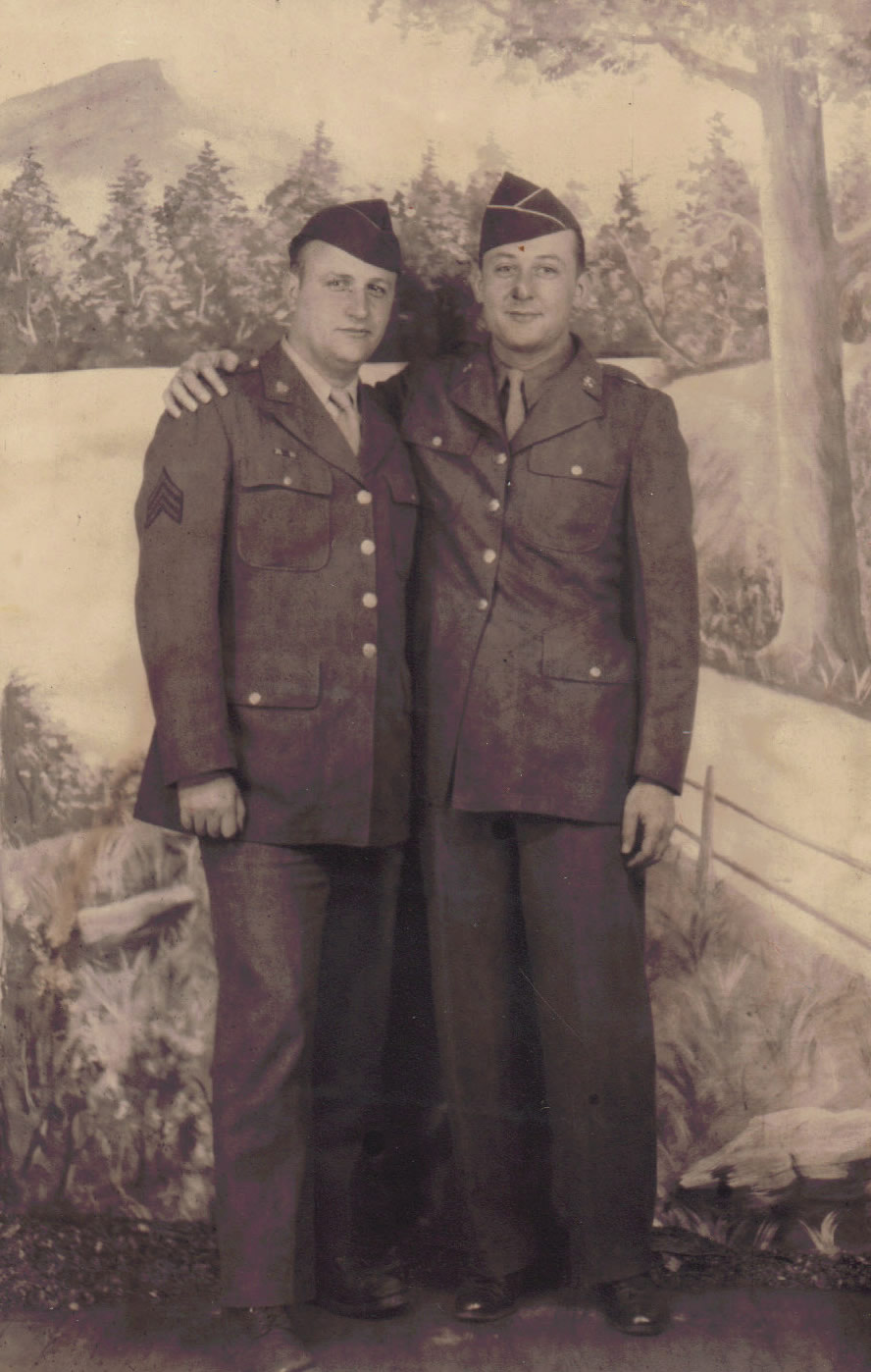
    PHOTO: Cascarino (left) with Army buddy Sol Schoenbach, for whom he composed his Bassoon Sonata in 1947. They recorded it in 1962. Schoenbach was principal bassoonist of the Philadelphia Orchestra from 1937 to 1957.
  • Romeo Cascarino’s Lost “Epitaph” Reborn

    Romeo Cascarino’s Lost “Epitaph” Reborn

    I wanted to post this yesterday for Romeo Cascarino’s birthday, but then life got in the way. It’s a computer realization of a rediscovered work by this sadly underperformed Philadelphia composer.

    “Epitaph for a Soldier” was written in 1942/43, when Cascarino was around 20-years-old and serving in the U.S. Army.

    According to his widow, soprano Dolores Ferraro, “It’s never been performed, just was among the scores in the basement. Romeo never talked much about the war and I was remiss in [not] asking him more about this piece, though I have my ideas. …[I]t’s stunning; dark with angst, thunder and lightning; yet lyrical and hopeful, too.

    “We all know a work of Romeo’s would be beautiful, masterfully written and orchestrated, and it is, but different. Of course, the subject matter calls for this. It’s upsetting, moving and exciting! …What a thrill it gave me to hear what a 20-year-old Romeo composed! How painful to think of what he was feeling during that time….”

    Its reemergence is like manna from heaven for admirers of the composer, most of whose orchestral output was issued on a Naxos compact disc conducted by JoAnn Falletta.

    There’s a biographical profile of the composer beneath the audio file at the link. The realization is by Cascarino pupil Joe Nocella.

    Cascarino’s “Blades of Grass,” for English horn and string orchestra, seems to have become his most-frequently encountered work, after perhaps the Bassoon Sonata and maybe some of the songs. The piece, which has been recorded twice, has, in addition to its other qualities, brevity on its side (at approximately nine minutes), so it gets the most radio air play. The work was inspired by a well-known poem of Carl Sandburg, “Grass,” a somber reflection on the nature of conflict and the futility of war, which makes it a good fit for any Memorial Day concert or radio show. Last year, it came to the notice of the U.S. Marine Band. Perhaps they might also be interested in this recent rediscovery?

    Cascarino attained the rank of sergeant. His Bassoon Sonata, which I broadcast yesterday on “Sweetness and Light,” was written for his Army buddy, Sol Schoenbach, who went on to become principal bassoonist of the Philadelphia Orchestra.

    “Epitaph for a Soldier” is a valuable addition to the composer’s catalogue and another piece wholly suitable for Memorial Day performance. Is there anyone out there in a position to give it its world premiere?

    BTW – There are other works by the composer that have either been similarly realized through electronic means or played only by student performers or by the composer himself in private recordings. These include movements for string quartet, piano works, and even a sextet for winds.

    If you are interested in taking a look at any of these, send me a note and I’ll put you in touch with Dolores.

    Here’s one of my many posts about the composer from last year.

    Happy belated birthday, Romeo Cascarino.


    PHOTO: Cascarino (left) with Sol Schoenbach

  • Romeo Cascarino Radio Doc Webcast

    In case you missed it, my radio documentary on Romeo Cascarino has been posted as a webcast, just in time for the composer’s centenary.

    The show includes commentary by soprano Dolores Ferraro, the composer’s wife for over 40 years, and arts writer and longtime champion Tom Di Nardo; also rare recordings from the family archive, music from a Naxos release of Cascarino’s orchestral music with JoAnn Falletta conducting, and a selection from the composer’s magnum opus, the opera “William Penn.”

    Click “listen” at the link.

  • Romeo Cascarino Lost American Composer

    Romeo Cascarino Lost American Composer

    O Romeo, Romeo, wherefore art thou Romeo? Why does no one play your music?

    It is well-crafted. It has heart. It is full of beauty. All it lacks is exposure.

    This Sunday night on “The Lost Chord,” we salute Romeo Cascarino, in anticipation of the 100th anniversary of his birth on September 28, 1922.

    Cascarino grew up in an unforgiving neighborhood in South Philadelphia. With a name like Romeo, he had to learn how to use his fists! While navigating the School of Hard Knocks, he taught himself privately, gleaning the mechanics of music theory from books checked out of the Free Library of Philadelphia. He was discovered by composer Paul Nordoff, who recognized his genius, and the two formed a bond that was more like a friendship than master-disciple.

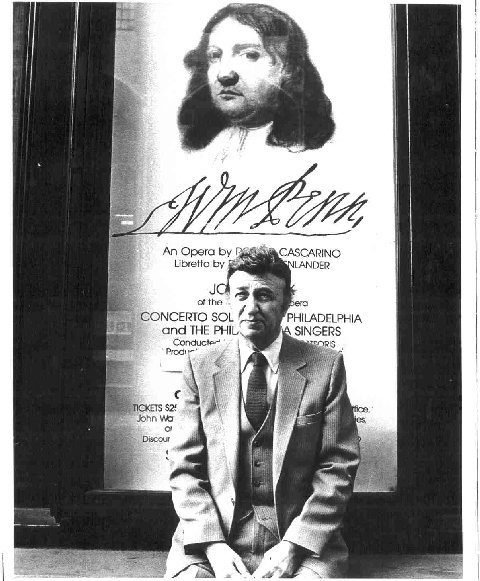
    For many years, Cascarino was a professor of composition at Combs College of Music. The recipient of two Guggenheim Fellowships, he labored at his magnum opus, the opera “William Penn,” for the better part of three decades. The work received its premiere at Philadelphia’s Academy of Music in 1982 to mark the 300th anniversary of the founding of the city.

    Metropolitan Opera singer bass-baritone John Cheek sang the title role, Cascarino’s wife, soprano Dolores Ferraro, created the part of Gulielma, Penn’s wife, and Christofer Macatsoris conducted the Philadelphia Singers and the Concerto Soloists of Philadelphia.

    Ferraro and arts writer Tom Di Nardo will join me to share their reminiscences and insights into Cascarino, the man and the composer, who died in 2002. I’ve assembled some of their remarks and punctuated the conversation with rare audio from the family archives, as well as studio recordings made by JoAnn Falletta and Sol Schoenbach, former principal bassoonist of the Philadelphia Orchestra.

    A seductive, twilit beauty informs much of Cascarino’s output. If only he had completed “William Penn” 30 years earlier, it would now be regarded one of the great American operas of mid-century, spoken of in the same breath as Carlisle Floyd’s “Susanna” and Robert Ward’s “The Crucible.”

    I hope you’ll join us in “Remembering Romeo,” this Sunday night at 10:00 EDT, on WWFM – The Classical Network and wwfm.org

Tag Cloud

Aaron Copland (92) Beethoven (95) Composer (114) Film Music (120) Film Score (143) Film Scores (255) Halloween (94) John Williams (185) KWAX (229) Leonard Bernstein (100) Marlboro Music Festival (125) Movie Music (135) Opera (198) Philadelphia Orchestra (88) Picture Perfect (174) Princeton Symphony Orchestra (106) Radio (87) Ralph Vaughan Williams (85) Ross Amico (244) Roy's Tie-Dye Sci-Fi Corner (290) The Classical Network (101) The Lost Chord (268) Vaughan Williams (103) WPRB (396) WWFM (881)

DON’T MISS A BEAT

Receive a weekly digest every Sunday at noon by signing up here


RECENT POSTS