This Sunday night on “The Lost Chord,” it’s the sharing of the green.
Edward Joseph Collins (1886-1951) was born to Irish-American parents in Joliet, Illinois. Though he studied abroad with Max Bruch and Engelbert Humperdinck, it was in Chicago that he made his career. Nearly a generation older than Copland and Gershwin, he too found inspiration in African-American spirituals, cowboy songs, and jazz.
Collins’ relationship to the Irish was a complex one. Nonetheless, he couldn’t escape the pull of his heritage and its music. Tune in to hear three of his Irish meditations this week. “Irish Ties Are Smiling,” this Sunday night at 10:00 EDT, on WWFM – The Classical Network and wwfm.org.
Well before there was Earth Day, there was Edward Joseph Collins (1886-1951).
Collins was born in Joliet, Illinois, the youngest of nine children, to Irish-American parents. All nine were musical, and Collins’ early aptitude was encouraged by his siblings. At 14, he began piano studies with Rudolf Ganz in Chicago, and then, from 1906, composition with Max Bruch, Engelbert Humperdinck, and others in Berlin.
He distinguished himself as a pianist and conductor, both in Europe and in the United States. He was engaged as assistant conductor at the Bayreuth Festival in 1914, but then with the outbreak of war, Collins left Europe to make a name for himself in Chicago, until he was called up for active duty. Throughout the conflict, he served as an interpreter and entertained troops.
Following the war, he married a voice student, who happened to be the daughter of meat-packing magnate Oscar Mayer. Needless to say, thereafter he had a comfortable support system.
Collins is a very interesting composer. Born nearly a generation before Copland and Gershwin, he nonetheless embraced African-American spirituals, cowboy songs, and American jazz.
In 1929, he composed the secular cantata “Hymn to Earth.” The work, scored for vocal soloists, chorus, and orchestra, falls into six movements and spans approximately 40 minutes.
It was commissioned by the New York Society of the Friends of Music, but, for whatever reason, the group may not have performed it. In fact, it is thought to have lain dormant for 60 years, only to be revived in 1989 by choral director William Ferris.
Like Gustav Mahler, Collins’ career kept him in the city during the season, where he found it difficult to compose. But during the summer months, he would retreat to the countryside, to be inspired by the beauty of the natural world. His journals are full of ecstatic musings on nature and observations about the Wisconsin countryside, where his wife’s family kept a cottage on Cedar Lake, and the Door County peninsula. He set “Hymn to the Earth” entirely to his own texts.
Marin Alsop made a complete recording of the piece in 2004, as part of her comprehensive series of Collins’ major works with orchestra for the Albany Records label.
Here’s the opening movement, “Hail! Mother of us all, and beautiful!”
and the fourth, “Hour of youth, Springtime of life”:
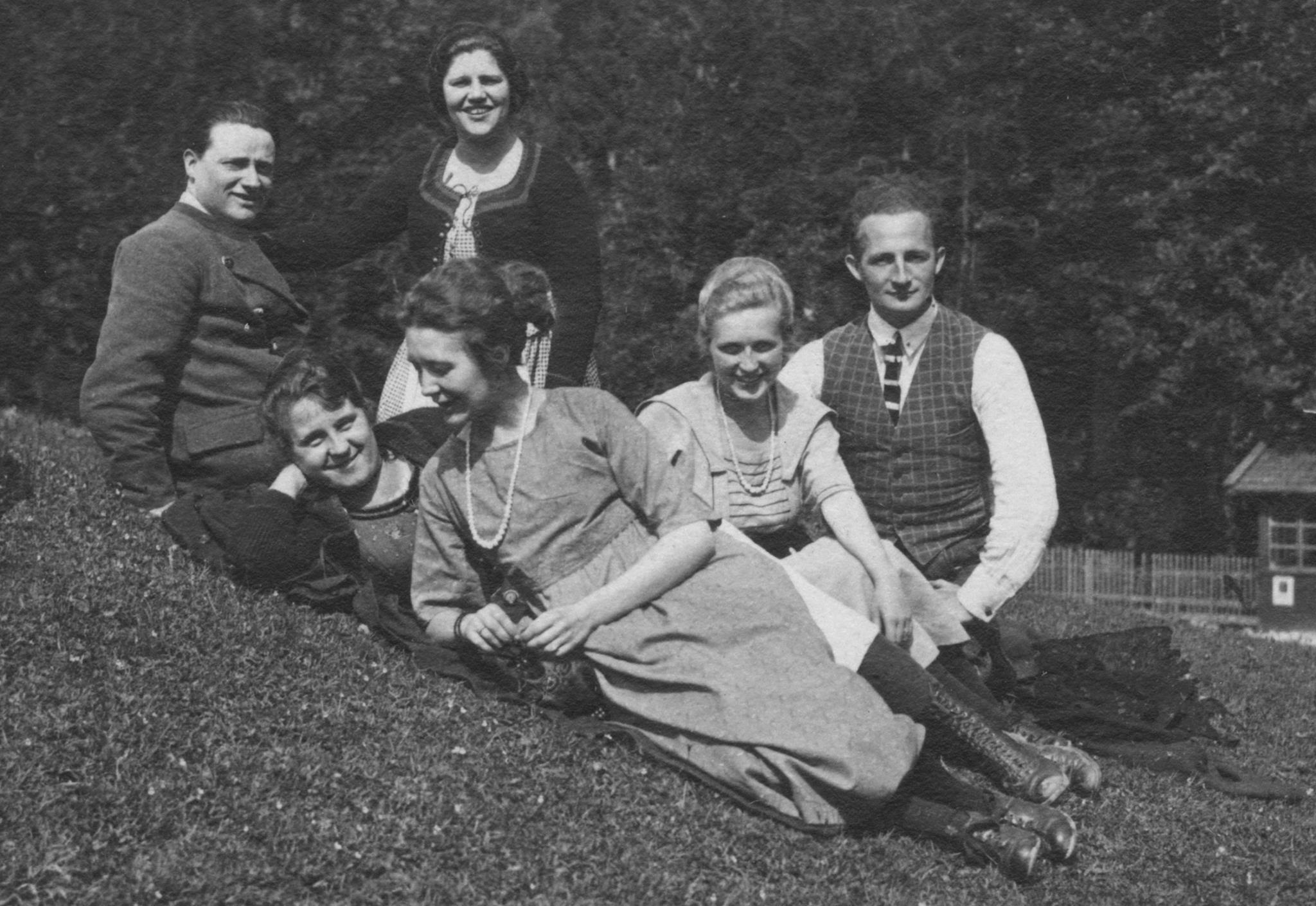
PHOTO: Edward Joseph Collins (left) enjoying the outdoors with wife Frieda (kneeling) and friends