Tag: Emil Waldteufel

  • Not All Devils Wear Horns

    Not All Devils Wear Horns

    I couldn’t lavish my usual love on Krampus this year, because Krampus Night, December 6, fell on a weekend, and I had to give preference to promoting my radio shows. I know, what a drag.

    Thankfully, only days after St. Nicholas’ dark helper was unleashed upon the naughty children of the world to lash them and toss them into hellfire comes the birthday of Emil Waldteufel. Waldteufel is German for “Forest Devil.” He was born on this date in 1837.

    Although Waldteufel had long been a mainstay of Paris society balls of the Second Empire, he was nearly 40 by the time he achieved international fame. It was the Prince of Wales – the future King Edward VII – who introduced him to London, and his music came to dominate Queen Victoria’s state balls at Buckingham Palace. One of his best-known works, “Les Patineurs” (“The Skaters’ Waltz”) was introduced there in 1882. Another of his most successful waltzes, from the other end of the decade, was “Roses de Noël” (“Christmas Roses”).

    The holidays are in bloom! Take some time to smell the roses with Emil Waldteufel.

    “The Skaters’ Waltz”


    “Roses de Noël”

    Because of the unusual nature of the conductor, in period costume and facial hair, to this I add the Rimsky-Korsakov Central Navy Band of Russia playing “Estudiantina”

    Happy birthday, Waldteufel, you devil.
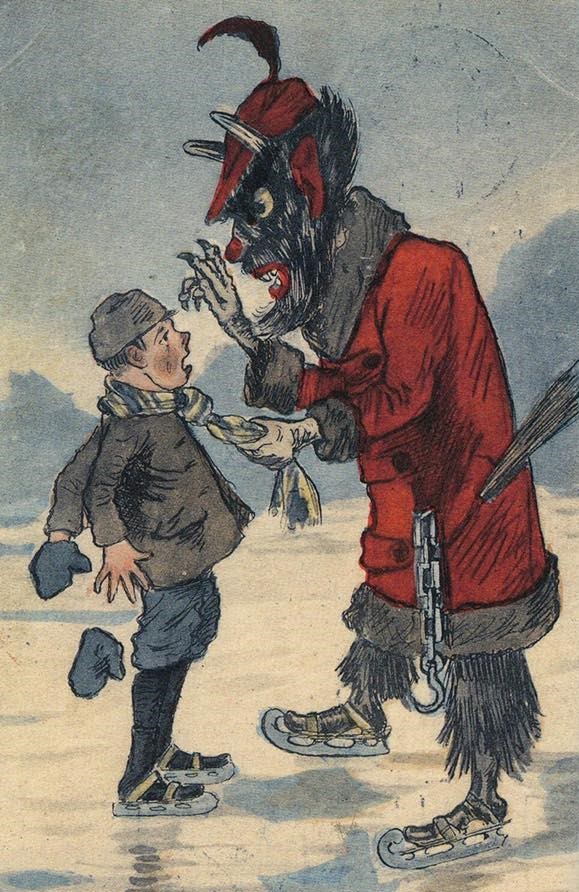
  • Emil Waldteufel Forest Devil of Waltz

    Emil Waldteufel Forest Devil of Waltz

    Only days after the arrival of Krampus, the Christmas devil, comes the birthday of Emil Waldteufel. Waldteufel is German for “forest devil.” He was born on this date in 1837.

    Though Waldteufel had long been a mainstay of Paris society balls of the Second Empire, he was nearly 40 by the time he achieved international fame. It was the Prince of Wales – the future King Edward VII – who introduced him to London, and his music came to dominate Queen Victoria’s state balls at Buckingham Palace. One of his best-known works, “Les Patineurs” (“The Skaters’ Waltz”) was introduced there in 1882. Another of his most successful waltzes, from the other end of the decade, was “Roses de Noël” (“Christmas Roses”).

    The holidays are in bloom! Take some time to smell the roses with Emil Waldteufel.

    “The Skaters’ Waltz”

    “Roses de Noël”

    Because of the unusual nature of the conductor, in period costume and facial hair, to this I add the Rimsky-Korsakov Central Navy Band of Russia playing “Estudiantina”

    Happy birthday, Waldteufel, you devil.

  • Back to School with Sweetness and Light

    Back to School with Sweetness and Light

    This week on “Sweetness and Light,” we’re headed back to school.

    We’ll have frothy music on scholastic themes. None frothier than a head of beer, conjured perhaps by Emil Waldteufel’s “Estudiantina,” or “Band of Students.” Listeners of a certain age may associate this music with a popular jingle for Rheingold Beer. Clearly its inclusion suggests a double-significance – not that I condone riotous student behavior (unless, of course, I’m invited)!

    I’ll also share one of my favorite lesser-heard works of Ralph Vaughan Williams: the “Charterhouse Suite,” a collection of light dances for strings, named for the public school the composer attended, beginning at the age of 15. Pendants will add that the work was actually arranged from an earlier “Suite of Six Short Pieces” for piano.

    Franz Joseph Haydn’s Symphony No. 55 is often referred to as the “Schoolmaster.” Passages are said to be strikingly similar to those in a lost Haydn divertimento, identified as “The Schoolmaster in Love.” In particular, it’s been suggested that the dotted rhythm of the second movement of the symphony calls to mind a schoolmaster’s wagging finger – disrupted at intervals by musical sighs as he swoons with love.

    Along the way, we’ll also enjoy music by Richard Addinsell, Gilbert & Sullivan, and Sigmund Romberg.

    Put on your school clothes, boys and girls, and learn your lessons well. You’ll get a gold star when you join me for “Sweetness and Light,” this Saturday morning at 11:00 EDT/8:00 PDT, exclusively on KWAX, the radio station of the University of Oregon!

    Stream it wherever you are at the link:

    https://kwax.uoregon.edu/

  • Christmas Roses Distler and Waldteufel

    Christmas Roses Distler and Waldteufel

    This Sunday night on “The Lost Chord,” we present a Christmas bouquet of sorts.

    Hugo Distler’s “Die Weihnachtsgeschichte” (“The Christmas Story”), from 1933, is an otherworldly, a cappella masterpiece, punctuated by seven variations on the carol “Es ist ein Ros entsprungen” (“Lo, how a Rose e’er blooming”). Over the course of some 40 minutes, the work reinvents the Baroque Christmas cantata, after the manner of Heinrich Schütz, and does so quite beautifully, conjuring the calm and quiet of a bygone era. The composer described the piece as “an oratorio with chamber music character.”

    Unfortunately, Distler’s life proved anything but calm. A man of conscience, he yet remained in Nazi Germany. He joined the Party with reluctance, when he realized his employment at the Lübeck Conservatory hinged on his doing so. Nevertheless, it did not smooth his path. The war separated him from his family, robbed him of many of his friends, and battered his psyche with nerve-wracking aerial assaults. Job pressures and fear of being conscripted into the German army further contributed to his anxiety.

    Furthermore, his devotion to sacred music put him at odds with the authorities, who were intent on twisting the Lutheran Church to its own ends. The Nazis wound up branding Distler’s works “entartete,” or “degenerate.” Unable to reconcile the irreconcilable – serving both God and the Nazis – one day he pushed his bed into the kitchen and turned on the gas, committing suicide in 1942. He was 34 years-old.

    Emil Waldteufel, by contrast, enjoyed much success and happiness. Although he was nearly 40 by the time he achieved international fame, his waltzes had long been a mainstay of Paris society during the Second Empire. It was the Prince of Wales – the future King Edward VII – who introduced him to London, where his music came to dominate Queen Victoria’s state balls at Buckingham Palace. One of his best-known works, “Les Patineurs” (“The Skaters’ Waltz”) was introduced there in 1882.

    For our purposes, we’ll round out the hour with one of Waldteufel’s most successful waltzes from the other end of the decade, “Roses de Noël.”

    The holidays are in bloom this week. I hope you’ll join me for “Christmas Roses,” this Sunday night at 10:00 EST, on WWFM – The Classical Network and wwfm.org.

  • Waldteufel Christmas Roses and Skaters Waltz

    Waldteufel Christmas Roses and Skaters Waltz

    Only days after the arrival of Krampus, the Christmas devil, comes the birthday of Emil Waldteufel. Waldteufel is German for “forest devil.” He was born on this date in 1837.

    Though Waldteufel had long been a mainstay of Paris society balls of the Second Empire, he was nearly 40 by the time he achieved international fame. It was the Prince of Wales – the future King Edward VII – who introduced him to London, and his music came to dominate Queen Victoria’s state balls at Buckingham Palace. One of his best-known works, “Les Patineurs” (“The Skaters’ Waltz”) was introduced there in 1882. Another of his most successful waltzes, from the other end of the decade, was “Roses de Noël” (“Christmas Roses”).

    The holidays are in bloom! Take some time to smell the roses with Emil Waldteufel.

    “The Skaters’ Waltz”

    “Roses de Noël”

Tag Cloud

Aaron Copland (92) Beethoven (95) Composer (114) Film Music (119) Film Score (143) Film Scores (255) Halloween (94) John Williams (185) KWAX (229) Leonard Bernstein (99) Marlboro Music Festival (125) Movie Music (134) Opera (198) Philadelphia Orchestra (86) Picture Perfect (174) Princeton Symphony Orchestra (106) Radio (87) Ralph Vaughan Williams (85) Ross Amico (244) Roy's Tie-Dye Sci-Fi Corner (290) The Classical Network (101) The Lost Chord (268) Vaughan Williams (102) WPRB (396) WWFM (881)

DON’T MISS A BEAT

Receive a weekly digest every Sunday at noon by signing up here


RECENT POSTS