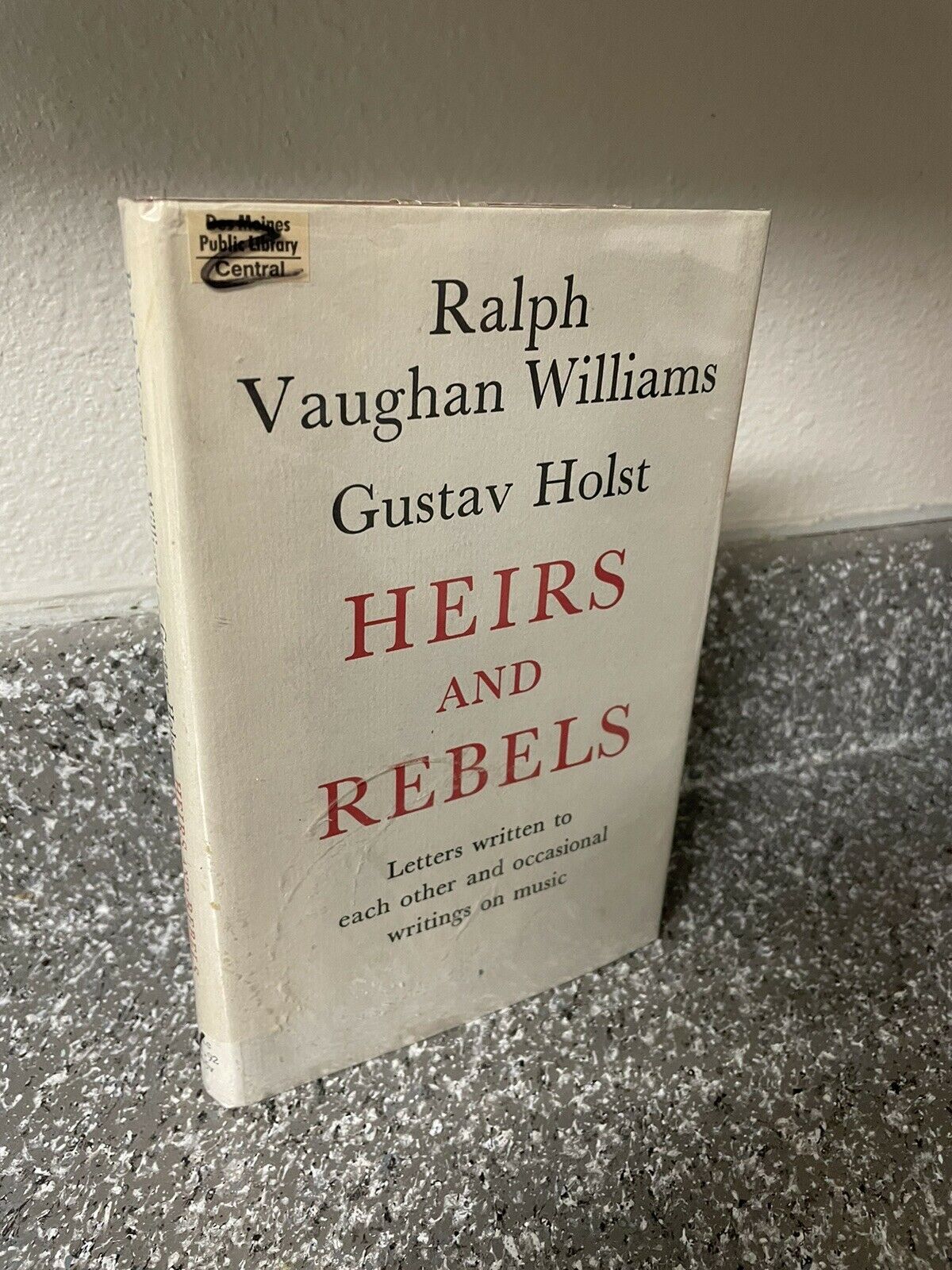
You may recall, I posted here a couple of times that I was the beneficiary of the Des Moines Public Library, which for some reason opted to discard a number of collectible volumes about Ralph Vaughan Williams, in the year that marks the sesquicentennial of his birth. (The actual date is October 12.) In any case, Des Moines’ loss is my gain, as I snatched them off eBay not long after they appeared.
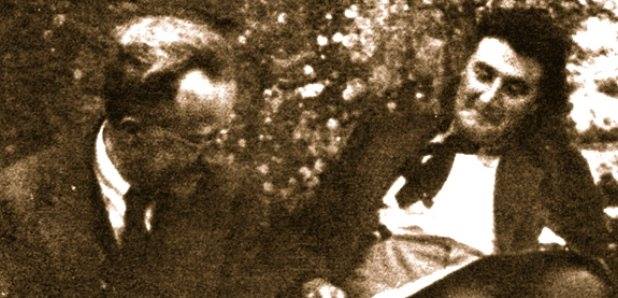
One of these is a collection of correspondence between Vaughan Williams and fellow composer Gustav Holst, edited by Ursula Vaughan Williams (RVW’s widow) and Imogen Holst (Gustav’s daughter). The letters are interleaved with musical essays by both artists.
Having just finished the book, which is rather slender at just over 100 pages, I come away with a better understanding of their friendship and just how much they influenced one another. There was such honesty and trust between them. In their shared pursuit of artistic excellence and a new English music, neither of them were ever insensitive in their criticism, but they weren’t afraid to be direct in stating what they thought worked and didn’t work in each other’s compositions.
There are several interesting essays by Holst that make me want to revisit the music of Thomas Weelkes and Samuel Wesley, so highly did he regard them at their best. It’s interesting what things the editors decide to footnote and what they don’t. I got a bit of a swollen head when I realized how much I was able to pick up that would have slipped past a reader perhaps not quite so well-versed in English music.
Of course, being a library discard, there are a few instances in my copy of random scrawl in the margins and unnecessary underlining in ink, which is irksome – who writes in a book in pen? – but for the price I am glad to have it, as copies on the secondhand market are many times the cost.
The title is a reference to a lecture delivered by Holst at Yale in 1929, in which he quotes Gilbert Murray: “Every man who counts is a child of tradition and a rebel from it.”
Vaughan Williams and Holst embodied this dictum most demonstratively, absorbing their lessons from hidebound Hubert Parry and Charles Villiers Stanford at the Royal College of Music, striking out on their own to harvest English folk song from its natural habitat before it could be plowed under by industrialization, and, in Vaughan Williams’ case, reaching back to the Tudor era to revitalize “The English Hymnal.” Holst also found inspiration in ancient Hindu texts. Both men built their own idiosyncratic structures on these foundations to become two of England’s most distinctive musical voices.
Holst offered the following words to Vaughan Williams, in a moment of self-doubt. Amidst all the advice and constructive criticism, he writes perceptively, in a letter from 1903, “Your best – your most original and beautiful style or ‘atmosphere’ is an indescribable sort of feeling as if one were listening to very lovely lyrical poetry. I may be wrong but I think this (what I call to myself the REAL RVW) is more original than you think.”
Theirs was a special friendship, and Vaughan Williams felt keenly Holst’s loss when he died in 1934, at the age of 59. RVW had a lot of creative years ahead of him. He died in 1958, at 85, active until the end. For the rest of his life, he missed the valued input of his close friend and kindred spirit.
Happy birthday, Gustav Holst.
“Jupiter” (1914)
“Beni Mora” (1910)
Vaughan Williams’ setting of “Seventeen Come Sunday” from his “English Folk Song Suite” (1923)
Listen for the tune in Holst’s “Somerset Rhapsody” (1906), about three minutes in
“Choral Hymns from the Rig Veda” (1911), anticipating Britten?
“Hammersmith” (1930), prelude and scherzo
“Song of the Blacksmith”
https://www.youtube.com/watch?v=DbNwpJPlpAQ
“My sweetheart’s like Venus”