For someone who aspired to such a contented, bourgeois lifestyle, Richard Strauss sure did write his share of decadent operas.
Perhaps because his musical language remained so rooted in the 19th century – for his expressive ends, stretching tonality, but never breaking it – he thought some added spice would keep him “modern.”
He never pushed harder than “Elektra,” grim, brutal, and strangely exhilarating. Its harmonic tension and mad intensity still pack a powerful punch today. Klytaemnestra’s bloodcurdling shrieks as she’s murdered by her son is a tough act to follow!
After that, the composer retreated to the milder titillations of “Der Rosenkavalier.” A little naughty, but only to the extent of driving one to hide one’s face behind one’s fan.
There is nothing in “Die ägyptische Helena” (“The Egyptian Helen”), first performed in 1928, to match the shock value of “Elektra,” introduced in 1908, nor for that matter, Salome making out with the severed head of Jochanaan, in 1905, but its psycho-sexual situations could only have emerged from the Vienna of Freud and Arthur Schnitzler.
The librettist, frequent Strauss collaborator Hugo von Hofmannsthal, knew Schnitzler. In fact, they belonged to the same literary circle (“Jung-Wien,” or “Young Vienna”). I don’t know any of Hofmannsthal’s work outside of opera, but some of his librettos for Strauss can get pretty oblique. “Elektra” and “Der Rosenkavalier” don’t require a lot of afterthought, but he also wrote “Ariadne auf Naxos” and “Die Frau ohne Schatten.” In these, there is rather more to unpack. Likewise, the erotic complexities of “Helen” are buried under layers of symbolism, with an ample gloss of psychological navel-gazing.
The current production at Bard College (a highlight of Bard SummerScape, the school’s annual festival of the arts), stage directed by Christian Räth, doesn’t make it any easier to get to the bottom of things. But its excesses sure are fun. It kind of plays like “Ariadne auf Naxos,” with farcical and dramatic situations intruding on one another, but more off the leash. Elves, choristers, dancers, and an Omniscient Seashell further ornament the narrative about Helen of Troy and Menelaus’ rocky road to reconciliation following the Trojan War.
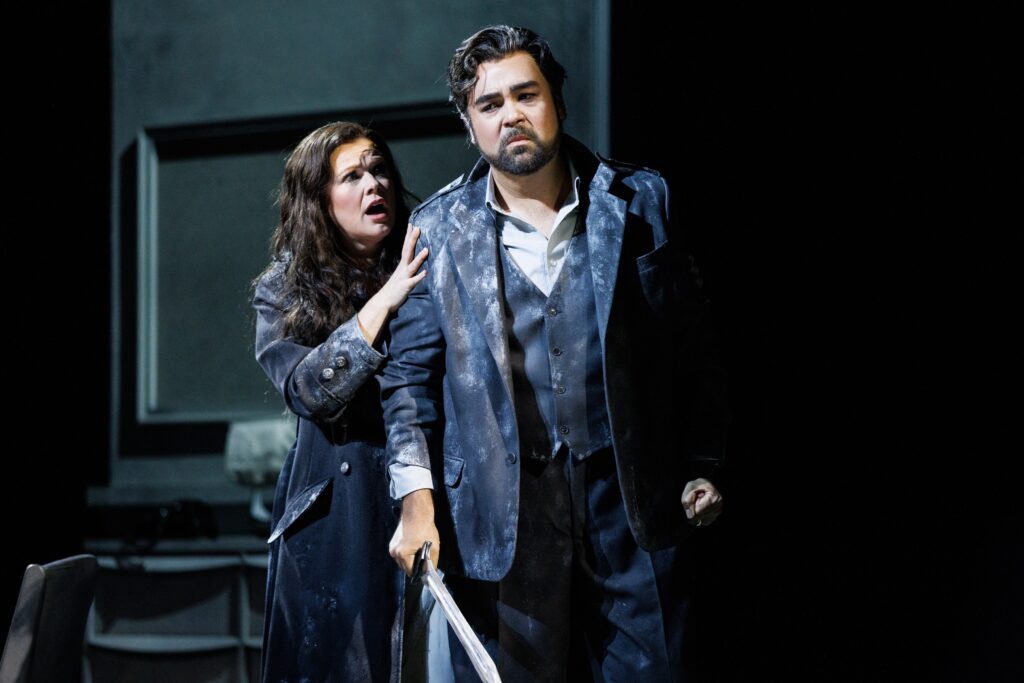
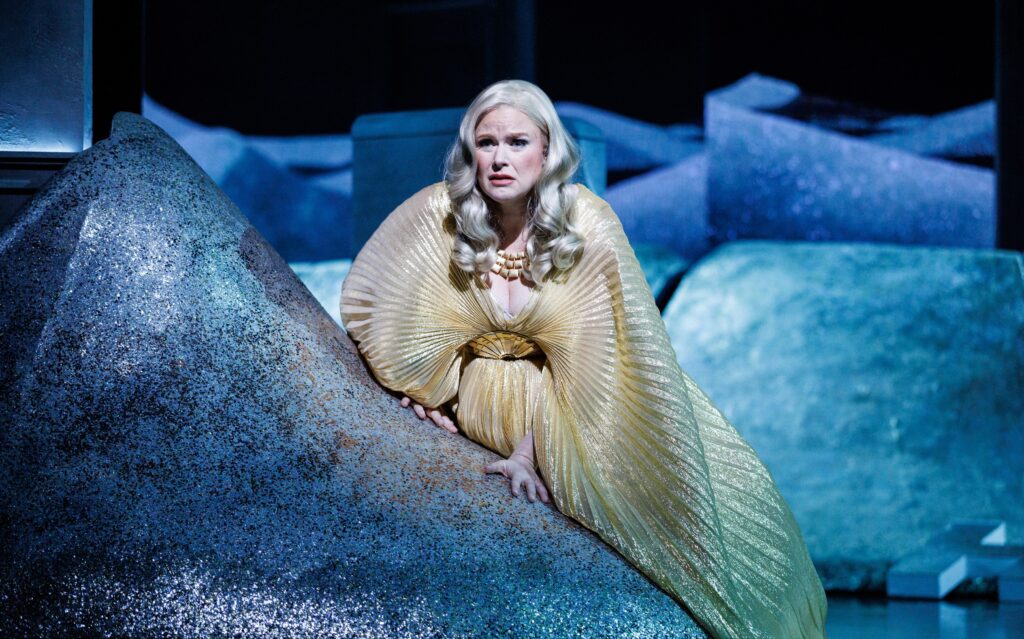
The couple are shipwrecked off the coast of Egypt by the sorceress Aithra, a gesture that saves Helen from being murdered by her husband. To say that he is still processing her infidelity with Paris is an understatement. Aithra takes it upon herself to oversee the couple’s rehabilitation, supplying lotus juice to calm Menelaus and allow him to forget, and concocting an alternative narrative in which a phantom Helen was conjured by the gods to run off with Paris, while the real Helen remained faithful, asleep in Aithra’s father’s palace on the slopes of the Atlas Mountains.
But the opera doesn’t begin with Helen and Menelaus. It turns out even powerful sorceresses have their issues, as Aithra has been stood up by her boyfriend, Poseidon, god of the sea (and protector of Troy), because he is in Ethiopia receiving tribute. But he swears he is steadfast in his love, sending her three white doves. Aithra is unimpressed, dismissing the gesture, as we learn that in the past Poseidon has also tried to smooth things over by sending dolphins. Clearly, there is tension in this relationship as well.
The parallels, and Aithra’s story about the “real” Helen’s unwavering fidelity, make one question: is anything in the narrative to be taken at face value? Is Helen and Menelaus’ presence even real? Their dilemma reflects the romantic complications – and jealousy – between Aithra and her absent lover. So is it a structural conceit? Or are the visiting couple actually archetypes, projections of Aithra’s own psychological state?
Räth stacks the deck in the Bard production – at a point, Aithra and Helen swap wigs, and a scene in the second act plays out among shifting mirrors – but do these reflect Hofmannsthal’s intentions? In accordance with the libretto, Helen makes the sensible determination, if a difficult one, that it is better to confront the truth than to repress it and live an imperfect life based on denial.
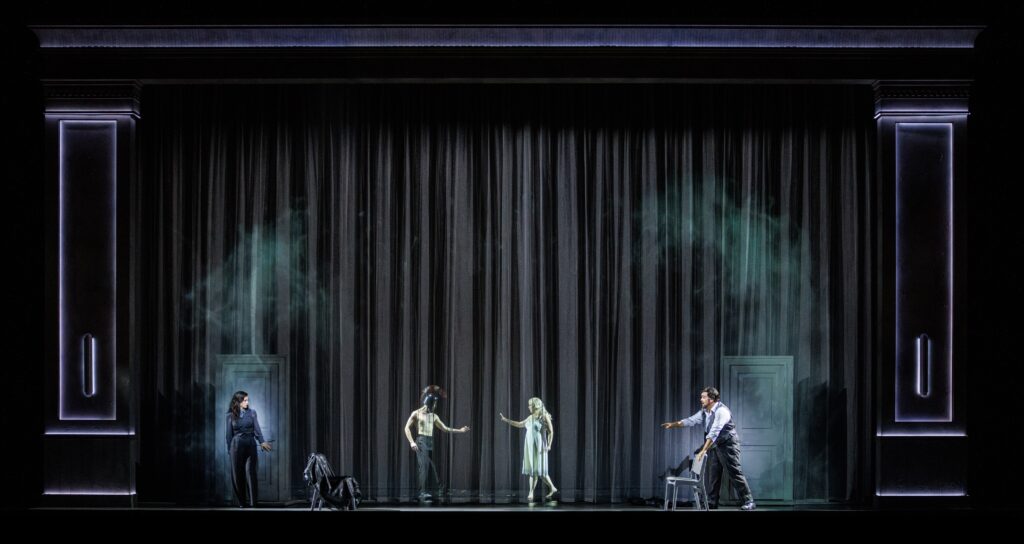
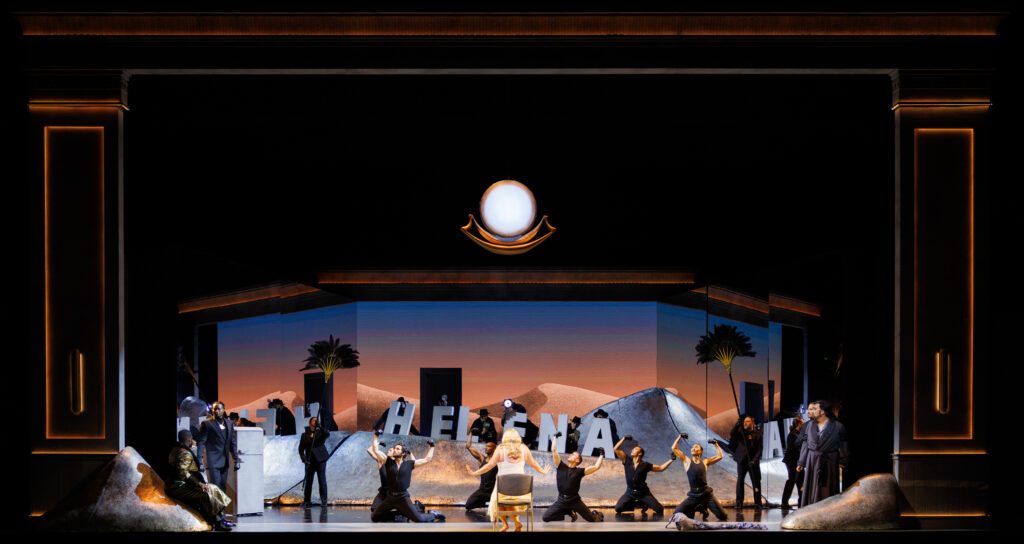
From the start, there is almost a cinematic quality to the staging, with a touch of Deco to the scenic design (by Räth and Daniel Unger), the glamorous costumes (including a pleated peignoir that makes Helen look like Cleopatra), and, in the second act, the paparazzi.
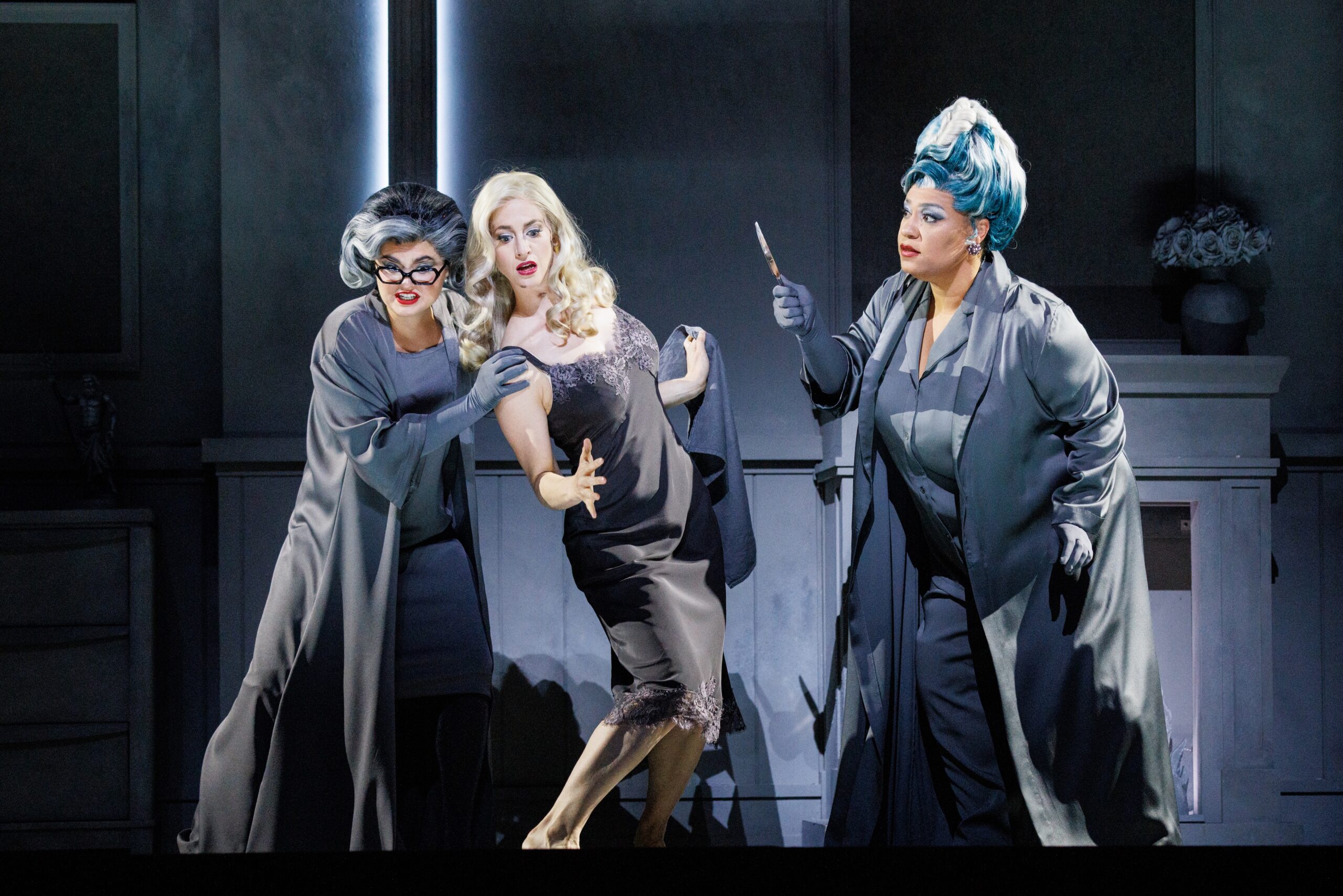
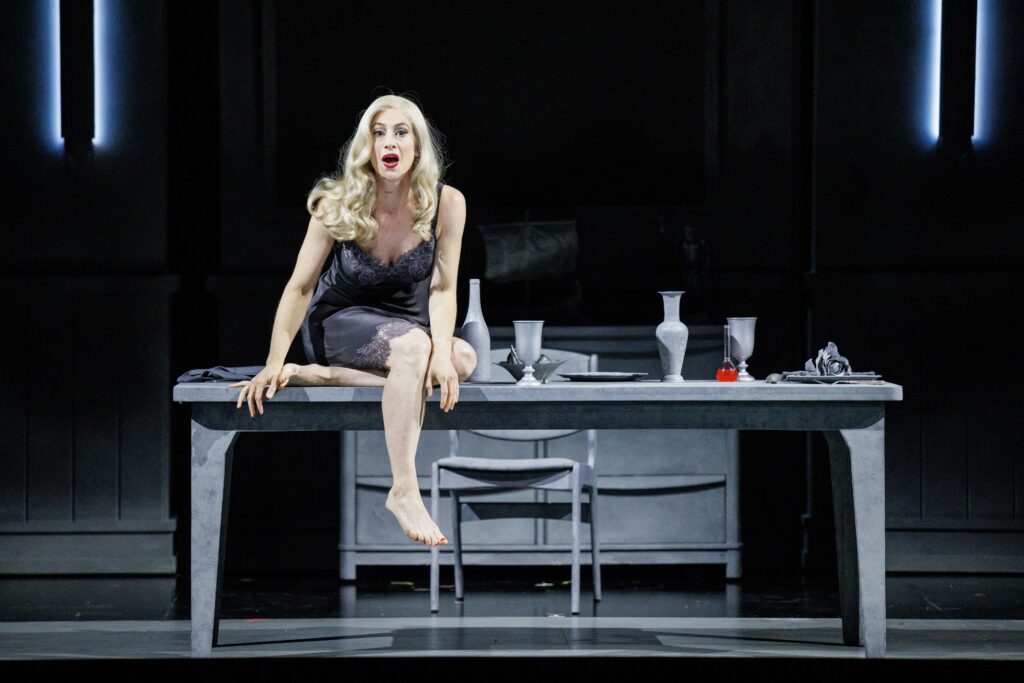
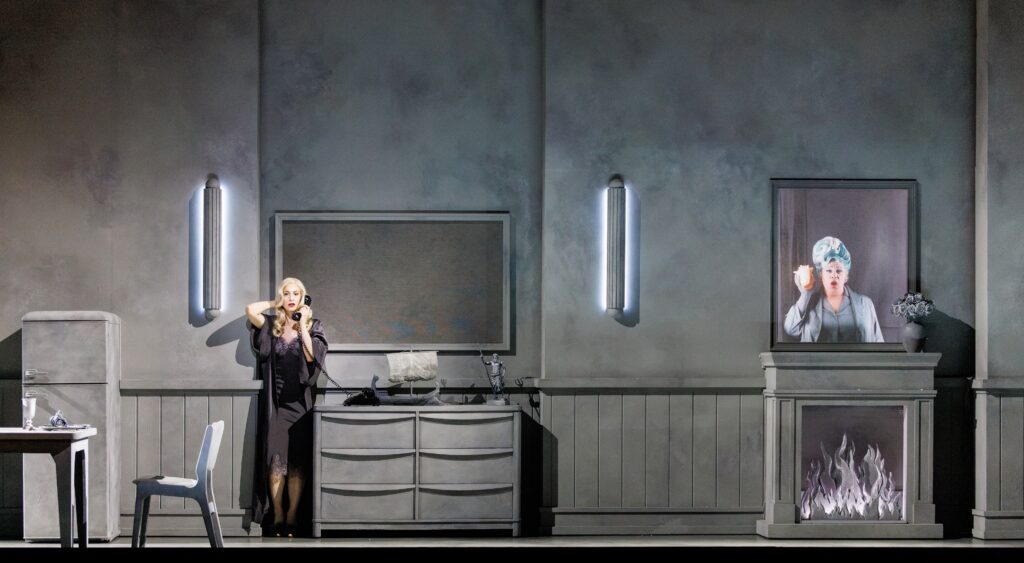
I’ve been to a number of these Bard productions over the years, and this one has one of the most promising openings. Aithra awaits Poseidon in a monochromatic room. Everything, save her Veronica Lake platinum wig – the furnishings, the walls, her slip –is gray. Projections depict crashing waves and Poseidon’s doves. When she attempts to phone, she amusingly handles a little statue of Poseidon displayed on a bureau. The Omniscient Seashell and Aithra’s “First Servant” appear as framed images courtesy of backlit scrims. So far, so good. But things get a little dicey with the entrance of the elves.
Much of the costuming (by Mattie Ullrich) is evocative and stylish. Among the leads, clearly more imagination, energy, and flair were lavished on the women than Menelaus, who makes due in a modified suit or a vest. On the other hand, the elves just look silly, their blonde wigs possibly intended as shorthand to tag them as extensions of Aithra’s multitudinous psychological self.
But really, don’t push too hard to impose rationality on the work. I’m reminded of Lord Henry’s remark in Oscar Wilde’s “The Picture of Dorian Gray,” “To define is to limit.” When he is pressed to elaborate, he adds, “Threads snap. You would lose your way in the labyrinth.” (How fortuitous, to recall this, while writing about an opera by the creators of “Ariadne auf Naxos!”) Truly, I think Hofmannstahl and Strauss really meant for this work to just wash over you and let it settle into your subconscious.
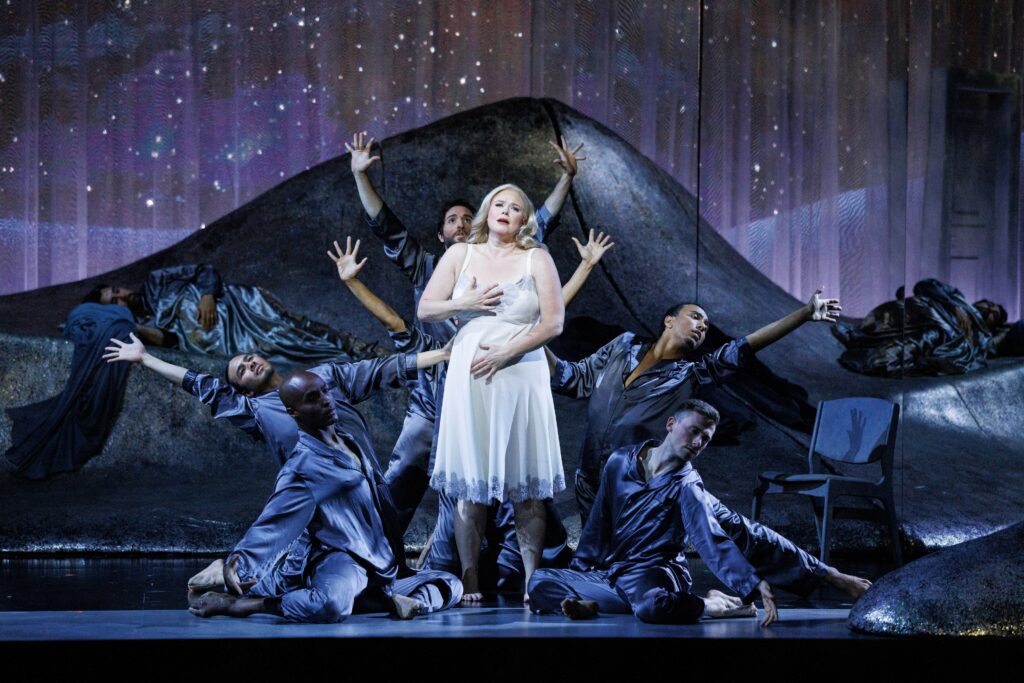
The Bard Chorus is ordinarily fantastic, always well-prepared by James Bagwell, but this time, I think they were diluted somewhat by the crazy costumes (in addition to the platinum wigs, they also had stuff over their faces) and all the business may have distracted from or muffled their vocal excellence.
The orchestra, on the other hand, had no issue with being heard, and the force of Strauss’ music did not disappoint, even if some of the incidental details were lost in the sweep of the overall performance. The scope of the composer’s orchestrations (including organ and wind machine) lends this surreal, quasi-symbolic drama an epic touch.
Of course, for an opera to be truly successful, it has to be sung well, and Bard is blessed with an assemblage of singers that do the work proud. I can’t lavish enough praise on the principals.
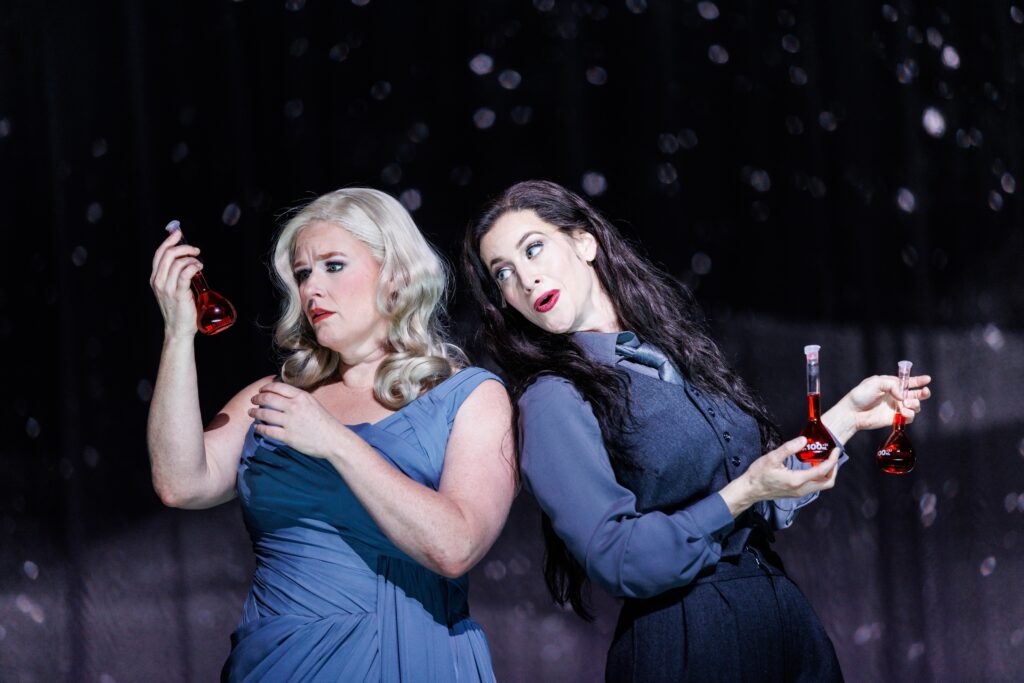
Jana McIntyre was an indefatigable goddess, singing over multiple concerts, at the Bard Music Festival devoted to “Berlioz and His World” in 2024. I’m happy to report, she’s still “fantastique” here as Aithra, her acting of a piece with her sparkling soprano. Whether in solo, duet, or trio, her mastery seemed effortless. And Strauss does love his ladies’ voices.
Hailey Clark had the weightier role of Helen, and a voice to fill the house. As the title character, she held pride of place during the curtain call, and she received the loudest applause. In terms of sheer power, she was a good match for John Matthew Myers as Menelaus. I’ve heard Myers several times in recent years, and his voice is a force. At one point, he sent a blast out into my section of the audience with such precision, it made everyone jump!
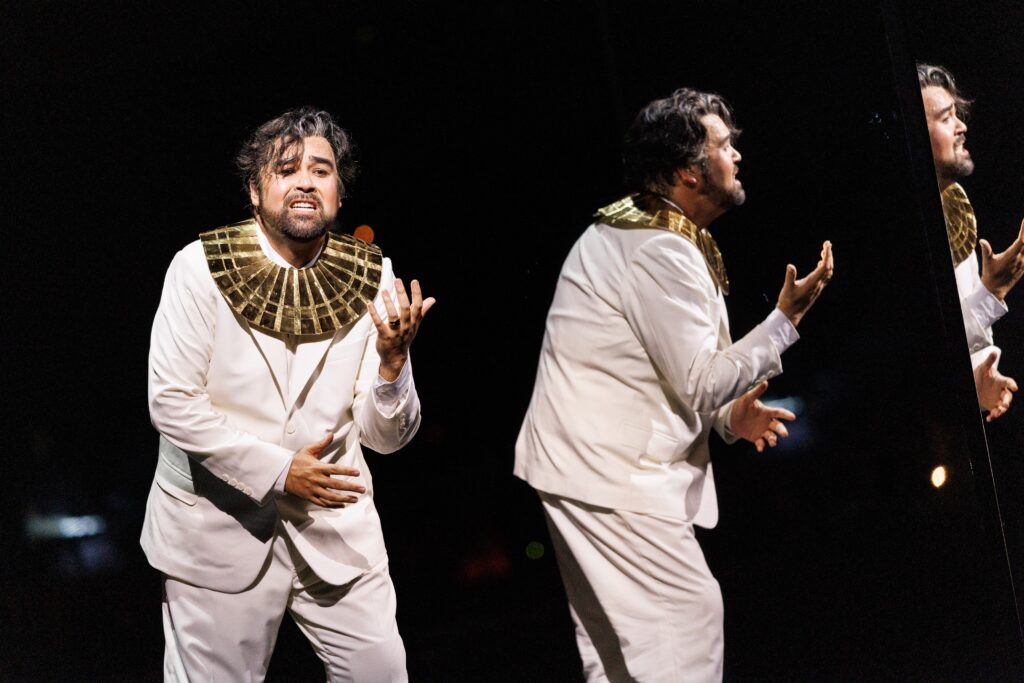
Blake Denson, the best-dressed of the men in a stately robe, was a wonderful discovery as Altair, prince of the Atlas Mountains, entrusted with protecting Helen – but of course Helen’s beauty is too great for him to behave himself. His authoritative presence and rock-solid baritone set him up as a formidable and attractive threat.
The sweet-voiced Shawn Roth, as Altair’s son, Da-Ud, brought an authenticity to the role that made you believe the character genuinely loves Helen. (Menelaus slays him in a fit of PTSD.)
Deborah Nansteel projected personality and a rich contralto as the Omniscient Seashell. I felt she was a little underrated at the curtain call. I thought surely she would at least get one unhinged “Brava!” It’s not a showy part, but she certainly deserved it.
Catherine Creed looked great in her glasses and gloves and her silver-streaked coif as the First Assistant, and she acted the part well, but her voice lacked the power to carry into the house. In a more lightly scored piece, it’s possible she would have been just fine, but this is Strauss, and you often need to swing for the bleachers in order to be heard. What she did project was confidence, and she had a pleasing if smaller voice. One shouldn’t fault a star for existing in a field of supernovas.
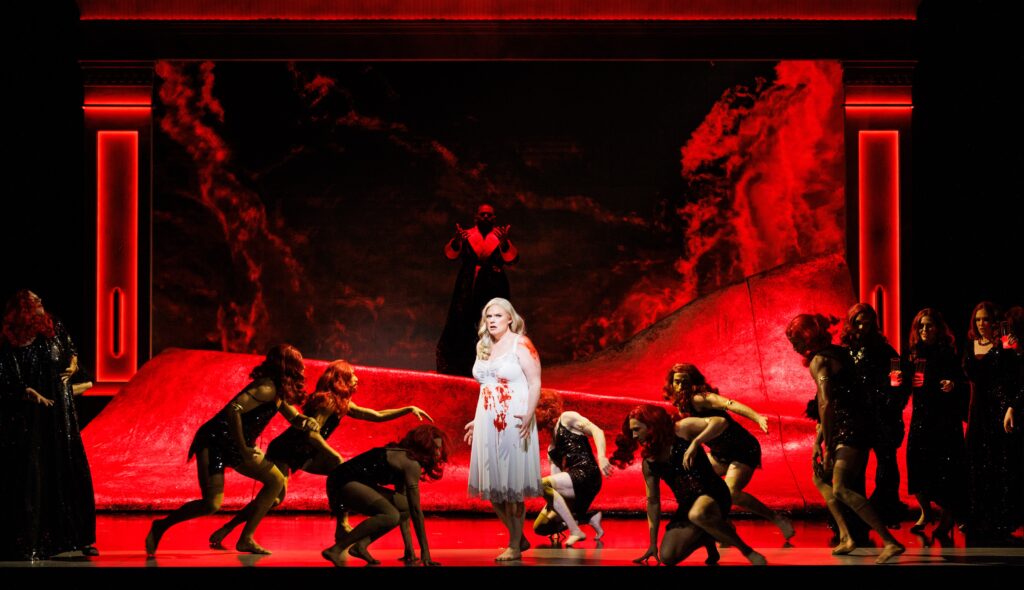
While the opera doesn’t really have a formal ballet interlude, the production features dancers throughout. (The choreography is by Catherine Galasso.) These appear variously as Trojan warriors, Altair’s guard, yet another “mirror” Helen and Menelaus, and even a headboard on a bed. In the final scene, the men are all in drag. Clearly, this was not intended as some sort of political pushback, but rather an artistic choice that reinforces the overall atmosphere of confusion and complexity in a kind of Freudian free-for-all.
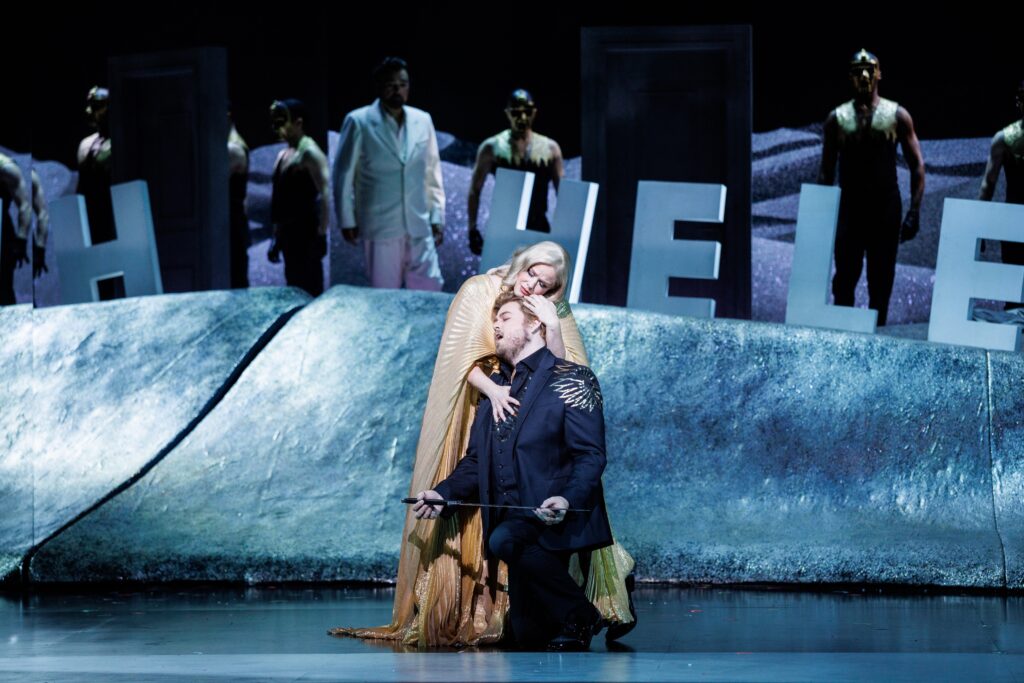
At a point, the letters of Helen’s name are carried out on stage and displayed in various configurations. By the end, we are left with only “EHE,” German for “marriage,” signifying the renewed strength of Helen and Menelaus’ union.
The American Symphony Orchestra was conducted by its longtime music director, Leon Botstein, who only just retired as president of Bard College last month after 51 years of service. Botstein has been raked over the coals recently for his reckless fundraising activities that had him going to extraordinary lengths to court Jeffrey Epstein, of all people. This began around 2012. Four years earlier, Epstein had already pleaded guilty to soliciting prostitution from a minor in Florida. At a point, Botstein stated that he would take money from Satan himself if it permitted him to do God’s work.
His transformative influence on the college over the course of his half-century tenure is undeniable. Bard would not be where it is today, if not for the extraordinary and seemingly indefatigable efforts. More broadly, he has brought a lot of good into the world, not just in terms of education and his advocacy of culture as a civilizing force, but also, not insignificantly, in his devotion to social causes. While he has bandied the idea of retirement for some time (Botstein will be 80 in December), the final decision to step down from the college’s presidency would seem to have been hastened by the Epstein revelation.
It is not my intention to minimize or dismiss the lasting pain of anyone who has ever been sexually abused when I say I am relieved that Botstein is still conducting the SummerScape opera and will continue as co-artistic director of the Bard Music Festival. It could be argued that he exercised poor judgment in the courting of Epstein – which came to wide notice with the release of the “Epstein files” – but an independent investigation cleared him of anything illegal in his conduct. Whether or not he attempted to minimize his actions once the connection was brought to light is not for me to say.
Nonetheless, a vocal contingent of student and community activists continue to push for his complete dismissal, and allegedly some on the college faculty are uncomfortable with the prospect of having to continue to work with him. But on Sunday, as at Carnegie Hall in this past spring, where I heard him conduct Berlioz’s edition of Weber’s “Der Freischütz,” the audience is still very much in his corner.
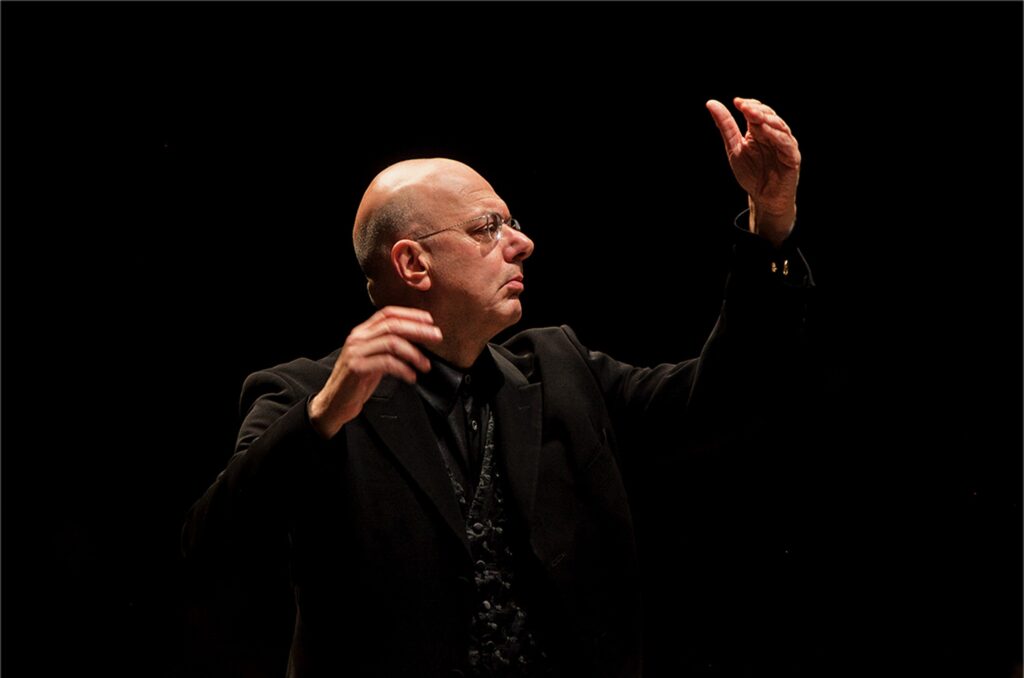
Botstein loves his Strauss, and he has broken many a lance for this hero’s life and works, both in staged productions at Bard and in concert with the American Symphony Orchestra at Carnegie Hall. I owe him a great debt of thanks for making it possible for audiences to experience this seldom-heard music, and for giving it context through his intelligent, though conversational, pre-concert talks. He has the mental acuity of a man half his age and a wonderfully wry sense of humor.
Personally, I would have a hard time continuing my faithful attendance of the Bard Festival if he is ever fully jettisoned by the college. In fact, the primary reason I will be attending this year is not for the subject (“Mozart and His World,” which hardly excites me, compared to most of the subjects of past festivals, which traditionally embrace unusual and neglected repertoire), but as a show of support for Botstein. I don’t want the college to get the wrong idea from any drop in attendance.
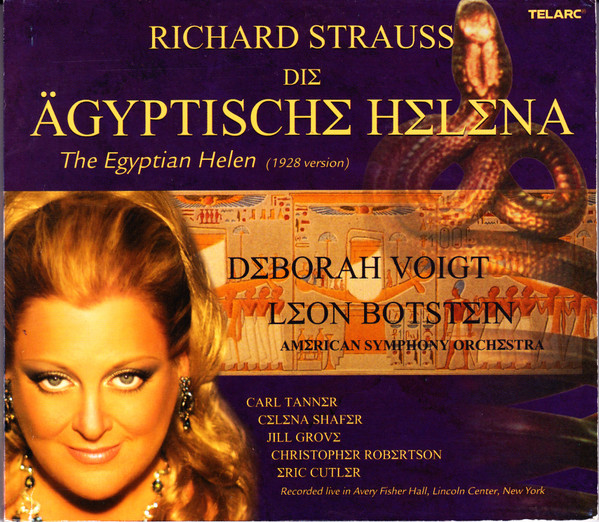
I can’t claim to be a Strauss expert, but it occurs to me I’ve now heard eight of his fifteen completed operas. There’s still a lot of beautiful music out there that hardly anyone knows. So enormous thanks to Bard SummerScape and especially Leon Botstein for reviving “The Egyptian Helen.” (Incidentally, Botstein recorded the work with Deborah Voigt for Telarc back in 2003.)
Of course, the timing of the revival couldn’t be better. Christopher Nolan’s “The Odyssey” has inspired extraordinary interest in Homer and the mythological stories surrounding the Trojan War. Why, just yesterday, I read there has been a sharp increase in people interested in learning Greek! And the connection between Nolan’s cyclops and Goya’s “Saturn Devouring His Son” is circulating on social media. Hofmannsthal found inspiration not only in Homer, but in Euripides’ drama “Helen” (which posits the whole “phantom Helen in Troy/faithful Helen in Egypt” story) and “The Histories” of Herodotus.
The opera in general and this production in particular gave me plenty to chew on for the 3-hour ride back to Princeton in Sunday traffic from the Catskills.
There will be three more performances at Bard: Wednesday (today) at 2:00 p.m., Friday at 4:00 p.m., and Sunday at 2:00 p.m. The Friday performance will also be available via simulcast.
This summer’s Bard Music Festival, “Mozart and His World,” will be held at Bard College, in Annandale-on-Hudson, NY, August 7-16.
For more information, visit the link.
https://fishercenter.bard.edu/what-we-do/summerscape/
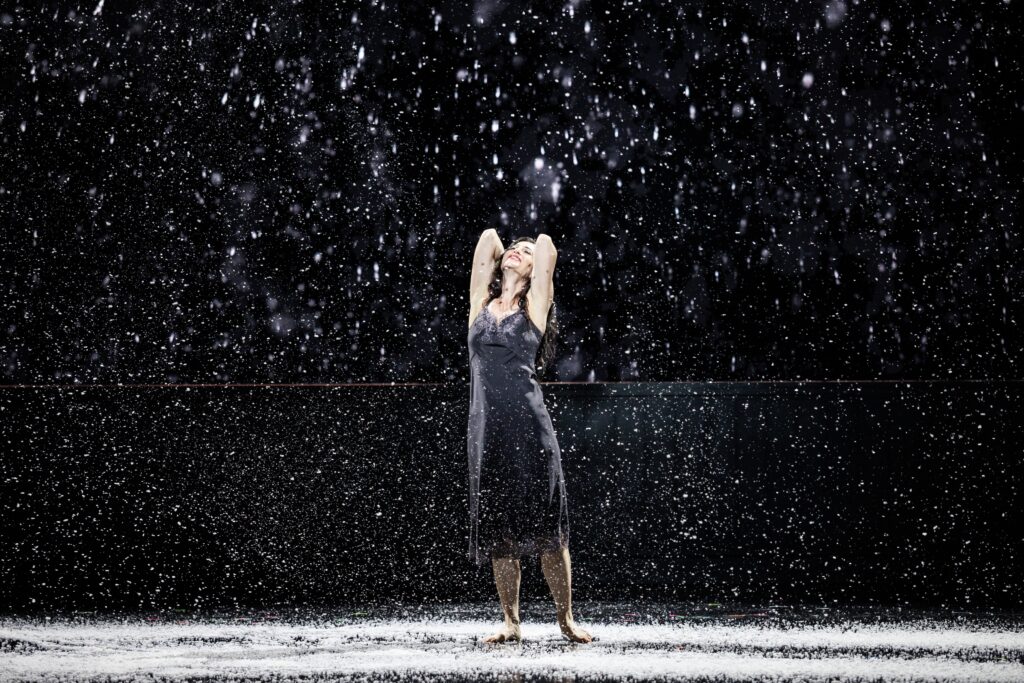
Photos of “The Egyptian Helen” by Maria Baranova