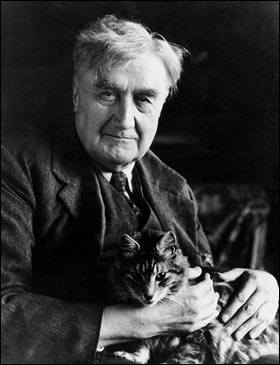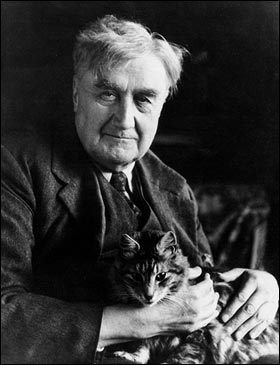
A rainy day in Princeton – perfect weather in which to celebrate Ralph Vaughan Williams. Vaughan Williams was born on this date in 1872. Don’t let that easygoing demeanor — the untrimmed eyebrows, the rumpled hat, the unkempt tie – fool you. Aside from being one of England’s greatest composers, “Uncle Ralph” possessed the drive and determination to render several other, far less glamorous services to music, each of which were of incalculable value.
First, he performed the actual legwork of roaming the English countryside and documenting the remnants of authentic folk song, the origins of which reached back deep into the nation’s past. He preserved these at a time when centuries-old traditions were in imminent peril of being swept away by encroaching modernization.
Equally, he worked with tireless enthusiasm in reviving and celebrating English church music. In selecting and arranging numbers for “The English Hymnal,” he produced one of the finest and most influential compilations of its kind. He had a passion for music of the Tudor Era. This is reflected in one of his greatest hits, the “Fantasia on a Theme by Thomas Tallis.” His Mass in G minor is a modern milestone in the revival of English polyphony. His magnum opus, which occupied him for decades, is a spiritual allegory after Bunyan, the opera “The Pilgrim’s Progress.” While not a conventionally religious man, Vaughan Williams wrote music that exudes a generosity of spirit and is often characterized by a kind of otherworldly luminosity, so that it seems at times to transcend any earthly concerns.
At the same time, he understood and confronted the horrors of the 20th century, as can be heard in the turbulent Symphony No. 4 or the desolate Symphony No. 6. Even in “A Pastoral Symphony” (the Symphony No. 3) – despite its title a reflection of the composer’s experiences as an ambulance driver during the First World War – all is not as it seems. But the cumulative effect of his music is one of hope, overriding any loss or melancholy, in pieces like the Symphony No. 5, which more than any other expresses an unshakeable faith in time of darkness.
Vaughan Williams also had faith in the value of amateur singing. In addition to his folk song settings and hymn tune arrangements, he composed innumerable Christmas carols. He loved Christmas, and he loved the communal aspect of musicmaking. To his way of thinking, music was not only for the professionals; it was a birthright. Anyone who draws breath should be entitled to partake in its joys. From 1905 to 1953, he returned every year to lead the amateur choirs of the Leith Hill Music Festival in performance of Bach’s “St. Matthew Passion.” He also wrote works, such as his “Concerto Grosso,” that include parts for amateur players, and “Household Music,” designed to be played on whatever instruments happen to be at hand.
Broadly speaking, Vaughan Williams was not enamored of German music – he was intentionally mischievous in his numerous digs against Beethoven, though clearly he recognized Beethoven’s genius – but in Bach he found a kindred spirit. It could be said that Vaughan Williams’ own greatest sin was in not being German himself, since it hindered his broader acceptance in a world that had grown accustomed to regarding Germany as center of the musical universe. Vaughan Williams did more than any other English composer to shatter that hegemony.
So his intent was not merely to promote a conservative agenda, of preserving the status quo. He was also quietly progressive. Every one of his symphonies, while hewing to tonality, is different from every other, always pressing into new territories and exploring fresh sonorities – the stark soundscapes of the “Sinfonia Antartica” (sic), the exotic percussion and sectional division of his Symphony No. 8, the strange saxophones and emotional ambiguity of his Symphony No. 9. When the Symphony No. 5 was given its premiere in 1943, Vaughan Williams was already 70 years-old. Many already began to regard each new work as valedictory. But the old man clearly had plenty of juice left. On top of everything else, he had only just begun to embrace new challenges in writing music for the movies.
As has been the fate of most composers, time and habit have worked against a broader appreciation of Vaughan Williams’ overall output, distilling his life’s work to just a few “hits.” Mostly we hear the “Tallis Fantasia,” the “Fantasia on Greensleeves,” and “The Lark Ascending.” Vaughan Williams’ music is still underrated in many circles, pigeon-holed as the modal ramblings of a cow-pat provincialist. His work on behalf of folk song has forever colored him in some people’s eyes. Certainly, his prominence in the field ensured legions of imitators, and the sins of the sons have been visited upon the father.
But Vaughan Williams was so much more than the musical soul of England, as if that were not enough. He acquired continental polish from his studies with Ravel, and he possessed a largeness of vision and character that place him on a par with any of the great composers. He was a 20th century master. That his music has traveled so poorly is everyone’s loss.
Incidental music to “The Wasps”
“Fantasia on a Theme by Thomas Tallis”
Mass in G minor
Symphony No. 4, conducted by the composer
Phantasy Quintet
Selections from the opera “The Poisoned Kiss,” virtually unknown, but full of good tunes
Adrian Boult conducts a selection from “Job: A Masque for Dancing”
Symphony No. 8, conducted by Charles Munch
Serenade to Music
My oft-posted but favorite photo of Vaughan Williams and Foxy