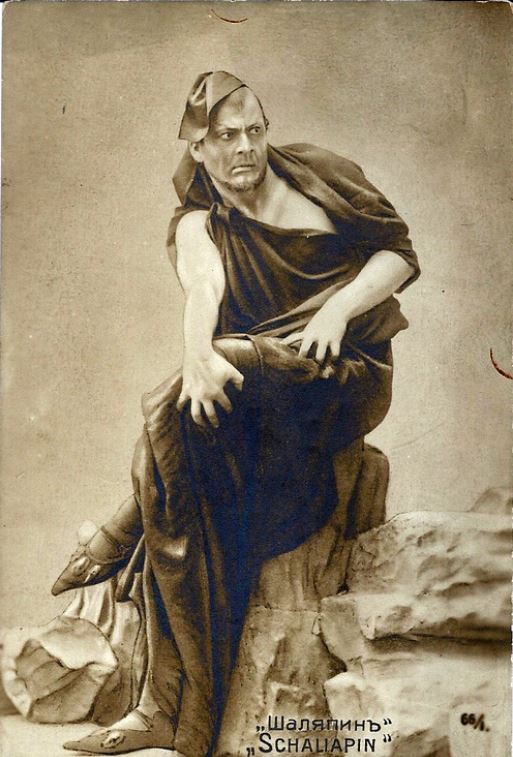
Tag: Feodor Chaliapin

  • Boito’s Devilish “Mefistofele”

    Boito’s Devilish “Mefistofele”

    Richard Strauss’ final opera, “Capriccio,” is an extended, if lighthearted debate on the relative merits of words and music. But for Arrigo Boito, the two never really came into conflict.

    As one of the great librettists, Boito provided the texts for Verdi’s late masterpieces, “Otello” and “Falstaff.” He also worked up a revision of “Simon Boccanegra” and – under the anagram Tobia Gorrio – provided the libretto for Ponchielli’s “La Gioconda.” That should be enough to guarantee his place in music history, right?

    But Boito himself was also a composer of merit, if not a prolific one. Although he destroyed his first opera, “Ero e Leandro,” and his last, “Nerone,” was left incomplete at the time of his death (to be finished by Arturo Toscanini and Vincenzo Tommasini), he totally nailed it with “Mefistofele.”

    There may be those who look down their noses at Boito’s take on Goethe’s “Faust,” yet the work stubbornly clings to the outskirts of the standard repertoire. Audiences love it. For me it is much more entertaining than anything in Verdi (I know, them’s fightin’ words), and I personally find the melodic invention much richer than that in the more popular version by master melodist Charles Gounod.

    Sure, as narrative it’s a little clunky – it’s as if Boito presents the story as a series of tableaux that are just kind of stitched together – and the most hair-raising set piece, the prologue in Heaven, comes right at the beginning. How could it not be all downhill from there? But the composer has the good sense to bring it all back at the end.

    What the opera really demands is a strong personality at its core, someone who, through his magnetic stage presence and sheer force of will, can tow the circus parade of wonders, wagon after wagon, before our astonished eyes and ears.

    Feodor Chaliapin, by all accounts, was just such a force. He gained wide notoriety in the title role, for his earthy interpretation and his insistence on playing it half-naked.

    In the recent past, Samuel Ramey owned the piece. He too preferred to show a fair amount of skin (though less than Chaliapin) – but really, couldn’t that be said for just about any of Ramey’s roles?

    Here’s the stunning – and cheeky – Robert Carson production first presented by San Francisco Opera in 1989, which I belatedly caught up with in New York, unfortunately after Ramey retired. The first 26 minutes will knock your socks off.

    Chaliapin in 1927

    https://www.youtube.com/watch?v=uVfjMHOeOVA

    Happy birthday, Arrigo Boito (1842-1918). Whether in words or in music, you gave the devil his due!


    DEVILED HAMS: Feodor Chaliapin (left) and Samuel Ramey

  • Arrigo Boito’s Mefistofele Still Thrills

    Arrigo Boito’s Mefistofele Still Thrills

    Richard Strauss’ final opera, “Capriccio,” is an extended, though lighthearted debate on the relative merits of words and music. In the case of Arrigo Boito, the two never really came into conflict.

    As one of the great librettists, Boito provided the texts for Verdi’s late masterpieces, “Otello” and “Falstaff.” He also worked up a revision of “Simon Boccanegra” and – under the anagram Tobia Gorrio – provided the libretto for Ponchielli’s “La Gioconda.”

    But Boito himself was also a composer of merit, if not a prolific one. Although he destroyed his first opera, “Ero e Leandro,” and his last, “Nerone,” was left incomplete at the time of his death (to be finished by Arturo Toscanini and Vincenzo Tommasini), he totally nailed it with “Mefistofele.”

    There may be those who look down their noses at Boito’s take on Goethe’s “Faust,” yet the work stubbornly clings to the outskirts of the standard repertoire. Audiences love it. For me it is much more entertaining than anything in Verdi (I know, them’s fightin’ words) and I personally find the melodic invention much richer than that in the more popular version by master melodist Charles Gounod.

    Sure, as narrative it’s a little clunky – it’s as if Boito presents the story as a series of tableaux that are just kind of stitched together – and the most hair-raising set piece, the prologue in Heaven, comes right at the beginning. How could it not be all downhill from there? But the composer has the good sense to bring it all back at the end.

    What the opera really demands is a strong personality at its core, someone who, through his magnetic stage presence and sheer force of will, can haul the circus train of wonders, boxcar after boxcar, before our astonished ears and eyes.

    Feodor Chaliapin, by all accounts, was just such a force. He gained wide notoriety in the title role, for his earthy interpretation and his insistence on playing it half-naked.

    In the recent past, Samuel Ramey owned the piece. He too preferred to show a fair amount of skin (though less than Chaliapin) – but really, couldn’t that be said for just about any of Ramey’s roles?

    Here are some scenes from the stunning – and fun – Robert Carsen production from San Francisco Opera in 1989. The first 26 minutes would knock your socks off. Unfortunately, the full video is not currently posted on YouTube.

    Son lo spirito che nega sempre tutto (I am the spirit that denies):

    Ecco il mondo (Behold the world):

    The finale, with Mephisto drinking Johnny Walker Red and tossing cards into a hat:

    Happy birthday, Arrigo Boito (1842-1918)!

  • Rimsky-Korsakov’s Lost Operas

    Rimsky-Korsakov’s Lost Operas

    Today is the birthday of Nikolai Rimsky-Korsakov (Julian date Mar. 6, 1844), who wrote so much enchanting music, and yet so much of it is comparatively unknown.

    In particular, his operas have failed to really secure a toehold in the West. This, despite a pre-political hot potato Valery Gergiev’s efforts to bring a taste of their opulence and pageantry to BAM, the odd touring company (the Bolshoi) bringing concert versions to Lincoln Center, or the now defunct New York City Opera putting together an English-language version of “Le coq d’or” for Beverly Sills and Norman Treigle – now almost 50 years ago!

    His works for the stage are often dismissed by Western critics, who apparently find them insubstantial, as if (non-Wagnerian) folklore is somehow less valid than an evening of Italian oom-pah-pah culminating in a jester discovering his dying daughter in a burlap sack.

    Be that as it may, I find what I’ve heard of his operas (and I’ve probably heard more than most) enthralling. He composed 16 in all, if we count the original version of “Mlada,” which he wrote in collaboration with other composers of The Mighty Handful.

    Sadly, Gergiev’s cycle of recordings for the Philips label was curtailed after only five operas, leaving one to feel one’s way through the thickets of mostly unreviewed (at least in the West) Russian recordings. The sound quality on these can be hit and miss, and the singing can be variable, but every once in a while, one hits pay dirt.

    Why is it that the most powerful recordings are from the pre-stereo era, when larger-than-life figures like Feodor Chaliapin and Mark Reizen walked the boards? If you don’t mind listening through a soup can, anything conducted by Nikolai Golovanov will knock your socks off. If ever I acquire a time-traveling DeLorean, I would make it my mission to round up some modern recording engineers and slip into the Soviet Union under Stalin’s moustache.

    Happy birthday, Rimsky. We hardly know ya.

    Chaliapin as the Viking Guest, in “Sadko”:

    Arguably topped by Reizen!

    Golovanov conducts “Christmas Eve” (complete):

    Golovanov conducts “May Night” (complete):

    Golovanov conducts “Sadko” (complete):
    https://www.youtube.com/watch?v=AMq87z_ZkPc

Tag Cloud

Aaron Copland (93) Beethoven (95) Composer (114) Film Music (127) Film Score (143) Film Scores (255) Halloween (94) John Williams (190) KWAX (229) Leonard Bernstein (102) Marlboro Music Festival (125) Movie Music (142) Mozart (87) Opera (206) Philadelphia Orchestra (89) Picture Perfect (174) Princeton Symphony Orchestra (108) Radio (88) Ross Amico (244) Roy's Tie-Dye Sci-Fi Corner (290) The Classical Network (101) The Lost Chord (268) Vaughan Williams (103) WPRB (396) WWFM (881)

DON’T MISS A BEAT

Receive a weekly digest every Sunday at noon by signing up here


RECENT POSTS