This article appeared in yesterday’s New York Times, calculated to whet the appetite for the impending Bard Music Festival, “Hector Berlioz and His World.”
It concludes with a great assessment of the composer by his contemporary, Ferdinand Hiller. I like the thought that Berlioz doesn’t belong in our solar system. It’s a very Berliozian observation.
Lest there be any doubt that Beethoven was the GOAT, check out this article in today’s Washington Post.
“The year before Beethoven died, the wife of a colleague earnestly wanted a lock of his hair, but she became the victim of a prank. Beethoven and his secretary instead sent a coarse snip of a goat’s beard…”
Makes it kind of awkward when scientists try to sequence your DNA.
Incidentally, Ferdinand Hiller, whom the article cites, was more than just a teenager who collected hair, a notable pianist and composer in his own right. I’ve posted about him once or twice myself.
Who was Ferdinand Hiller, and what does he have to do with the most famous setting of “Kol Nidre” in all of classical music?
Hiller, born to Jewish parents in 1811 (his father changed his name from Hildesheim), was a child prodigy. By 10, he was playing Mozart piano concertos in public, and by 12, he completed his first original composition. As a child, he met Felix Mendelssohn, who was two years his senior. Their friendship deepened in their teens and endured for over 20 years. Eventually, Hiller succeeded Mendelssohn as director of the Leipzig Gewandhaus Orchestra, which likely precipitated a rapid cooling between them. Within four years, Mendelssohn was dead at the age of 38.
Hiller, who nearly doubled his friend’s lifespan (he died in 1885), composed in all forms – opera, symphony, concerto, chamber and instrumental works, and choral music, including an oratorio, “The Destruction of Jerusalem.” An outstanding pianist, he became the dedicatee of Robert Schumann’s Piano Concerto. Chopin also dedicated his three Nocturnes, Op. 15, to him.
Hiller was a forceful writer on music and an influential teacher. His star pupil was Max Bruch, who was not Jewish. Bruch became acquainted with the cantorial chant “Kol Nidre” after being introduced by Hiller to the Berlin hazzan, Abraham Lichtenstein. In 1880, the same year that Bruch composed his “Scottish Fantasy” for the violinist Pablo de Sarasate, he embarked on his famous cello elegy.
“Even though I am a Protestant, as an artist I deeply felt the outstanding beauty of these melodies,” Bruch wrote in 1889. He uses the plural because the second section of the work is a treatment of a setting by Isaac Nathan of Lord Byron’s “Oh! Weep for those that wept by Babel’s stream.”
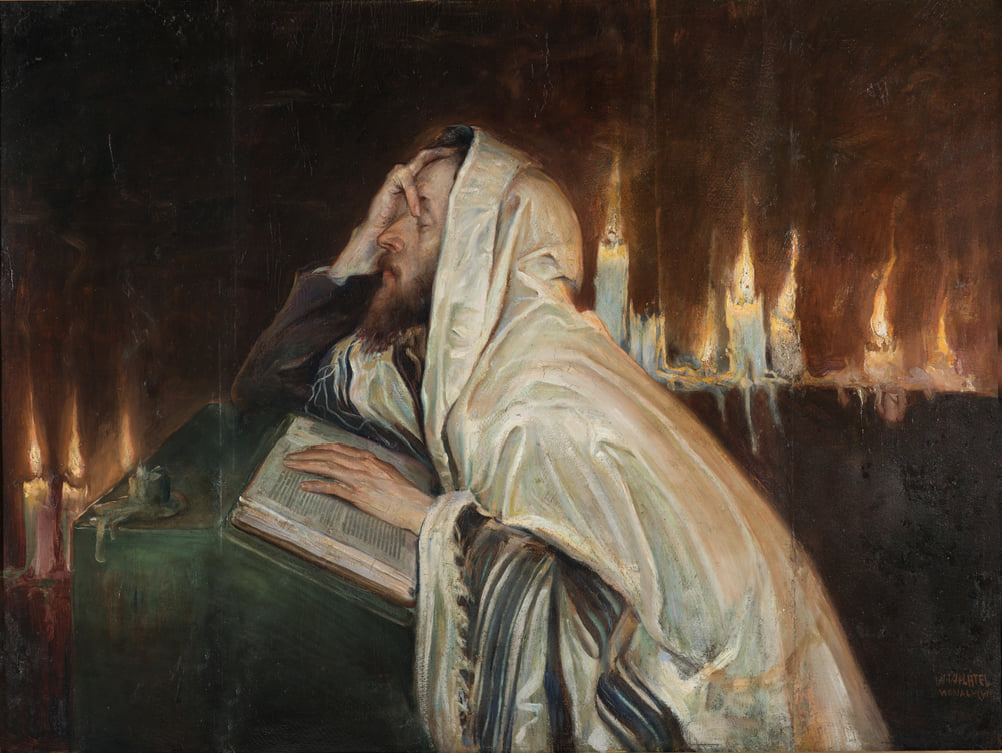
“Kol Nidre” – the traditional prayer, not the cello work – opens the evening service on Yom Kippur. The Day of Atonement, the holiest day on the Jewish calendar, begins tonight at sunset.
Bruch, “Kol Nidrei”
Nathan’s setting of Byron, which supplies the work’s B-section.
Selections from Hiller’s neglected oratorio, “The Destruction of Jerusalem”
His once popular Piano Concerto No. 2
An absorbing article on the power, influence, and universality of “Kol Nidre”
IMAGES (counterclockwise from top): “Kol Nidre” by Wilhelm Wachtel; Ferdinand Hiller; Janos Starker’s classic recording of “Kol Nidrei;” and its composer, Max Bruch
Just because someone classifies you as avant-garde doesn’t mean your music can’t be fun. Join me today as we celebrate two of music’s more engaging avant-gardists, George Crumb and Luciano Berio.
Crumb, who makes his home in Swarthmore, Pa., near Philadelphia, turns 87 today. Sure, he’s written his share of spooky music, but, like Charles Ives, personal connections and playful juxtapositions are seldom far away. For example, he’s devoted his twilight years to colorful and inventive settings of hymns and folk tunes from his formative years, growing up in West Virginia, which he’s collected into seven cycles for voice and percussion, titled “American Songbook.” These are remarkably effective and affecting works, especially when heard live in concert and the breadth and subtlety of the instrumentation can be fully appreciated.
Be that as it may, what we’ll hear this afternoon are five humoresques, titled “Mundus Canis” (“A Dog’s World”), a musical portrait gallery for guitar and percussion of the Crumbs’ family dogs. Apparently Yoda, a fluffy white mixed-breed adopted from a New York City pound, was especially disobedient.
In his best-known music, Berio had a tendency to work in collages (a term the composer disliked), but he also made groundbreaking use of electronics and extended techniques. There’s none of that in his own set of “Folk Songs,” from 1964. Written for his wife, the mezzo-soprano Cathy Berberian, the songs are mostly drawn from traditions of various countries and cultures, but some of them were actually written by Berio himself.
We’ll also raise a glass to German-Jewish composer and conductor Ferdinand Hiller, a close friend of Felix Mendelssohn. Mendelssohn and Hiller were both directors of the Leipzig Gewandhaus Orchestra. One of Hiller’s pupils was Max Bruch, who was not Jewish. It was through Hiller that Bruch was introduced to the Yom Kippur prayer “Kol Nidre,” which became the basis for one of Bruch’s most famous concert pieces. Hiller was also the dedicatee of Schumann’s Piano Concerto.
I hope you’ll join me for music of Crumb, Berio, Hiller and more, today from 4 to 7 p.m., on WWFM – The Classical Network and at wwfm.org.