It amuses me that I’m such a flighty bird, and yet I am able to hyperfocus on ridiculous projects like coming up with 45 musical clues about the American Flag!
For a while, when we were all sitting at home during COVID, I made it a point to pull together a crossword puzzle for every Sunday. I would come up with the clues during the week while doing the dishes. I just came across this one, which, conveniently, is Flag Day specific.
To fill out the puzzle, follow the link and select “solve online” at the bottom of the page. You’ll then be able to type directly into the squares. Once you feel you’ve exhausted the puzzle, you’ll find the solutions by clicking on “Answer Key PDF.”
I probably should have specified in one or two of the clues that a full name or title is required (that is to say, more than one word).
For Flag Day, two works inspired by Old Glory – one, one of the most famous pieces of American music ever, and the other, virtually forgotten:
On Christmas Day, 1896, John Philip Sousa received the bolt of inspiration that would become “The Stars and Stripes Forever.” He knocked off his quintessential march in a New York hotel room in a matter of hours. Sousa’s magnum opus was first performed in Philadelphia on May 14, 1897.
Though the piece was enthusiastically received, it wasn’t until the Spanish-American War in 1898 that sales went through the roof. This was precipitated in part by the composer having organized a spectacle involving hundreds of performers, complete with flag-bearing soldiers and a ravishing beauty decked out in red, white and blue. With a dash of canny showmanship, “The Stars and Stripes Forever” surfed a wave of wartime patriotism to world-wide and lasting renown.
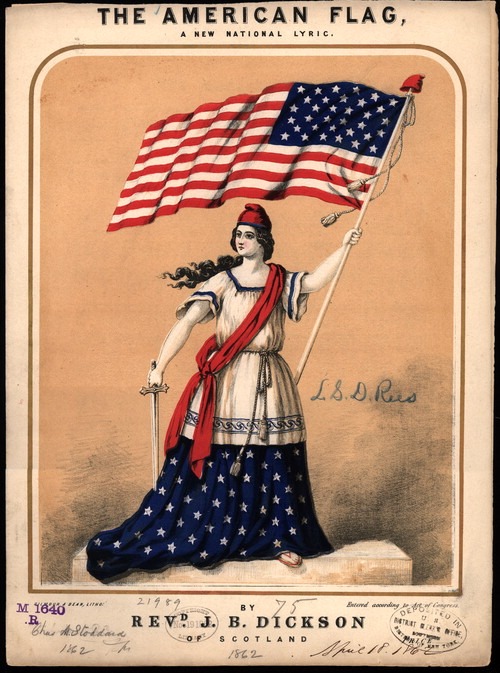
The same year, the respected Czech composer Antonin Dvořák put the finishing touches on his cantata “The American Flag.” The work had been planned to celebrate the composer’s arrival in the U.S., in 1892, to take up the directorship of the National Conservatory of Music in New York. But the text, by Joseph Rodman Drake, arrived too late, and the cantata didn’t receive its first performance until 1894. Though he submitted the vocal score for publication in 1895, Dvořák did not consider the work complete until three years later.
Scored for tenor, baritone, chorus and orchestra, the cantata falls into eight sections:
I. The Colors of the Flag
II. First Hymn to the Eagle
III. Second Hymn to the Eagle
IV. Orchestral Interlude: March
V. First Address to the Flag (The Foot-Soldier)
VI. Second Address to the Flag (The Cavalryman)
VII. Third Address to the Flag (The Sailor)
VIII. Apotheosis (Prophetic)
Part of the reason the work remains such an obscurity is likely the fact that it doesn’t sound particularly American. This is not the Dvořák of the “New World Symphony” or the “American” String Quartet.
It was Henry T. “Harry” Burleigh, the composer’s African-American assistant at the conservatory, who introduced Dvořák to the Negro spiritual. Travels to the Midwest would get him thinking about Native American folk music. Dvořák was thrilled to learn of these untapped musical resources. He set about exhorting his American colleagues, who had been churning out largely forgettable scores on European models, to embrace these overlooked treasures and, in doing so, forge a distinctive national sound.
Mindful of their invaluable contributions, Dvořák lobbied to waive tuition to the conservatory for talented African American and Indigenous composers who could not afford the fee. His perceptivity, his enthusiastic support for, and his elevation of sounds that really were in the American ear all along earn Dvořák his place as the honorary Grandfather of American Art Music.
Here is his neglected cantata, “The American Flag”:
Test your musical knowledge of Flag Day favorites with this week’s Classic Ross Amico crossword.
To fill out the puzzle, follow the link and select “solve online” at the bottom of the page. You’ll then be able to type directly into the squares. Once you feel you’ve exhausted the puzzle, you’ll find the solutions by clicking on “Answer Key PDF.”