My recent posts about Jill Pasternak have prompted me to go back and search out a few air checks of WFLN that I’d been able to find online. WFLN served as Philadelphia’s only full-time classical music radio station since 1949. Pasternak, who was hired in 1986, was the one tasked with bidding farewell, before the frequency’s changeover to a contemporary pop format, on September 5, 1997.
At the link below, you’ll find her in happier times, sitting in for Bill Shedden and hosting “Evening Concert” on August 20, 1989. Jill introduces music by Balakirev, Tchaikovsky, and Rachmaninoff. (The audio cuts off shortly after she announces Rimsky-Korsakov’s “Scheherazade.”)
On the same page, there’s a sound file of Frank Kastner hosting on October 22, 1989. Kaster was the announcer who signed on the station on March 14, 1949 (his 25th birthday), playing Brahms’ “Academic Festival Overture,” Rachmaninoff’s Piano Concerto No. 2, and Sibelius’ Symphony No. 2 from 78 rpm records. The playlist here consists of Léo Delibes’ “Coppélia” (in progress) and Ralph Vaughan Williams’ Partita for String Orchestra (sadly, cutting off before the end).
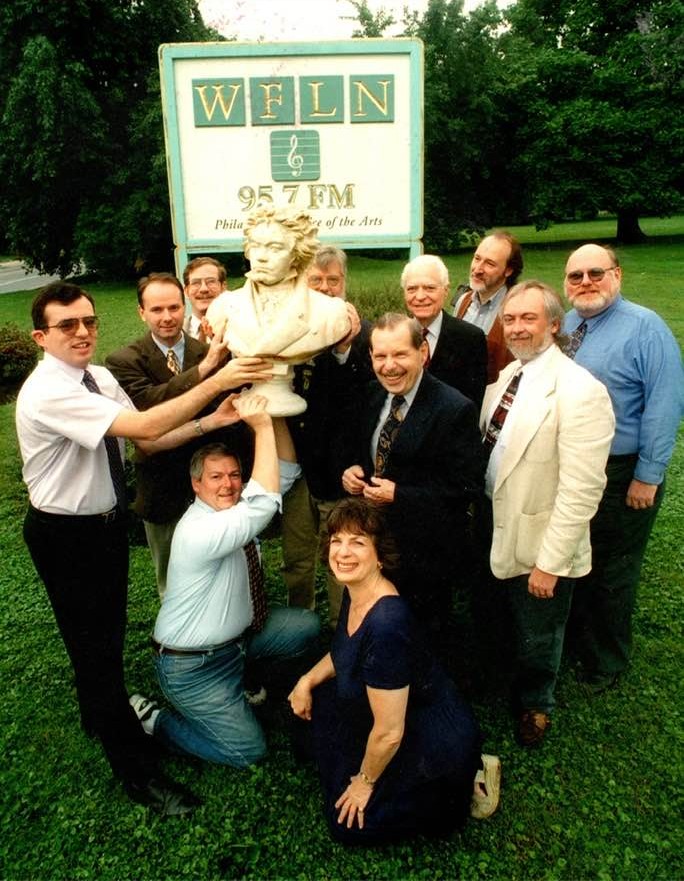
PHOTO: Representatives of the WFLN crew in 1997, Jill Pasternak kneeling in front. I also recognize Mark Pinto (left), Dave Conant (obscured), Frank Kastner (with mustache), Charles Lee (white hair), Jack Moore (white jacket), Bill Shedden (blue shirt). Anyone know the others?
I found it yesterday in a secondhand shop, and I had to pick up, because of my fond memories of WFLN, Philadelphia’s classical music station for 48 years.
So much did I love that station that I still remember useless bits of trivia about it, such as the fact that it was Frank Kastner who signed on for the first time in 1949 and hosted the first two hours, which included recordings (on 78 rpm) of Brahms’ “Academic Festival Overture,” Rachmaninoff’s Piano Concerto No. 2, and Sibelius’ Symphony No. 2.
Frank was a piece of living history. He returned to WFLN years later, and I had the opportunity to meet and converse with him several times. I remember discussing neglected music with him, and our talking about Giuseppe Martucci. I also remember once Frank hilariously playing Peter Maxwell Davies “Eight Songs for a Mad King” at around 9:00 on a weekend morning. Definitely NOT music authorized by the program director!
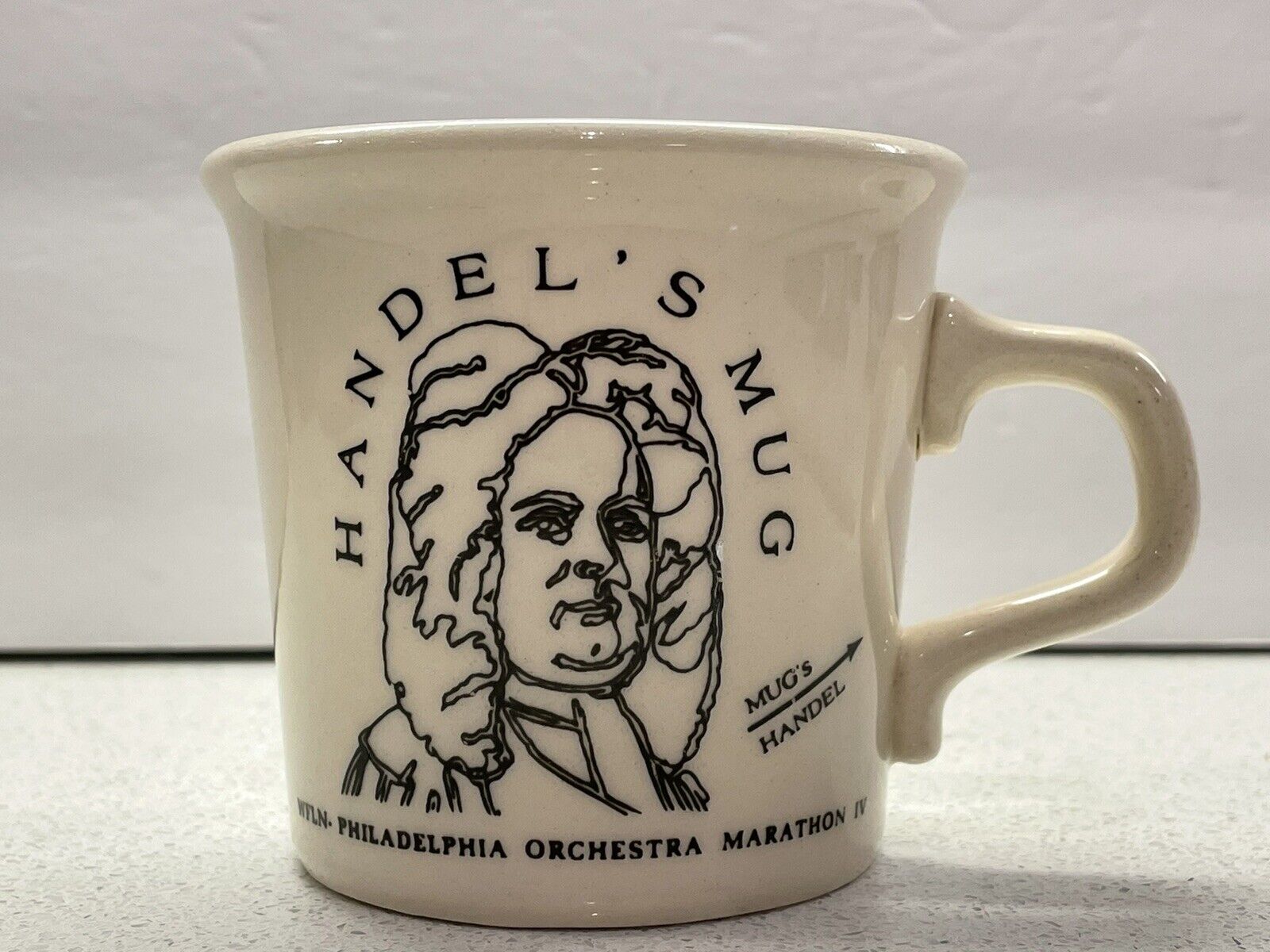
For a number of years, the station would host a joint fundraiser with the Philadelphia Orchestra. These were frequently broadcast with WFLN announcers and celebrity guests (such as Celeste Holm) appearing in a public location, so that you could drop by and pick up your “thank you” premium. These were often in the form of a mug or an autographed CD.
Apparently, there was a Bach’s Mug, a Mozart’s Mug, a Beethoven’s Mug, a Brahms’s Mug, and a Tutti Per Muti Mug (a reference to then-Philadelphia Orchestra music director Riccardo Muti). These all came up in the course of my Google searches this morning.
The one pictured, of course, is Handel’s Mug. 3-1/2 inches tall. 3-1/2 inches wide. I’ll add it to my collection of broadcast trophies and memorabilia, including a Metropolitan Opera mug, once owned by WCLV’s Robert Conrad, and Ralph Collier’s briefcase, debossed with his birth initials. (He was born Ralph Kisch.) I also own a number of Collier’s neckties, including his Abraham Lincoln tie from the Union League of Philadelphia.
Needless to say, I hung on to a selection of the old WFLN program guides. I’ve got one from October 1982 on my bedside table right now. I especially treasure those from around the holidays. That’s back when classical music Christmas was really classical music Christmas, hardcore! And I’ve got a few of the station’s annual limited-edition posters.
In my memory, the programming was not the most adventurous, but it was cozy. I’m always saying I learned the entire standard repertoire from listening to WFLN. However, revisiting the October 1982 program guide reveals plenty of surprises, with, for instance, Witold Lutoslawski’s Cello Concerto scheduled for around 3:00 on a weekday afternoon. I also remember hanging around one day waiting to start a cassette tape because I saw they would be playing Roy Harris’ “Folk Song Symphony.” I heard Olivier Messiaen’s “Turangalîla Symphony” for the first time on a New York Philharmonic broadcast, with Leonard Bernstein conducting. So clearly, this was an invaluable resource that presented more than just the three B’s.
The announcers were familiar without ever coming across as fake, and nobody blathered on about inanities – except in the mornings, when Dave Conant would needle Dick James from Schuylkill Valley Nature Center about the weather.
Each day part was capped by a signature tune, drawn from Haydn (the last movement of the Symphony No. 6 “Le matin”), Fauré (“Masques et bergamasques” and “Pavane”), Sibelius (the “Entr’acte” from “Pelleas and Melisande”), and Johann Ernst Altenburg (the Concerto for 7 Trumpets). I have so many happy memories associated with that music. Truly, this station was like home. So much of it was entwined with my youth.
Here’s a biography of Frank Kastner in his own words:
And a preserved aircheck from 1990, opening with Ralph Collier doing an ad for Jack Kellmer Jewelers; then Dave Conant, host of the drivetime show “Morning Potpourri” (also the station’s GM); with Dick James banter starting around 39 minutes in:
Wish I could find more like this, especially from the early ‘80s.
Almost too painful to listen to: the format change in 1997. Philadelphia has not had a full-time classical music station since.
Some of the WFLN staff was picked up by WRTI at Temple University. The rest drifted away to other stations around the country or changed careers.
I actually interviewed with Conant a few times at WFLN, back in the 1980s, while I was still in college. He was very nice man, very patient. He put me in a booth, and recorded me onto reel-to-reel tape, and then he’d critique it and tell me I could come back. I did, three times – it was an hour bus ride from center city to the studios in Roxborough – but eventually I gave up.
I found my own way into radio, as a community broadcaster for nine years, before getting hired at WWFM in 1995.
Interestingly, Conant and I finally did work together, during his twilight years as general manager and early morning host at WRTI. I was hired at WRTI in 2014 as an on-call classical announcer. I wound up doing regular jazz overnights on the weekends, but when I was called in on a weekday, either to do 12-6 a.m. jazz or the 10 a.m. classical shift, Conant and I would switch chairs.
Even having done radio for nearly 40 years, I will never be as good as he was. I’ll never have the pipes, for one thing. I’m stuck with a frustratingly high voice, so that listeners are often surprised to find that I stand well over six feet. But Conant just exuded radio. He had that resonant voice, and he’s just one of those people who is one with the mic.
I probably should have added more cigarettes and bourbon to my regimen. Those WFLN announcers were old-school.
A brief history of WFLN (since I know this has already been a lot to Handel):