Happy birthday, George Gershwin! Here, from 1932, Gershwin plays “Fascinating Rhythm,” “Liza,” the Prelude No. 2, and “I Got Rhythm,” and participates in a quick, evidently-scripted Q&A with host Rudy Vallée on his radio show, “The Fleischmann Hour” (sponsored by Fleischmann’s Yeast).
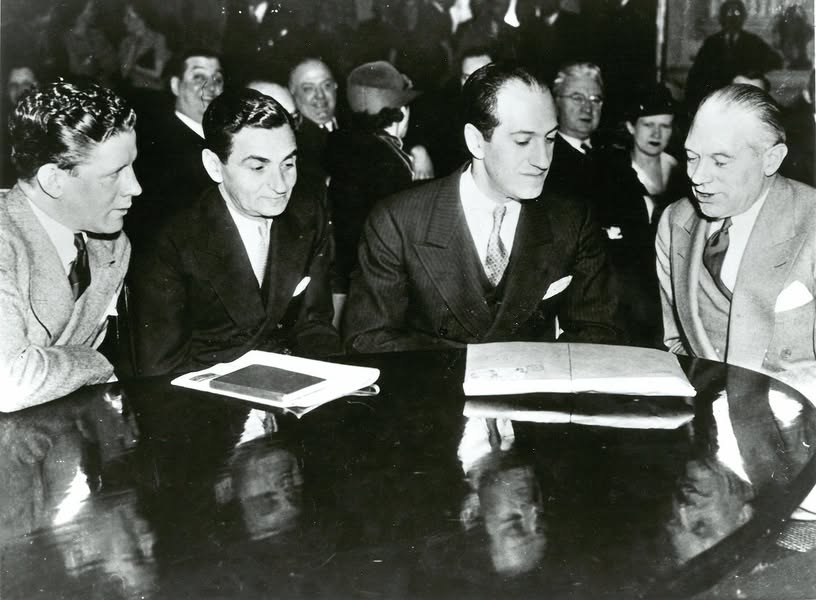
PHOTO: Rudy Vallée, Irving Berlin, and Gershwin with ASCAP president Gene Buck
One more post to mop up a few things I’d been meaning to address about the Bard Music Festival, and then I promise to try to find other things to talk about until next year’s schedule is announced in February.
One of the great challenges at Bard, when the only time one really seems to have to sit and focus is while actually attending concerts, is that there is very little opportunity to write while the festival itself is actually in progress. The rest of the time is taken up by travel and eating and sleeping and socializing. I lament all the observations and clever turns of phrases and natural flow between ideas that have been lost for the simple matter of not being able to drive and type at the same time. And no, despite any evidence to the contrary, I am not a great dictator. By that I mean, I am not the greatest extemporizer. For me, writing is more like sculpting. I am forever building up and chiseling away at the raw material. To converse with the actual Classic Ross Amico is a very different experience from reading him. You might say I am a life student of the Jimmy Stewart School of Articulation.
Then, of course, I also have other things I have to write about. I like to promote my radio shows, for instance, so that knocks out a couple of days a week. Occasionally I’ll even have an article due. I don’t know how I did it, back in the days when I had a weekly column, on top of sometimes multiple radio jobs.
At any rate – and thanks for hanging in there, as I am finally about to get around to the meat of the matter – there are just a few more details about my experiences at this year’s festival, “Martinů and His World,” I would like to share. These include a few photos of festival merch, which as I commented elsewhere, for whatever reason, was much diminished from previous years, when Rhinebeck’s Oblong Books offered tables of recordings for attendees to peruse and purchase. And despite the proliferation of streaming options, yes, people did buy. Classical music people are a breed apart; many of us still love physical media. By the end of the second weekend, the tables were always fairly well picked over.
This year, no Oblong, but there was still the tie-in volume of essays, “Martinů and His World,” edited by festival scholars-in-residence Michael Beckerman and Aleš Březina. Some of the unusual attractions include a section devoted Martinů’s operas, a recently discovered Martinů diary, and recollections from some who knew the composer during his years in the United States. The book is still available for order from University of Chicago Press and other fine booksellers (likely online).
Of course, there was also the festival t-shirt, which I’ve already mentioned, this year sporting one of the composer’s amusing self-caricatures, with his hedgehog-headed alter ego seated at the piano. A lavishly-illustrated 70-page festival program (free with ticket) is chock full of information and always a valued keepsake.
Attempting to fill the vacuum left by Oblong, in its more modest way, was the Bohuslav Martinů Foundation and Institute. There was a table of paraphernalia laid out to entice one to join the Martinů Society, along with some attractive books and, all too briefly, some of their in-house-produced CDs. I purchased one that includes “The Epic of Gilgamesh,” dating from 1959, the year of the work’s first performance. The recording features Marilyn Horne and Walter Berry (in great voice) and is conducted by Martinů champion Paul Sacher. Later, I googled this to learn that it is not available anywhere else. Nor were many of the other recordings, so now I regret not buying more. I would have loved to have heard some of the other historic material, a lot of which hasn’t even been uploaded to YouTube, and some of which is now, sadly, sold out even on the Martinu Foundation website.
I am saving the best for last, as I often meet interesting people at the festival, but none more compatible than Mather Pfeiffenberger, next to whom fate seated me while I was shoveling down a wan Bard wrap outside one of the venues in my desperation for some sustenance between events. Mather is extraordinarily knowledgeable. It’s rare that I meet anyone with whom I can communicate so freely, on every level, about music. We share a language of refined geekdom that, in my experience, is quite beyond the capacity of your average classical music weirdo.
In two years, Bard will be tackling “Gershwin and His World,” so somehow he and I got to talking about American music. It turns out that Mather has done quite a bit of radio work himself, at WHRB, Harvard. I’ve looked at some of his playlists, and I assure you he is first-rate. In fact, there was plenty of stuff I wasn’t familiar with, especially some of the historic recordings I didn’t even know existed, that I wouldn’t mind checking out myself. Furthermore, the guy’s interviewed Aaron Copland and harassed Walter Piston for autographs (twice).
In the words of Rick Blaine, this looks like the beginning of a beautiful friendship. A lively correspondence began almost immediately and has been full of enlightening information and links to, again, audio files I didn’t even know existed. I don’t think I flatter myself in saying I have held my own in reciprocation. I’ve been very busy in the week since my return from Bard – in fact the reason I wasn’t able to finish writing this and get it posted this morning was because I had to be on the road yet again – but I look forward to learning and listening to more.
Next year at Bard: “Mozart and His World” – and as I say, in 2027, Gershwin!
BONUS: I’d been sitting on this video for many months, hoping to share, but then forgot all about it. It’s a performance of Martinů’s vigorous and optimistic “Bergerettes,” presented, incongruously, film noir style. Enjoy!
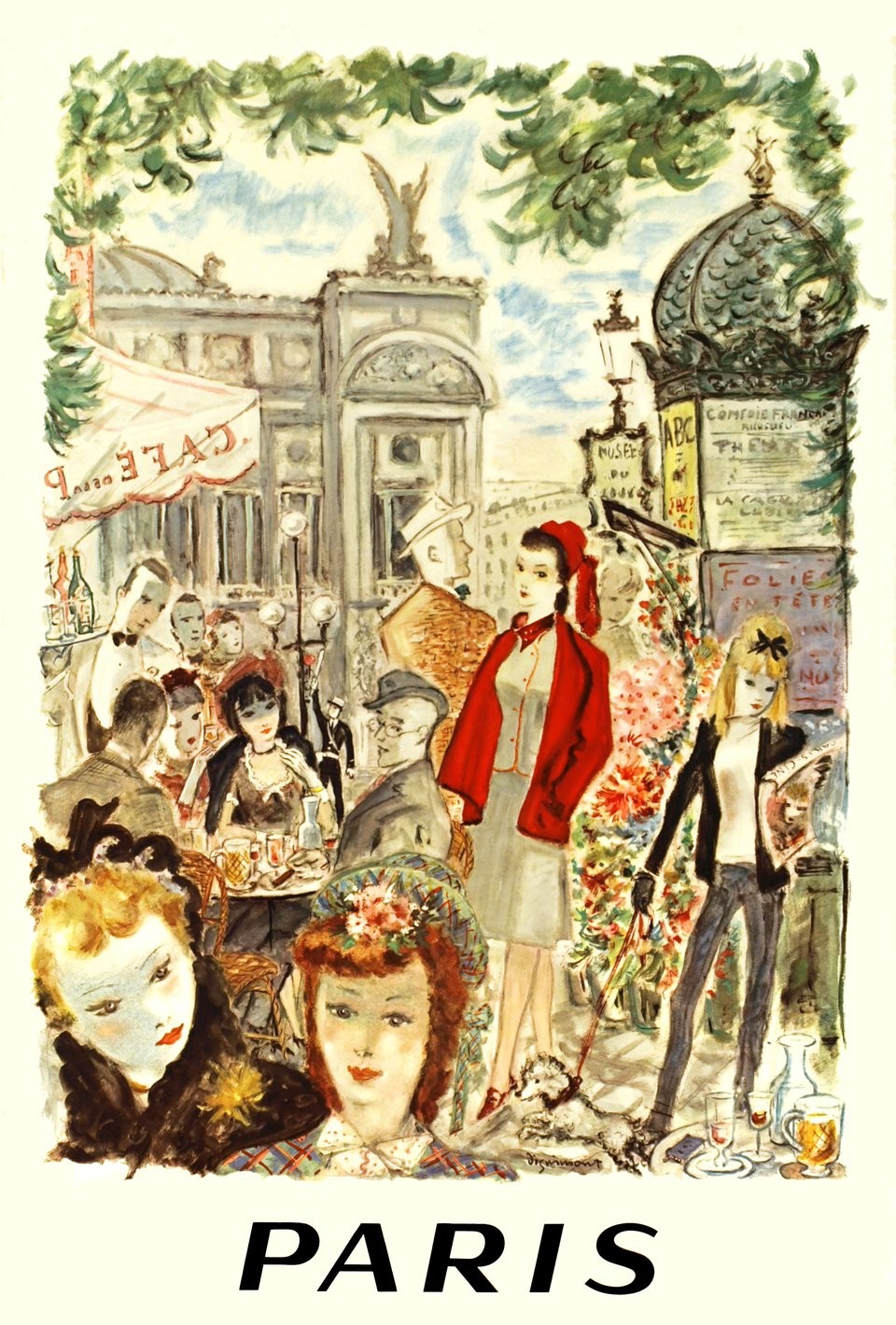
This morning on “Sweetness and Light,” join me for an hour of cherry blossoms and sunshine, birdsong, and café au lait. It’s our annual celebration of spring in the City of Light!
We’ll hear April-and-Paris themed songs by Charles Trenet and Vernon Duke, a suite for four pianos by Darius Milhaud, a jaunty work for trumpet and winds by Jean Françaix (who sounded the “x” when pronouncing his name), a couple of pieces of British Light Music on Parisian themes, and the world premiere recording of George Gershwin’s “An American in Paris,” performed by musicians of the Philadelphia Orchestra (masquerading as the Victor Symphony), with the composer himself on the celesta. It’s music as good as spring itself!
I hope you’ll join me for an hour of cafés and croissants, boulevards, blossoms, and bisous, on “Sweetness and Light,” this Saturday morning at 11:00 EDT/8:00 PST, exclusively on KWAX, the radio station of the University of Oregon!
On days when I’ve got a lot of work to do, I’ll often post something short or simply cut and paste, with a few tweaks, from the Classic Ross Amico archive. If it happens to be the birthday of a major composer – in this case, Maurice Ravel, born on this date in 1875 – I try to take a fresh perspective, if I can, since I tend to write about the subject every year. I thought this year, I might write about Ravel’s experiences in the United States with George Gershwin and, by extension, jazz. But of course the subject is an involved one. And really, I don’t know how I could handle it any better than it has been by the writer at the link. Enjoy the musical examples below, and happy birthday, Maurice Ravel!
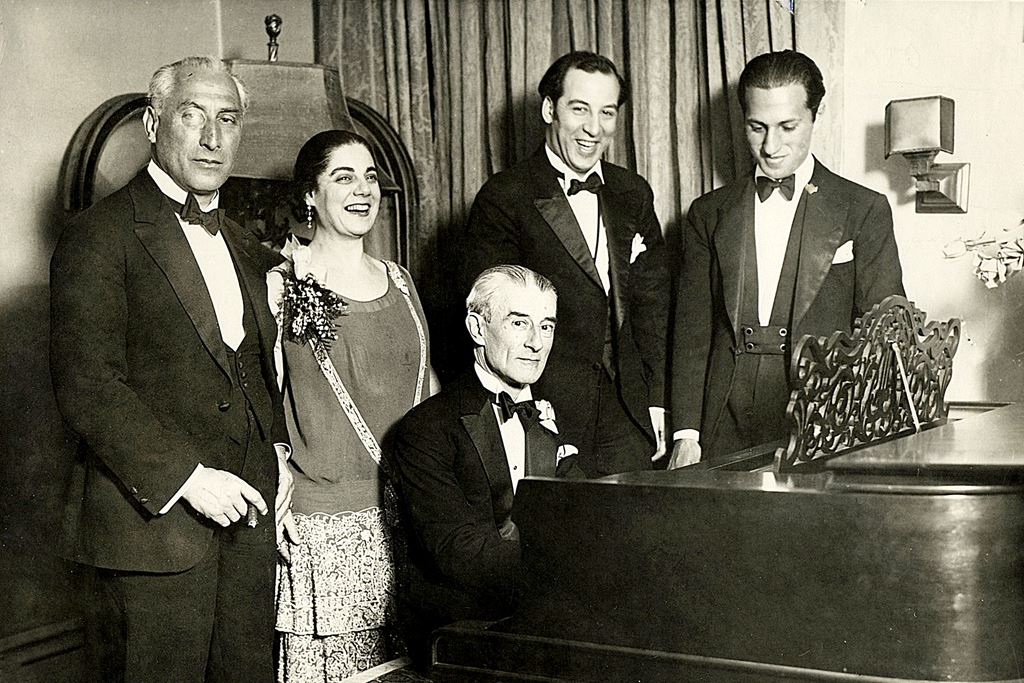
PHOTO: Ravel (seated), in New York the day after his 53rd birthday, in 1928, with (left to right) conductor Oskar Fried, mezzo-soprano Éva Gauthier, composer-conductor Manoah Leide-Tedesco, and George Gershwin
Gershwin and Berlioz are “in” this weekend at the Princeton Symphony Orchestra. The orchestra will present “An American IN Paris” and “Harold IN Italy,” IN Richardson Auditorium IN Alexander Hall, this Saturday evening at 8:00 and Sunday afternoon at 4:00.
By merest coincidence, “Harold in Italy” received its first U.S. performance on this date, 160 years ago. In 1863, it was presented in New York by the Theodore Thomas Orchestra, sharing a program with Mozart’s overture to “The Magic Flute” and Beethoven’s Symphony No. 5, interspersed with some shorter musical interludes.
Berlioz’s symphony is unusual for, among other things, its prominent role for an instrumental soloist – a flourish usually reserved for the concerto. The work was written for Niccolò Paganini, the legendary violinist who was hoping for a showcase for his new Stradivarius viola.
Unfortunately, when Paganini received the score, his face dropped, as the composer was evidently more interested in Harold’s meditations – admittedly punched up by some colorful musical evocations, of a religious pilgrimage, a mountaineer’s serenade, and a brigands’ orgy – than in the virtuosic flights Paganini had envisioned. In the event, the world premiere took place in Paris in 1834, with Chrétien Urhan as the soloist.
Though Paganini never played the piece, he did come to appreciate its genius. When he finally heard the work performed in 1838, he ascended the stage, dropped to his knees, and before a cheering crowd, kissed Berlioz’s hand. Perhaps even more gratifying for the composer, Paganini later sent him a bank draft for 20,000 francs.
As Berlioz stated in his “Memoirs,” “My intention was to write a series of orchestral scenes, in which the solo viola would be involved as a more or less active participant while retaining its own character. By placing it among the poetic memories formed from my wanderings in the Abruzzi, I wanted to make the viola a kind of melancholy dreamer in the manner of Byron’s Childe-Harold.”
Although “Harold” is probably the composer’s second most-popular symphony, after the weird and wonderful “Symphonie fantastique,” concert performances are comparatively rare, due to a scarcity of star violists – that is to say, violists who are able to sustain a career as soloists. If the work is done, it’s generally with an orchestra principal in the spotlight. In fact, I believe the last time I heard the piece in person was over 30 years ago, with Joseph de Pasquale and the Philadelphia Orchestra. That’s not to say it hasn’t been played, but rather in my decades of concertgoing, it’s the last time I personally encountered it. Indeed, De Pasquale was the orchestra’s principal violist, but he had quite an association with the piece, having performed it in Boston, where he had also been principal, with Charles Munch, and recorded it in Philadelphia with Eugene Ormandy.
Princeton’s soloist will be De Pasquale’s successor, Roberto Diaz, who was Philadelphia’s principal violist for ten years. In 2006, he left to become director of the Curtis Institute of Music.
The weekend’s concerts will also include Julia Perry’s “Study for Orchestra.” Perry, a graduate of Princeton’s Westminster Choir College in 1948, continued her studies with Luigi Dallapiccola at the Berkshire Music Center at Tanglewood, at the Juilliard School in New York, and with Nadia Boulanger in Paris. With the recent push to reevaluate neglected music by minority composers, Perry’s “Study” has become a focus of renewed interest, with a number of performances popping up on orchestra schedules this season and next.
The other American on the program requires little introduction. “An American in Paris” even became the subject of an Academy Award winning movie, starring Gene Kelly, with the show-stopping climax a 17-minute ballet inspired by Gershwin’s by turns eager, melancholy, and exuberant score.
It’s an American IN Paris and Harold IN Italy IN Princeton, with one of Westm-IN-ster’s own, IN concert this Saturday and Sunday with the Princeton Symphony Orchestra. Rossen Milanov will conduct. For tickets and information, visit princetonsymphony.org.
Berlioz, stylin’, in 1832 (portrait attributed to Emile Signol)