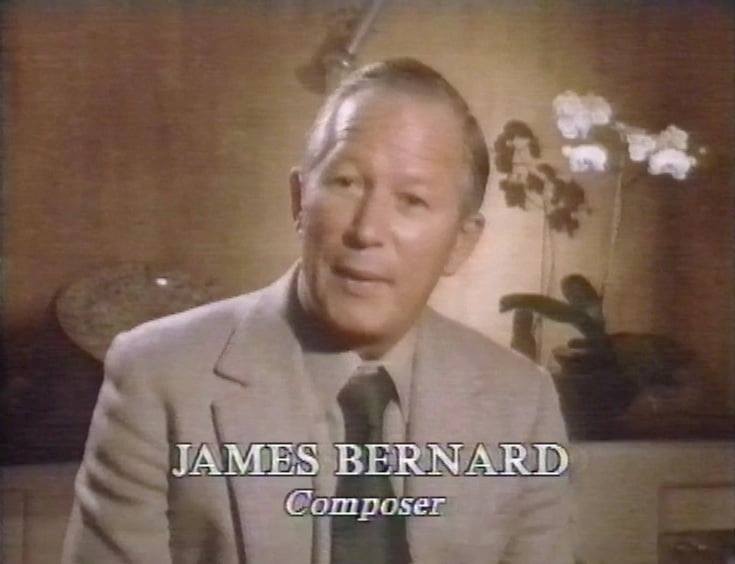
Hammer house composer James Bernard (“The Curse of Frankenstein,” “The Horror of Dracula”) makes today’s “Composers Datebook.” To listen to the audio, follow the link and click the green button. As far as I’m concerned, it can’t be Halloween soon enough!
One of the things I love about foreign countries is that, historically, their composers haven’t been blackballed for writing film music. In fact, some of the most esteemed have made significant contributions to the form: Prokofiev, Shostakovich, Honegger, Milhaud, Vaughan Williams, and Walton, to name a few. In America, Aaron Copland or John Corigliano aside, there has been a sharp, critical divide between “serious” composer and “film composer,” as if the latter somehow automatically implies hack work. And depending on a musician’s ability and artistic freedom, I suppose it all-too-frequently does.
I’m sure there are plenty of foreigners that only wish they could make the kind of money writing film music they could here in the U.S. It’s easy to romanticize when you’re not the one breaking your back for a modest pay day! Composers don’t come any more esteemed, in England anyway, than the Master of the Queen’s Music. Yet, in having to earn a living, even a Master’s candidate may sometimes find it necessary to get his hands dirty.
Since the 17th century, Masters have assumed their post with the expectation that they would write music for important milestones in the lives of the Royal Family and for ceremonial occasions. Past Masters of the Queen’s (or King’s) Music have included John Eccles (who served four monarchs), William Boyce, John Stanley, Sir Edward Elgar, Sir Arnold Bax, and Sir Arthur Bliss. The appointment is an honor, to be sure, but the responsibility brings with it a certain amount of pressure.
When Malcolm Williamson, Australian by birth, was appointed as the successor to Bliss in 1975, there was grumbling among his colleagues. Sir William Walton attributed the choice to a utilitarian need for “cementing the cracks in the Commonwealth.” He confided to Sir Malcolm Arnold (who most certainly would have brought his own set of problems) that “they had got the wrong Malcolm.” Arnold, a sporadically brilliant composer, was also a manic depressive (and possibly bipolar), who survived alcoholism and multiple suicide attempts.
Williamson’s great sin was that he was very bad with deadlines (and for that, he certainly has my sympathy). Most particularly, he failed to complete a symphony in time for the Queen’s Golden Jubilee in 1977. His ambitious “Mass for Christ the King,” also intended for the occasion, was also delivered late. Significantly, he was the first Master of the Queen’s (or King’s) Music in over a century not to be knighted.
Following the Jubilee debacle, his output slowed, though he was seldom unproductive. In all, he wrote seven symphonies, concertos for piano, violin, organ, harp and saxophone, and numerous other orchestral, choral, chamber and instrumental works.
Williamson suffered from ill health in his later years. He too turned to the bottle, and it can only be speculated if depression and the stress of trying to hold his head high as a colonial outsider at the Royal court contributed to his decline. Those close to him assert that toward the end of his life, Williamson never drank, but rather struggled with aphasia, the result of a series of strokes.
What’s certain is that he was the first non-Briton to be named Master. Following his death in 2003, the parameters of the appointment were revised. The position is no longer one for life, but rather a fixed, ten-year term. Sir Peter Maxwell Davies was the first to serve under the new guidelines. He was succeeded in 2015 by Judith Weir, the first woman to hold the post (and yes, she is still referred to as “Master”).
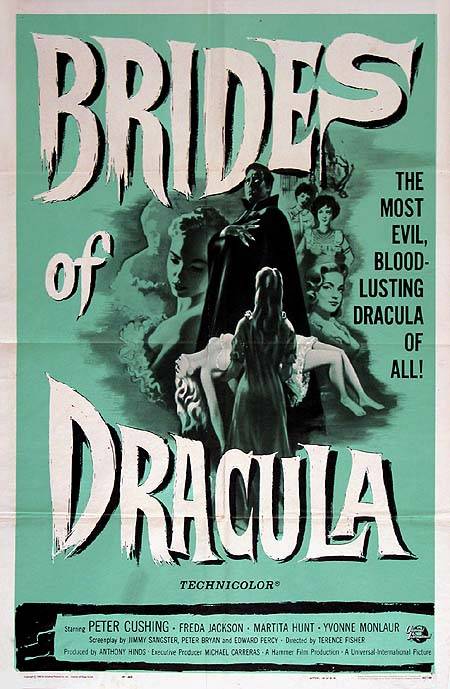
Like many of his colleagues (Bliss and Bax did it too), Williamson wrote a fair amount of music for the cinema, admittedly for films of varying quality. It’s always amusing to discover his name in the opening credits of Hammer productions like “The Brides of Dracula” and “The Horror of Frankenstein.” But, as the prehistoric appliances on “The Flintstones” often remarked… it’s a living.
“Don’t look at the eyes, Rex… DON’T LOOK AT THE EYES!”
But of course, nobody in this movie listens.
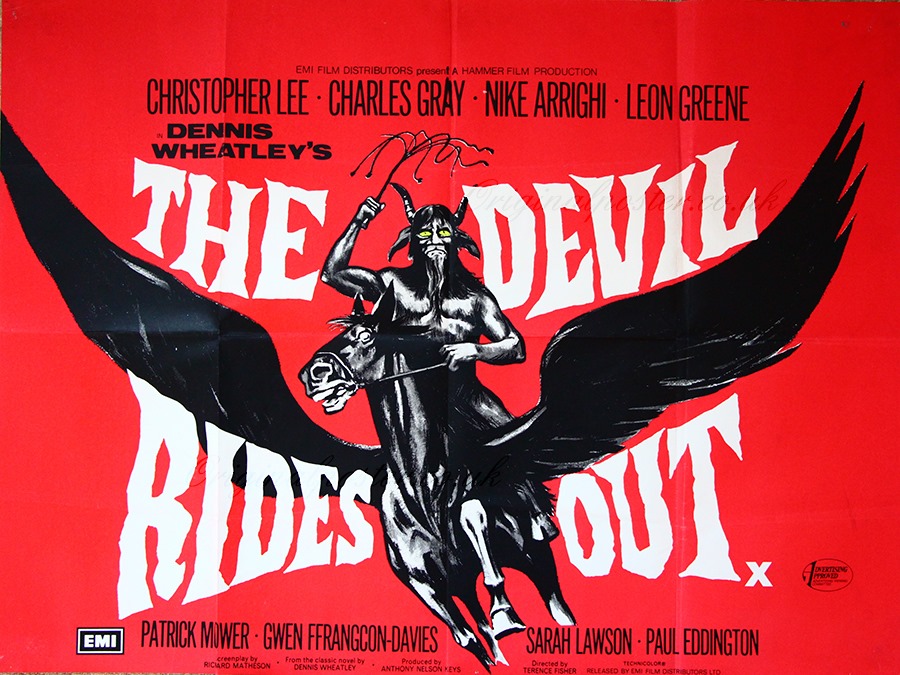
Roy Bjellquist and I will continue our month-long celebration of Halloween with a discussion of my favorite Christopher Lee film, “The Devil Rides Out” (released in the U.S. in 1968 as “The Devil’s Bride”).
Lee gets to play the hero for a change, aristocrat and occultist Nicholas, Duc de Richlieu, who alone possesses the arcane knowledge to do battle against a web of Satanists. Richlieu is the hero of no less than ELEVEN novels by Dennis Wheatley – of which only THREE have supernatural themes. WTF? Elsewhere, he’s frittering away his time solving mysteries, battling Spanish anarchists, rescuing relatives from Soviet prison, fighting Nazis, or otherwise engaged in colorful globetrotting.
But perhaps that’s all just as well. Having read “The Devil Rides Out,” I can tell you it’s nothing to write home about. Thankfully the movie is another story, surely one of Hammer’s best!
We’ve already made our sacrifice to the Goat of Mendes, so hopefully we’ll be spared the connectivity issues we suffered on Friday night.
I hope you’ll join us, with your comments and insights, on the next Roy’s Tie-Dye Sci-Fi Corner, to be live-streamed on Facebook this Sunday night at 7:00 EDT!
Since the movie itself doesn’t appear to be available for streaming through official channels in the U.S., here are a couple of links to Dailymotion, where it’s been posted in two parts.