Tag: Hans Zimmer

  • Sherlock Holmes Movie Music on WWFM

    Sherlock Holmes Movie Music on WWFM

    The game’s afoot! It’s an afternoon of mystery and imagination.

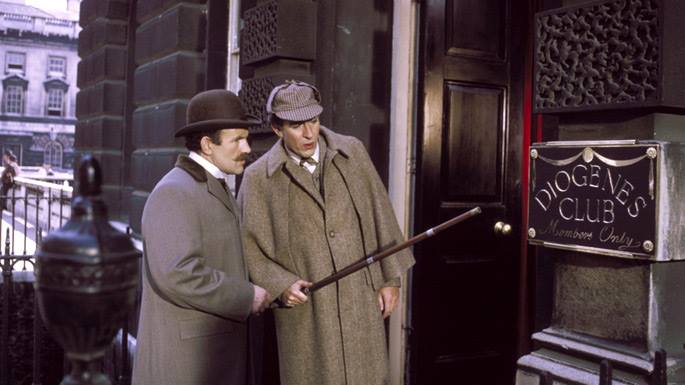
    This week on “Picture Perfect,” the focus will be on films inspired by the world’s greatest detective, including “Sherlock Holmes” (2009), with music by Hans Zimmer, “The Private Life of Sherlock Holmes” (1970), with music by Miklos Rozsa, “Without a Clue” (1988), with music by Henry Mancini, and “Young Sherlock Holmes” (1985), with music by Bruce Broughton. That’s all coming up at 6:00 EDT.

    To get you in the mood, I’ll be playing Rozsa’s Violin Concerto in the 4:00 hour, a work director Billy Wilder listened to incessantly while writing his screenplay for “The Private Life” and upon which he requested the composer base his film score.

    Then in the 5:00 hour, we’ll have the Sherlock Holmes ballet, in all-but-name, “The Great Detective,” by English composer Richard Arnell.

    In the words of Holmes himself, “Once you eliminate the impossible, whatever remains, no matter how improbable, must be the truth.” Join me for an afternoon of improbably good music, from 4 to 7:00 EDT, on WWFM – The Classical Network and at wwfm.org.

  • Superhero Movie Scores: Bland by Design?

    Superhero Movie Scores: Bland by Design?

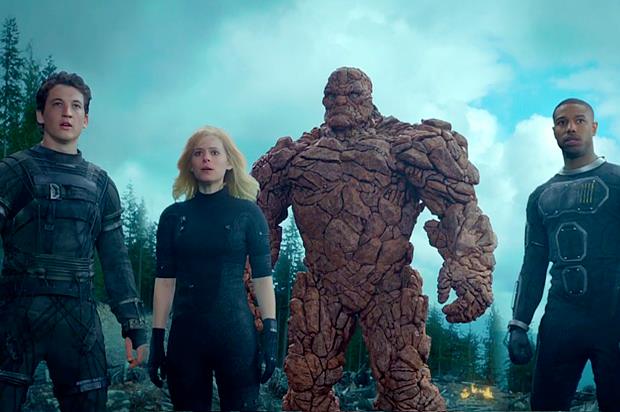
    So why are the film scores to blockbuster superhero films so undistinguished? You know something’s got to be wrong when Patrick Doyle, one of the screen’s great melodists (he wrote the music for “Henry V,” “Much Ado About Nothing,” and “Sense and Sensibility”), succumbs to a bludgeoning drum beat for “Thor.” One thing’s for certain, we are a long, long way from John Williams’ “Superman” (1978), which proved, even in its most intimate scenes, how indelible and uplifting a superhero score could be.

    To be fair, there isn’t a lot of room in contemporary superhero films for the music to breathe, the scores often swallowed up by hyperkinetic editing and ear-splitting sound effects. For a composer’s contribution to be heard, he needs to be pounding the biggest drum – even if it’s an electronic drum – in the room.

    If there is melody, it is either cranked out of a noodle press, someone running their fingers mindlessly across a keyboard with no concept of how a true melody is structured, or limited to a recurring motif (as in “The Avengers”), as if the composer is embarrassed to let his score “sing.” Alan Silvestri, composer for “The Avengers,” wrote the music for “Back to the Future,” for crying out loud! His scores since at least “Van Helsing” (2004) have been horrifying assaults. He was given the chance to write a good old-fashioned march for “Captain America,” but the film itself was a self-conscious throwback, directed by Lucas and Spielberg associate Joe Johnston.

    So who decided audiences were fed up with grand, post-romantic, orchestral scores? What film composer has sold more albums than John Williams? What composer is more represented in a list of top-grossing films of all time? Who doesn’t love “Star Wars” and “Raiders of the Lost Ark” and “E.T.” and “Jurassic Park” and “Harry Potter?” I’m not saying every score has to be like those, but the majority of scores these days sound as if they are churned out on a synthesizer – which may very well be the case. Sure, the composer, as the last in the post-production assembly line, has to deliver very quickly, but Jerry Goldsmith churned out plenty of memorable music at white heat.

    The sad fact of the matter is that the bean-counters have figured out that music no longer has to make much of an impression for a film to make a billion dollars worldwide. Also, if a composer no longer requires extensive training, then anyone can sit down and noodle something out on their computer – which is why so many rock musicians are now on the rise as film composers. Think back on the incredibly rich scores by Erich Wolfgang Korngold or Miklós Rózsa or Bernard Herrmann or Andre Previn, and measure their contributions against just about anything being written today. These guys were honest-to-goodness geniuses at their craft.

    Hans Zimmer, who, by his own admission doesn’t have the chops to write on Williams’ level, as far as orchestral scores are concerned, helped sow the seeds of destruction by demonstrating that synthesizers and electronic sampling by a team of composers would be perfectly acceptable to most audiences. When producers have the choice between hiring out to Zimmer’s studio or leasing the London Symphony Orchestra, who are they going to go with? It could take a composer, working with a trusted orchestrator, a good month or more to come up with a polished score. Using electronics, music can be cranked out like sausages, and today’s audiences are only too ready to gobble them down.

    Okay, that’s my rant. Here’s a related piece on how cannibalized temp tracks have helped keep Marvel movies at a level of musical mediocrity.

    http://www.theverge.com/2016/9/12/12893622/hollywood-temp-scores-every-frame-a-painting-film

  • Film Composers Times Changing?

    Film Composers Times Changing?

    “Times sure have changed for film composers,” writes Allan Kozinn of the New York Times. I’m not so sure.

    Kozinn is of the opinion that film music is making massive strides in the concert halls. While it’s true that orchestras have embraced the profitability of performing film scores with showings of the actual movies, for the most part you’ll find music written for film relegated to pops concerts. And you’ll likely hear only the main themes. That’s not to say that all film music deserves to stand toe-to-toe with the world’s masterpieces. But judicious selections from the best would be at least as welcome as Berlioz or Liszt.

    Part of the problem is that many of the composers themselves weren’t thinking of posterity. They were just churning the stuff out against deadline and then chasing the next paycheck. But when you think about it, so was Mozart.

    Some of the music is derivative, certainly, but that can be gotten around. There is plenty of finely-crafted music from which to draw by composers with a strong, original voice. Miklós Rózsa, for instance.

    Another part of the problem is that because of the nature of the film business, many of the scores weren’t even preserved. So many modern recordings have taken place only after painstaking reconstruction. If the actual, widespread rehabilitation of classic film music ever catches fire, it could be the biggest business since the period instrument movement.

    Finally, it was comparatively seldom that film composers made usable concert arrangements, so that the music can be enjoyed separate from the images. There are notable exceptions: for instance, Bernard Herrmann’s “Psycho: A Narrative for String Orchestra.” Can you name another piece of orchestral music composed in 1960 that is as widely recognized as that written for the film’s shower scene? Herrmann’s suite contains 15 minutes of alternately driving, moody and chilling music.

    On the other hand, sometimes composers are not the best judge of their own material. I cringe whenever I hear John Williams’ concert arrangement, “Adventures on Earth,” drawn from his score to “E.T.,” which completely subverts the perfection he achieved when writing for the film. The music was so good, director Steven Spielberg told Williams to just go with it when conducting and he’d edit the images to suit the music. That’s a show of respect rarely bestowed on the film composer. Yet rather than allow the music to speak as it did so eloquently in the film’s final 15 minutes, Williams’ concert arrangement jumps all over the place, grabbing a little bit from here and a little bit from there. Even judging from a purely musical standpoint, the end result is a much weaker statement.

    Anyone who has ever listened to Sibelius’ incidental music to “The Tempest” understands the wisdom of taking the best moments and arranging them into concert suites. In the digital age, there are multiple recordings of the complete score for the curious. For the average symphony concert, I don’t propose programming the complete music from “King Kong,” say, any more than I would the complete incidental music to Mendelssohn’s “Oepidus at Colonus” (though I certainly believe there is a niche to be filled by some enterprising orchestra that would devote itself exclusively to just that – playing and preserving classic film scores in their entirety). Often the best bits are already in the concert suites, or even the overtures.

    There is at least one positive development, in terms of respectability. Kozinn reports that London’s Royal College of Music is offering a new scholarship named for the composer John Barry. Barry was the winner of five Academy Awards, including two for “Born Free,” and one each for “The Lion in Winter,” “Out of Africa” and “Dances with Wolves.” The John Barry Scholarship for Film Composition, established by the composer’s widow, Laurie Barry, covers tuition fees for a two year period, as well as a student’s living expenses.

    While this post has devolved into a rant about preservation and acceptance, what we really need in the present are educated film composers. I am so sick of Hans Zimmer.

    But if the music is going to get better, one hopes so will the films, or at least the conditions, so that the composer is able to write something good. Writing music takes time, and time is money. In Hollywood, there has always been a tension between art and commerce. Over the decades, however, the shift has been decidedly in favor of the latter. Can independent films afford the expense of recording with a symphony orchestra? The ball, sadly, appears to remain in Hollywood’s court.

    Here’s Kozinn’s article:

    PHOTO: John Barry accepts his Oscar for “Out of Africa.”
  • Sherlock Holmes Movie Music on Picture Perfect

    Sherlock Holmes Movie Music on Picture Perfect

    The game’s afoot!

    This week on “Picture Perfect,” it’s an hour of music from movies inspired by the world’s greatest detective.

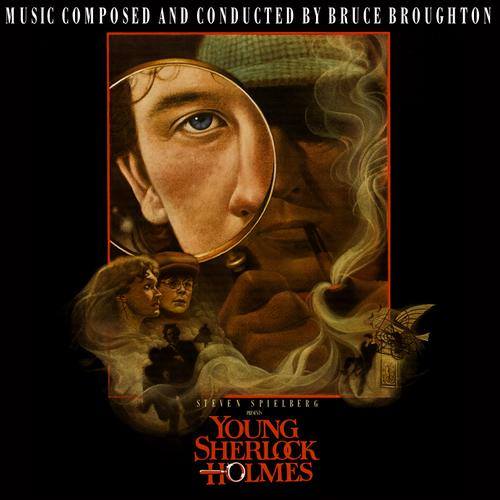
    Intrada Records has released the soundtrack to Bruce Broughton’s “Young Sherlock Holmes,” which is finally making it to compact disc after the better part of three decades.

    Steven Spielberg produced the 1985 film, which offers a conjectural origins story, including Holmes and Watson’s first meeting as teenagers (ignoring the particulars laid out by Arthur Conan Doyle in his stories, with Watson already a war veteran who had served in Afghanistan).

    It’s all for fun, though it’s unfortunate the filmmakers felt the need to interject ‘80s-style special effects, rather than simply trust in the inherent magic of the subject matter. “Young Sherlock Holmes” features the first photorealistic, fully computer-generated character. Also, some Indiana Jones B-movie antics involving an Egyptian cult seem especially out of place.

    Interestingly, the film’s screenwriter, Chris Columbus, went on to direct the first two Harry Potter films. By my recollection, “Young Sherlock Holmes,” with its boarding school setting, has some of that same feel.

    The music is certainly buoyant and beautiful, in the best John Williams tradition. Broughton, who’s probably best-known for his rousing music for the western “Silverado,” was one of the great film music hopes of the 1980s. He did score a handful of big screen hits, notably “Tombstone,” though arguably it is in the medium of television that he’s made his greatest impact. Thus far, his work has been recognized with a record 10 Grammy Awards.

    Also featured will be selections from Hans Zimmer’s score for the Robert Downey, Jr., “Sherlock Holmes” (2009), Miklós Rózsa’s lovely, melancholy music for “The Private Life of Sherlock Holmes” (1970), and Henry Mancini’s theme for the tame Holmes comedy “Without a Clue” (1988).

    It’s elementary, my dear Watson. “Picture Perfect” can be heard this Friday evening at 6 ET, or later as a webcast, at http://www.wwfm.org.

Tag Cloud

Aaron Copland (92) Beethoven (95) Composer (114) Film Music (120) Film Score (143) Film Scores (255) Halloween (94) John Williams (185) KWAX (229) Leonard Bernstein (100) Marlboro Music Festival (125) Movie Music (135) Opera (198) Philadelphia Orchestra (88) Picture Perfect (174) Princeton Symphony Orchestra (106) Radio (87) Ralph Vaughan Williams (85) Ross Amico (244) Roy's Tie-Dye Sci-Fi Corner (290) The Classical Network (101) The Lost Chord (268) Vaughan Williams (103) WPRB (396) WWFM (881)

DON’T MISS A BEAT

Receive a weekly digest every Sunday at noon by signing up here


RECENT POSTS