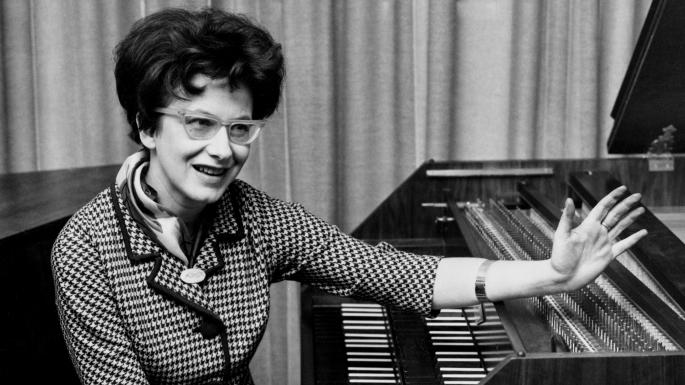
The harpsichord has frequently been employed on soundtracks to mysteries and thrillers, when it has been appropriate to lend a film somewhat of a “wry” tone. This week on “Picture Perfect,” we’ll hear selections from four scores that keep tongue embedded firmly in cheek, even as the corpses begin to pile up.
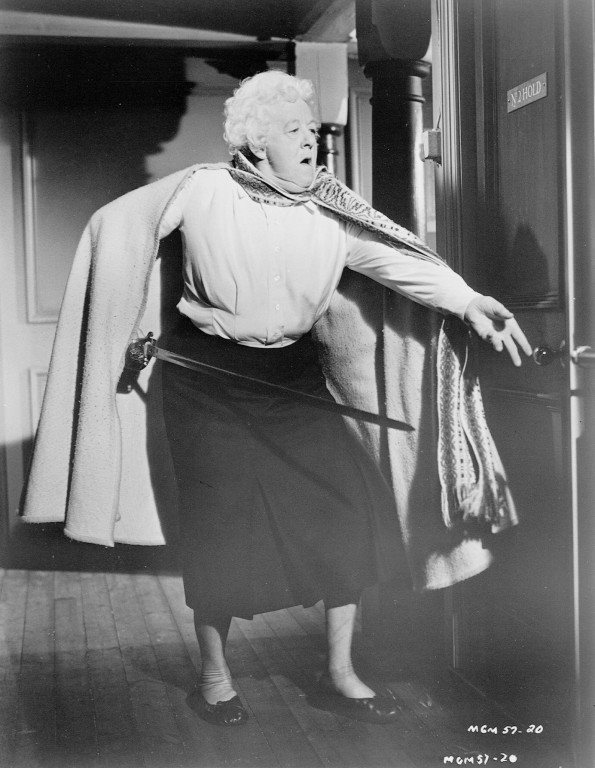
Ron Goodwin wrote the music for a series of Agatha Christie adaptations that starred Margaret Rutherford as Miss Marple. In the first of these, “Murder She Said” (1961), Marple goes undercover as a domestic servant. The Miss Marple theme became a popular hit, which you may still recognize.
Bette Davis enjoyed something of a comeback following her turn in “Whatever Happened to Baby Jane?,” opposite Joan Crawford. The film singlehandedly defined a subgenre which has been variously described as “psycho-biddy,” “hag horror,” “hagsploitation” and “grande dame guignol.” Camp and black comedy are essential elements. “Dead Ringer” (1964) was yet another “bad twin” film, with Davis’ delicious performance underscored by André Previn.
Sir Laurence Olivier and Michael Caine play a deadly game of cat and mouse, as a mystery writer plans to exact revenge on his wife’s lover, in a big screen adaptation of Anthony Shaffer’s play, “Sleuth” (1972). John Addison, who had previously harpsichorded his way to an Academy Award with his score for “Tom Jones,” wrote the impish music.
Finally, Barbara Harris plays a fake psychic and Bruce Dern her cab-driving, private investigator boyfriend, who become embroiled with serial kidnappers, in Alfred Hitchcock’s final film, “Family Plot” (1976). The composer was none other than John Williams, poised between his breakout success, “Jaws,” and “Star Wars,” which was to make him a household name. (Both “Jaws” and “Star Wars” were Academy Award winners for Best Original Score),
Hitchcock was full of suggestions as to the music and how it should be conducted. The composer recollects that on one occasion, when trying to convey the tone he was seeking, Hitch remarked, “Mr. Williams, murder can be fun.”
I hope you’ll join me for an hour of “arch harpsichords” this week on “Picture Perfect,” this Friday evening at 6 ET, with a repeat Saturday morning at 6, or that you’ll listen to it later as a webcast at http://www.wwfm.org.