
Once more unto the beach, dear friends!
This morning on “Sweetness and Light,” for Labor Day weekend, we’ll wring the last from our beach towels as we bid farewell to the summer season.
I’ll have two works that are Jersey Shore specific, including the “Cape May Suite” by Rick Sowash (who lives in Cincinnati) and “The Atlantic City Pageant” by John Philip Sousa – named for the famous beauty pageant and given its first performance on Atlantic City’s Steel Pier.
We’ll also hear from Virgil Thomson, Émile Waldteufel, Ronald Binge, Clive Richardson, Ralph Vaughan Williams, John Williams, and Morton Gould.
It will be hotter than Harfleur, but we’ll seek solace in the surf. Join me by the seaside for the last throes of summer, on “Sweetness and Light,” this Saturday morning at 11:00 EDT/8:00 PDT, exclusively on KWAX Classical Oregon!
Stream it, wherever you are, at the link:
https://kwax.uoregon.edu/
Tag: Henry V
-

Shakespeare Saint George and England’s April 23
April 23 – The feast day of Saint George, dragon-slayer and patron saint of England (and elsewhere). He’s famously invoked in Shakespeare’s “Henry V,” during the siege of Harfleur. It’s only appropriate that England’s most-celebrated playwright was born on this date in 1564. Or was he? We’re not sure, but we know he was baptized on April 26, and he died on April 23, 52 years later, so we’re inclined to make it fit! Methinks the Bard would appreciate the touch of poetic license.
Happy birthday, Shakespeare, and cry Harry, England and Saint Geooooooooorge!
Olivier, “Once more unto the breach, dear friends!”
Branagh, same
Bonus! Brian Blessed, who played Exeter in the Branagh version, at 84
Edward Elgar, “The Banner of Saint George,” conducted by the late Sir Andrew Davis
Some of the most impressive artistic renderings of St. George aren’t even English. And I kind of feel sorry for the dragon, to be honest.
Branagh as “Henry V” (left) and “Saint George Killing the Dragon” by Bernat Martorell
-

Shakespeare’s Birthday Henry V on Film
This week on “Picture Perfect,” it’s William Shakespeare’s birthday (observed).
No one knows for sure when the Bard was born – his baptismal date was April 26, 1564 – but since he died on April 23, 1616, the tradition has been to keep it tidy. So, like Mark Twain, who “came in” with Halley’s comet and “went out” upon its return, we feel it as a matter of poetic satisfaction that Shakespeare’s death date must also be his birth date.
All’s well that ends well! I’ll celebrate Shakespeare on both of my show’s this weekend (following up tomorrow night on “The Lost Chord” with some Shakespeare-inspired concert works at 10:00 EDT), beginning today with two complementary versions of “Henry V.”
William Walton composed his now-classic score for Laurence Olivier in 1944. We’ll hear selections from a recording that hews closer to the film’s original orchestrations than does the sanctioned concert suite by Muir Mathieson and restores the parts for chorus. In addition, Olivier himself will declaim two of Henry’s rousing speeches, in a separate release conducted by the composer.
Then Patrick Doyle will be the baritone that initiates the choral showpiece “Non nobis Domine” that caps his own acclaimed score for Kenneth Branagh’s directorial debut in 1989.
Olivier’s “Henry V” was nominated for four Academy Awards: those for Best Picture, Best Actor, Best Art Direction, and Best Score. It didn’t win in the competitive categories, but Olivier was honored with a special award “for his outstanding achievement as an actor, producer and director in bringing ‘Henry V’ to the screen.”
To go toe-to-toe with the 20th century’s most renowned Shakespearean interpreter was a bold gamble, but at 29 Branagh did just that. Amazingly, when his version galloped into theaters 45 years later, comparisons were not unfavorable. The film and Branagh’s performance would also be nominated (along with the film’s Costume Design). But despite its enthusiastic reception, Doyle’s music would be overlooked by the Academy. The soundtrack, however, received a lot of exposure on classical radio at the time, and the score remains popular.
It’s instructive to view the two directors’ takes on “Henry V” in the context of the times in which they were filmed. When Olivier brought Harry the King to the big screen, England was in throes of the Second World War and his “Henry” bubbles over with patriotic zeal.
Branagh, on the other hand, offers a grittier, post-Vietnam “Henry,” with his charismatic, ambitious king plunging his country into a war that is both costly and messy. Fortunately, as history tells us, the long-bow saves the day, and Branagh’s Henry makes us forget his cold rejection of old friendships with a hair-raising rendition of the St. Crispin’s Day speech that would drive anyone who hears it to want to fight the French, consequences be damned.
Judge for yourself, from these two contrasting interpretations of the St. Crispin’s pep talk from “Henry V.”
Olivier, a powerful and patriotic – if somewhat theatrical – symbol for the beleaguered British during World War II:
And Branagh, a cinematic, very human Henry for today:
https://www.youtube.com/watch?v=cRj01LShXN8
Once more unto the breach, dear friends! I hope you’ll join me for “Henry V” times two, on “Picture Perfect,” music for the movies, this Saturday at 6:00 EDT, on WWFM – The Classical Network and wwfm.org.
-

Christopher Plummer A Life in Acting
I’ve been silent about celebrity deaths recently – otherwise, I’d never be off Facebook!
But I have to acknowledge, I am very sorry to learn of the passing of Christopher Plummer. A seasoned veteran of stage of screen, Plummer had one hell of a career, and he was much-decorated and acclaimed for it.
Even so, Oscar remained standoffish. He received his Academy Award for Best Supporting Actor, for “Beginners,” only in 2010. At 82, it made him the oldest person ever to be so recognized in an acting category. Six years later, he was nominated again, at 88, for “All the Money in the World.” He was now the oldest actor ever to receive a nomination.
Whether he was Iago, Cyrano de Bergerac , Sherlock Holmes, or Georg von Trapp, Plummer was a virtuoso, always in command of his instrument. That’s not to say he undertook everything in the service of art. In 1978, he appeared as the Emperor of the Galaxy in “Starcrash,” an Italian knockoff of “Star Wars,” because it allowed him a free trip to Rome. The film achieves its delirious apotheosis when Plummer assumes an authoritative stance and intones, “Imperial Battleship! Halt… the flow of time!”
In 1956, he essayed the role of Henry V at Ontario’s Stratford Festival. However, for one performance, he was laid low by an attack of kidney stones. This opened the door for his understudy, a struggling young actor by the name of William Shatner. Shatner and Plummer would later face off, with Plummer as a Shakespeare-spouting Klingon, in “Star Trek VI: The Undiscovered Country.”
Here’s a fine recording of William Walton’s music for the Laurence Olivier film of “Henry V” (1944). Plummer supplies the big speeches, and then some.
The Stratford Plummer-Shatner “Henry” story is recounted here:
His greatest role?
R.I.P. Christopher Plummer, dead at 91.
PHOTO: Plummer in Walton’s “Henry V” with the New York Philharmonic in 2011
-
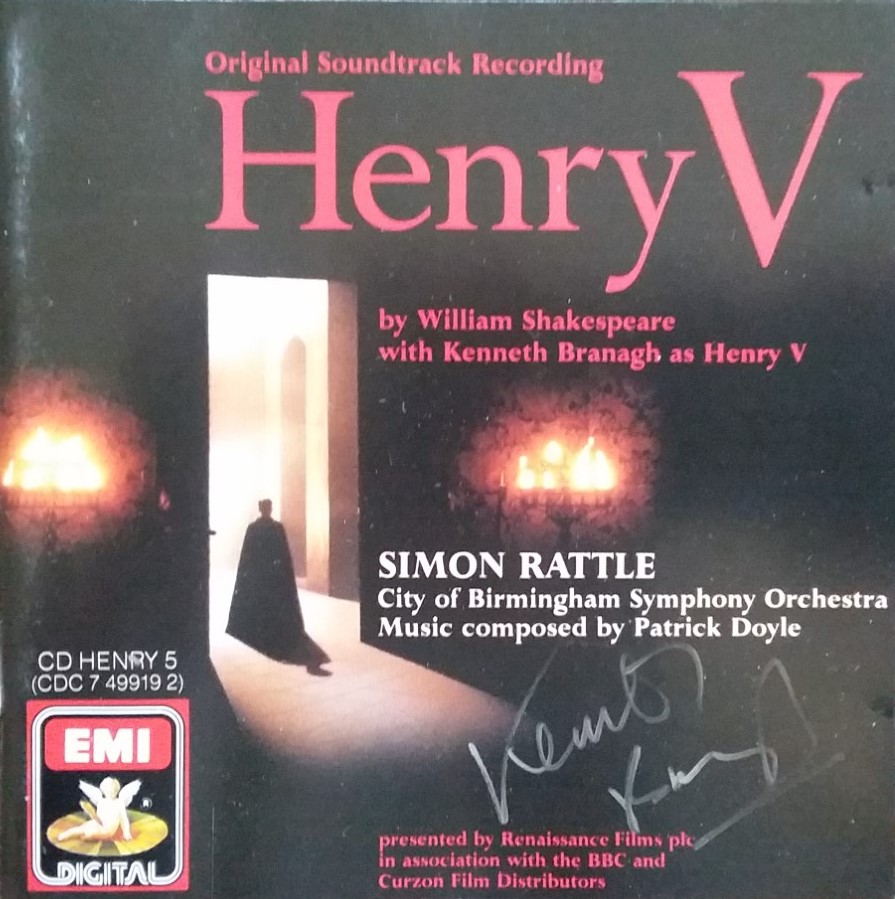
Branagh’s Henry V Soundtrack & Shakespeare
Here’s a glimpse of my soundtrack to Patrick Doyle’s “Henry V.” I had the booklet signed by Kenneth Branagh. At the time, Branagh had just been hired by Marvel to direct “Thor,” and I was hoping to talk him into casting Brian Blessed as Odin and Derek Jacobi as Loki. Alas, it was not to be… not that I ever thought it would be!
Enjoy selections from Branagh’s “Henry V,” alongside Doyle’s music for “As You Like It,” “Hamlet,” and “Much Ado About Nothing.”
Branagh meets the Bard on “Picture Perfect,” this Friday evening at 6:00 EDT, on WWFM – The Classical Network and wwfm.org.
Tag Cloud
Aaron Copland (93) Beethoven (95) Composer (114) Film Music (144) Film Score (143) Film Scores (255) Halloween (94) John Williams (195) KWAX (229) Leonard Bernstein (104) Marlboro Music Festival (125) Movie Music (159) Mozart (90) Opera (212) Philadelphia Orchestra (89) Picture Perfect (174) Princeton Symphony Orchestra (109) Radio (88) Ross Amico (244) Roy's Tie-Dye Sci-Fi Corner (290) The Classical Network (101) The Lost Chord (269) Vaughan Williams (105) WPRB (397) WWFM (881)