Say what you want about Christopher Nolan, he sure can open a movie. I was at Barnes & Noble yesterday, and there was a table devoted to “The Odyssey,” an “Odyssey” endcap, and a massive display of “Odyssey”-related gift items. Furthermore, people are actually reading the thing. What other director has that kind of sway?
Nolan repeats the feat of a few summers ago, when “Barbenheimer” was all the rage – moviegoers participating in incongruous, ironic, de facto double features of “Barbie” and Nolan’s “Oppenheimer.” Now, he’s triggered the Summer of Homer.
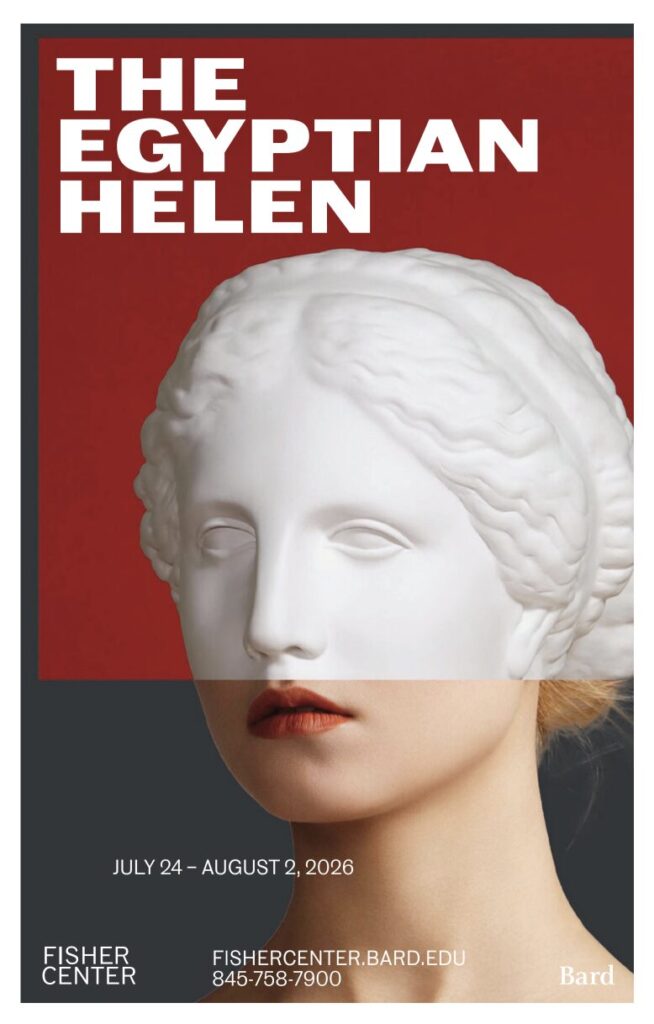
Wholly by coincidence – because, really, Classical mythology never really goes away – Richard Strauss’ rarely-heard opera “Die ägyptische Helena ” (“The Egyptian Helen”), about the troubled relationship of Helen of Troy and her husband Menelaus (whom she abandoned for Paris, precipitating the Trojan War), will be revived at Bard College this week.
The work was the fifth of six collaborations between Strauss and librettist Hugo von Hofmannsthal (that also yield “Elektra,” “Der Rosenkavalier,” “Ariadne auf Naxos,” “Die Frau ohne Schatten,” and “Arabella”), and Hofmannsthal’s personal favorite.
Their treatment, inspired not only by Homer, but also Euripides and Herodotus, humanizes and contemporizes these figures of Classical mythology, who struggle with timeless issues of memory, fidelity, and restoration of trust. But there are also oracles, elves, elixirs, and an Omniscient Seashell. The action and themes are colored or motivated by humor, jealousy, rage, philosophical musings, equanimity, warmth, and reconciliation.
The opera will be performed at the campus’ state-of-the-art, Frank Gehry-designed Fisher Center for the Performing Arts, July 24-August 2, as part of Bard SummerScape, the college’s annual festival of the arts, which will also encompass the Bard Music Festival, this year focusing on “Mozart and His World,” August 7-16.
A livestream of “The Egyptian Helen” will be offered on July 31 at 4 p.m. EDT.
Bard College is located in Annandale-on-Hudson, NY. For me, it’s about a 2 ½ hour drive – certainly a commitment, though I’d hardly call it an odyssey.
For tickets and information visit
https://fishercenter.bard.edu/what-we-do/summerscape/
Tag: Homer
-
Summer of Classical Myth from Bard Homer and Bard College
-
Epic Summer
I’ve got some followers that I know are big readers. Myself, I am reading something all the time, but unfortunately I am rather slow under the best of circumstances, and since I read mostly at bedtime these days (thank you, internet), I often find myself pushing back against drooping eyelids. I used to read in the morning also, in the days before I had a laptop. Previously, what happened at work – where I kept my desktop – stayed at work. When you have two reading sessions built into your day, even short ones, at breakfast and bed, you do cover a lot of ground, more than you would think.
Anyway, last week I finally finished Robert Fagles’ translation of “The Odyssey,” in advance of Christopher Nolan’s movie, which I’m pretty sure I’m going to have issues with (and not because I’m a “culture warrior”). And since then, I knocked out Bernard Knox’s 60-page intro, which I found informative and essential, in order to more fully grasp the history and significance of this cornerstone of Western literature, which is so much more than simply an adventure story.
The edition – which I discover is inscribed by Fagles (who taught at Princeton University) – has been part of my library since I skimmed it off the inventory of one of my bookstores, but somehow I never got around to reading it until now. It’s been part of the Princeton High School curriculum. In my hometown, for some reason, we read “The Iliad.” Granted it was an AP course, but with all the cataloguing in which Homer indulges, so that we know all about the participating forces, the leaders’ lineages, their geographical origin and their weaponry, it was kind of a slog. It was a long time ago, but I don’t even know that I can blame the translation (by W.H.D. Rouse).
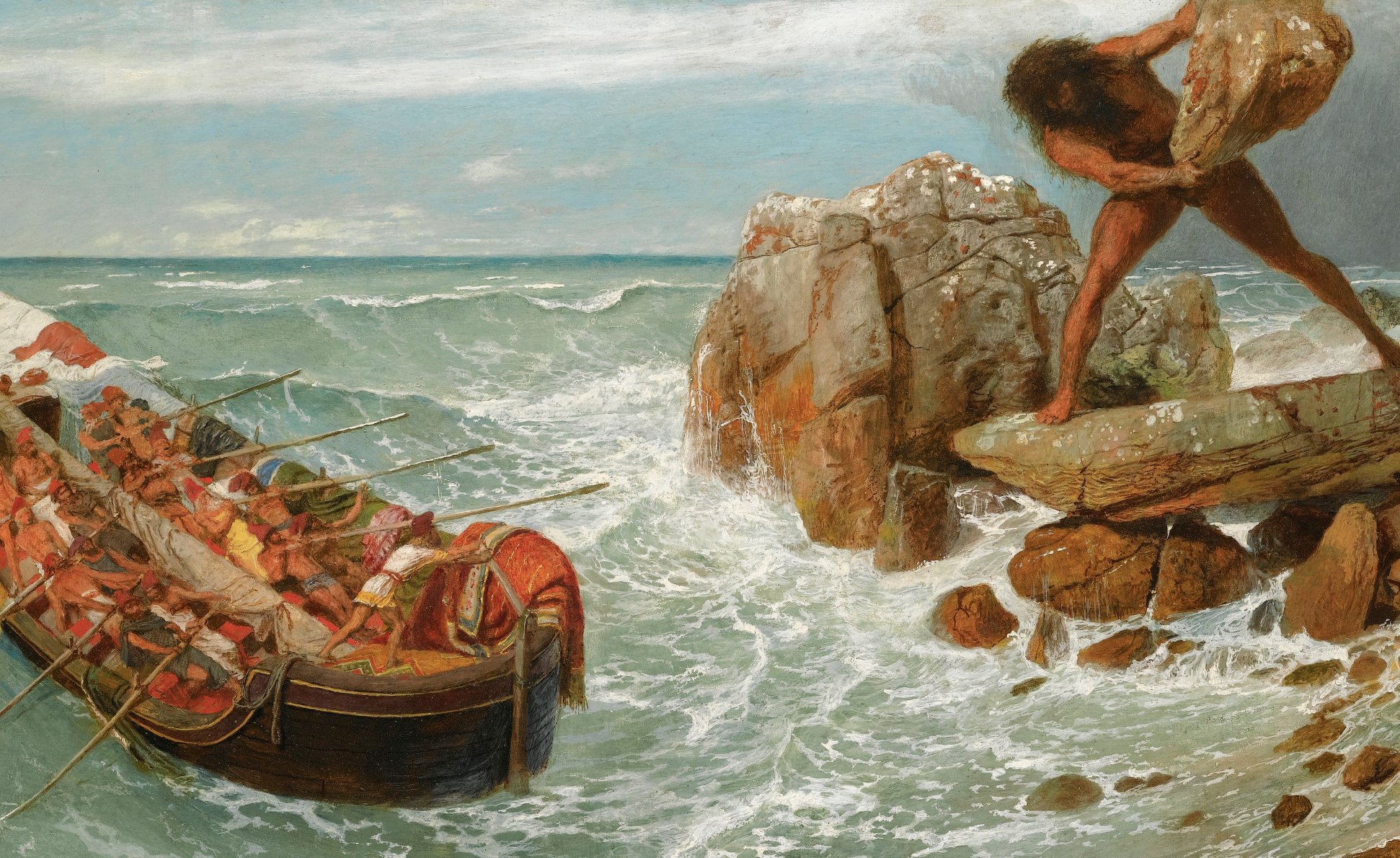
Fagles’ “Odyssey” is a much more enjoyable read. In fact, surprisingly so. I expected it to be heavy lifting, akin to the boulder Polyphemus uses to seal his cave. But it turned out to be far from it. (Incidentally, I see the audio book is read by Sir Ian McKellen!)
However, I am sure it is not the last word in “Odyssey” translations, acclaimed though it be. In fact, I can understand why there are so many “Odyssey” fanatics on YouTube, who seem to have a working familiarity of the finer points of all the various translations. Since I cannot read Greek myself, I would definitely be interested in checking out some of the other versions. I am especially curious to take a look at the much-lauded, and I’m sure more elevated, translation by Alexander Pope. Somewhat in common with its hero’s travails, one’s encounter with “The Odyssey” could expand into an epic journey of many years.
You have to admit, the story has had legs. Even if you’ve never read a word of it, you probably already know a lot of it. It’s been a crowd-pleaser for 2,800 years! Ralph Fiennes played a brooding (and surprisingly jacked) Odysseus only last year, in “The Return,” and I recently learned that Jerry Bruckheimer, of all people, is overseeing an animated musical (!) on the story, based on a recent internet series (?), for theatrical release. I remember watching a miniseries with Armand Assante, back in the ‘90s, but for me, the benchmark will probably always be Kirk Douglas in “Ulysses.” When men were men, and cyclopes were cyclopes!
By coincidence, I’ve got a ticket to see “Die ägyptische Helena” (“The Egyptian Helen”) at Bard College later this month. Richard Strauss’ rarely-heard opera about Helen of Troy sets a libretto by Hugo von Hofmannsthal – whose source material is Euripides’ play “Helen,” as opposed to Homer’s “Iliad,” but hey…
Only yesterday, I bought a loaf of bread from a local bakery and the woman on the counter’s name was Penelope! I’m taking it as a sign.
Nolan’s movie opens tomorrow. Watch this space, because this weekend all three of my radio shows – “Picture Perfect,” “Sweetness and Light,” and “The Lost Chord” – will be on Classical mythological themes.
It seems Homer is everywhere these days. But really, has he ever gone away?
———-
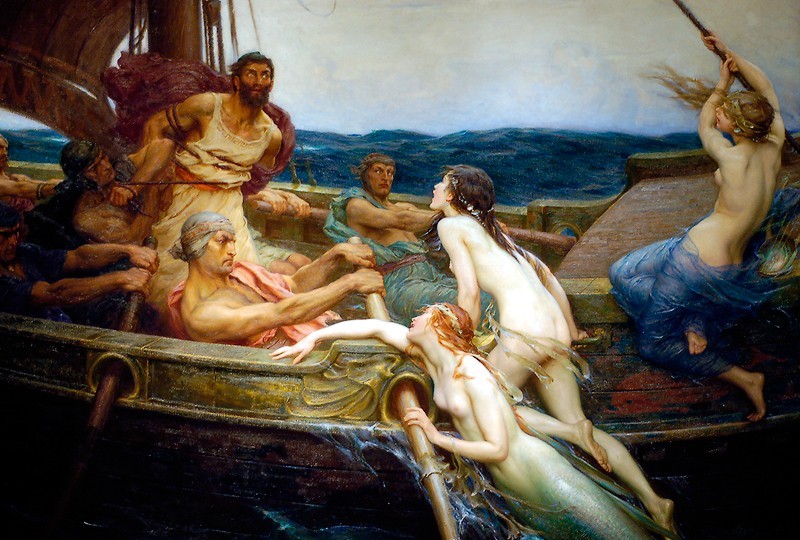
IMAGE: Matt Damon tempted by the Sirens in Christopher Nolan’s “The Odyssey”
(Actually “Ulysses and the Sirens,” 1909, by Herbert James Draper) -

Odysseus’ Journey Music Inspired by “The Return”
With Ralph Fiennes now in theaters as Odysseus in “The Return,” I’m girding myself for a cathartic dose of holiday bloodletting. To get myself in the mood, this week on “The Lost Chord,” I’ll have an hour of music inspired by Odysseus’ homeward journey.
We’ll hear Ernst Boehe’s symphonic poem “Departure and Shipwreck,” from his cycle “From Odysseus’ Voyages” (1903-05), and Benjamin Britten’s radio play “The Rescue of Penelope” (1943), narrated by Dame Janet Baker.
Odysseus, of course, is one of the heroes of the Trojan War, waylaid time and again on his homeward journey by Poseidon and the frailties of his own men. It takes him ten years to find his way back to Ithaca. When he gets there, he finds his wife beset by boorish suitors all vying for her hand and his throne.
What happens next pushes all the same buttons that are still pushed whenever the descendants of Arnold Schwarzenegger and Sylvester Stallone begin applying the camouflage, strapping on their bandoliers, and sheathing their big knives. In the process, there’s also some meaningful father-son bonding. Homer always did know how to lend class to the classics.
If you’re looking for angry gods, shipwrecks, cannibalism, gratuitous nudity, riotous drunkenness, blinded Cyclopes, and the vicarious slaughter of one’s rivals, I hope you’ll me for “Home Sweet Homer” on “The Lost Chord,” now in syndication on KWAX, the radio station of the University of Oregon!
Clip and save the start times for all three of my recorded shows:
PICTURE PERFECT, the movie music show – Friday at 8:00 PM EST/5:00 PM PST
SWEETNESS AND LIGHT, the light music program – ALL NEW! – Saturday at 11:00 AM EST/8:00 AM PST
THE LOST CHORD, unusual and neglected rep – Saturday at 7:00 PM EST/4:00 PM PST
Stream them, wherever you are, at the link!
-
Odysseus’ Journey Home: Music & Adventure
Homesick for Homer?
This Sunday night on “The Lost Chord,” it’s an hour of high adventure and satisfied bloodlust, as we listen to musical evocations of Odysseus’ homeward journey.
We’ll hear Ernst Boehe’s symphonic poem “Departure and Shipwreck,” from his cycle “From Odysseus’ Voyages” (1903-05), and Benjamin Britten’s radio play “The Rescue of Penelope” (1943), narrated by Dame Janet Baker.
Odysseus, of course, is one of the heroes of the Trojan War, waylaid time and again, on his return, by Poseidon and the frailties of his own men. It takes him ten years to find his way back to Ithaca. When he gets there, he finds his wife beset by boorish suitors all vying for her hand and his throne.
What happens next pushes all the same buttons that are still pushed whenever Sylvester Stallone or Arnold Schwarzenegger apply the camouflage, strap on the bandoliers, and sheathe the big knives. Along the way, there’s also some meaningful father-son bonding. Leave it to Homer, who always knew how to lend a little class to the classics.
Odysseus strings his bow, for “Home Sweet Homer,” this Sunday night at 10:00 EDT, on WWFM – The Classical Network and at wwfm.org.
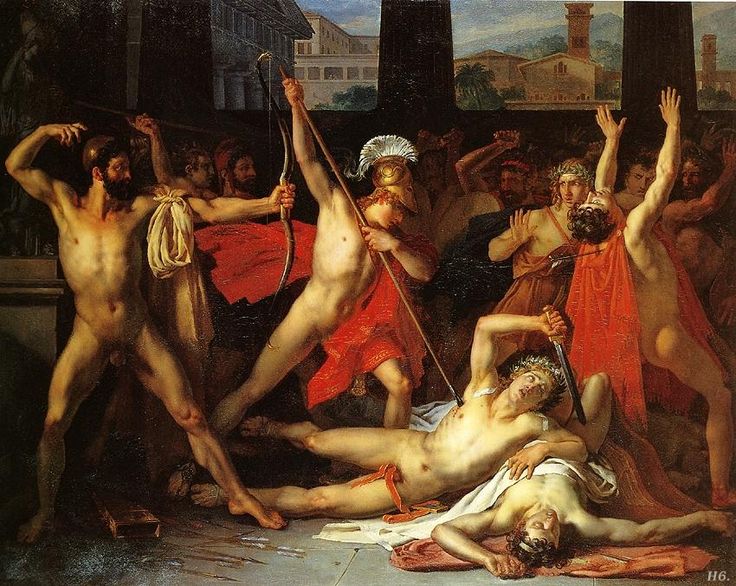
“The Slaughter of the Suitors by Odysseus and Telemachus” (1812), by Louis-Vincent-Léon Pallière
-
Homer’s Homesick Sounds on WWFM
As one who seemingly can’t find his way home, I thought I would offer up an afternoon of music inspired by the ultimate wanderer.
Our centerpiece will be a rarely-heard work, “Odysseus: Symphony in Four Movements,” by the English composer Armstrong Gibbs. Its four movements are meant to evoke the “Escape from Calypso,” “Circe,” “Cyclops,” and “The Return.” If you’re a fan of Vaughan Williams’ “A Sea Symphony,” you might also enjoy this.
“The Return,” of course, refers to Odysseus’ return to Ithaca, after 20 years’ absence, when he finally strings his bow and lays waste to his rivals in one of the most satisfying bloodbaths in all of literature. It also forms the climax of Benjamin Britten’s “The Rescue of Penelope,” a radio play for vocal soloists and orchestra. In the work’s only recording, we’ll hear none other than Dame Janet Baker as the speaker.
I’ll try to mix it up from there, with music suggested by “The Iliad” and “The Odyssey.”
We’re homesick for Homer, from 12 to 4 p.m. EDT, on WWFM – The Classical Network and wwfm.org.
Tag Cloud
Aaron Copland (94) Beethoven (95) Composer (114) Film Music (149) Film Score (143) Film Scores (255) Halloween (97) John Williams (197) KWAX (232) Leonard Bernstein (105) Marlboro Music Festival (125) Movie Music (164) Mozart (91) Opera (215) Philadelphia Orchestra (90) Picture Perfect (174) Princeton Symphony Orchestra (110) Radio (90) Ross Amico (244) Roy's Tie-Dye Sci-Fi Corner (290) The Classical Network (101) The Lost Chord (269) Vaughan Williams (107) WPRB (397) WWFM (881)