After several unfortunate postponements, Roy and I seem to have finally wriggled out from beneath the curse of “The Exorcist” (1973). Now we can finally put Halloween – and Regan – to bed.
One of the unfortunate effects of talking about a film weeks after the fact is that I tend to forget some of the fascinating details that leap out at me while viewing. Even if I jot them down, I don’t always recall the precise trajectory of my thoughts. The difficulty is compounded as, even under the best of circumstances, I can be frustratingly wayward when attempting to express myself in speech. So I guess it’s a good thing I’ve worked for 37 years in broadcast media!
Hopefully we left you with some food for thought, or at any rate, kept you entertained, even as we got sidetracked discussing the relative merits of directors’ cuts and at what length a film should necessitate the inclusion of an intermission. There were plenty of loose ends as we got turned around in the labyrinth. But the journey is always the destination on Roy’s Tie-Dye Sci-Fi Corner. If you missed our 50th anniversary discussion of this horror high-water mark, the entire lollaPazuzu is archived here:
Prior to “Night of the Living Dead” (1968), cinematic zombies were eerie, but mostly harmless. Generally, they did the bidding of Bela Lugosi or wandered like somnambulists through Val Lewton films. But that all changed overnight when filmmaker George A. Romero turned them into flesh-eating “ghouls” (as he called them; the word zombie is never uttered). Now, it seems, the zombie apocalypse is here to stay.
However, few films in the genre are so well executed. Romero’s lean and mean thriller has the simplest of premises and the lowest of budgets, yet good writing, editing, and direction, and a matter-of-fact tone make this one of the most convincing horror movies ever made. Especially since, as would always be the case throughout Romero’s zombie cycle (he made six “Dead” films in all), the chills are informed by real-world social and political subtexts.
“Night of the Living Dead” serves as both the last gasp of 1950s B-movie drive-in fodder and the dawn of contemporary horror. And people were indeed horrified. The film opened a month before the MPAA ratings system was implemented, and it was distributed to theaters as typical Saturday matinee fare. Critics were appalled and children were scarred for life.
We’ve become so desensitized, yet there’s a power to this film that will never die. Roy and I discuss George A. Romero’s implacable classic on the next Roy’s Tie-Dye Sci-Fi Corner. Wander glazed in the comments section. Our intestinal fortitude will be on display as human flesh is on the menu, when we livestream on Facebook (and Twitter and YouTube), this Friday evening at 7:30 EDT!
“I am Frederick Loren, and I have rented the house on Haunted Hill tonight so that my wife can give a party. She’s so amusing. There’ll be food and drink and ghosts, and perhaps even a few murders. You’re all invited. If any of you will spend the next twelve hours in this house, I will give you each ten thousand dollars, or your next of kin in case you don’t survive.”
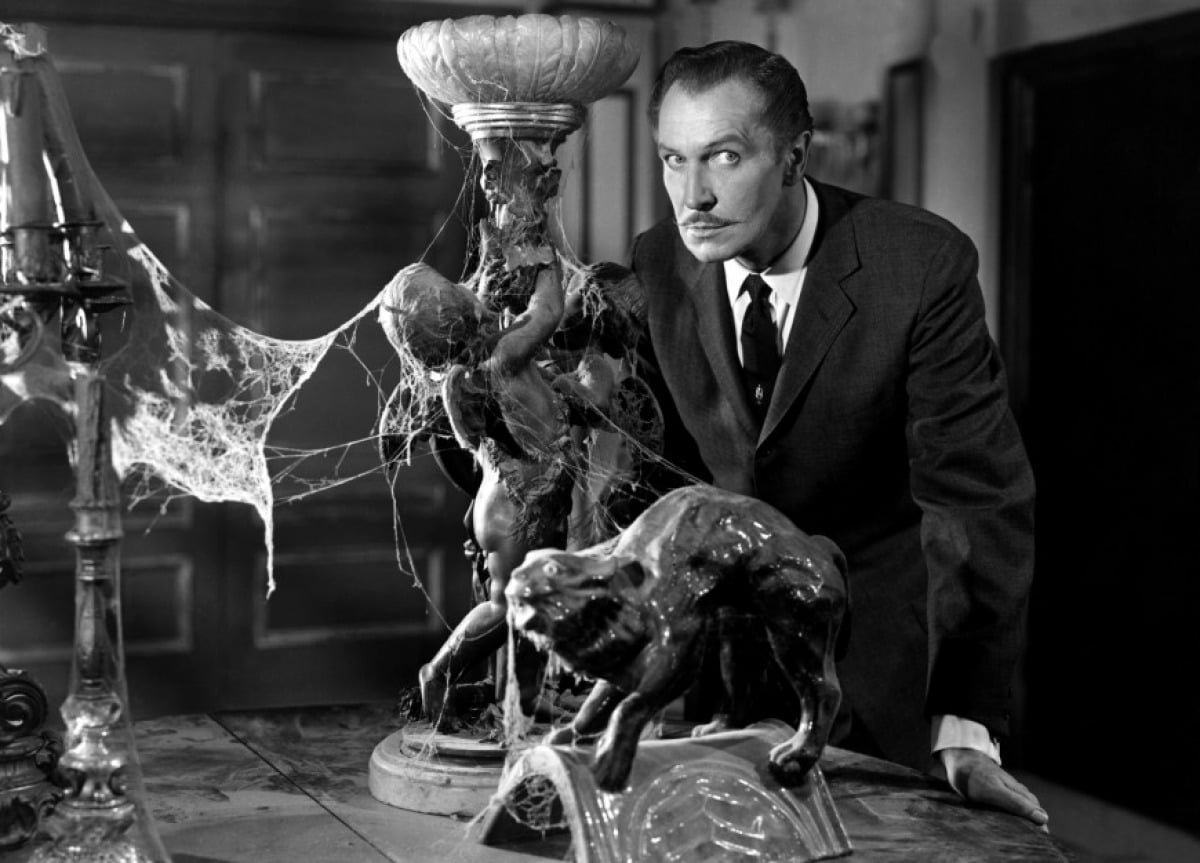
Vincent Price clearly relishes his part as a sociopathic millionaire in “House on Haunted Hill” (1959), oozing disdain for his equally contemptuous spouse and distributing macabre party favors to his guests: tiny coffins with pistols inside! In kind, we’ll savor our discussion of the film, though perhaps with a little less polish, on the next “Roy’s Tie Dye Sci Corner.”
This Halloween camp classic was the brainchild of William Castle. Castle was notorious for spicing up his B-movie entertainments with in-theater gimmickry, like wiring seats for electricity, including breaks so that audiences can pass judgment on a villain or scream away monsters, and issuing $1,000 life insurance policies in case anyone should die of fright. For “House on Haunted Hill,” a skeleton was sent hurtling over the audience at a key moment in a technique he dubbed “Emergo.”
The film’s disproportionate success is said to have caught the notice of Alfred Hitchcock and inspired Hitch to undertake his own low-budget black-and-white thriller, “Psycho.” At a lean 75 minutes, “House on Haunted Hill” never outstays its chilly welcome.
Roy and I will be haunted housesitting and swapping acid remarks on the next Roy’s Tie-Dye Sci-Fi Corner. Lend us a little rope in the comments section, as we livestream on Facebook, this Friday evening at 7:00 EDT!
What are the odds of two horror icons being born on the same day? It’s like Jascha Heifetz and Fritz Kreisler sharing a birthday (February 2), or Ferruccio Busoni and Sergei Rachmaninoff (April 1). Today is the birthday of both Vincent Price (1911-1993) and Christopher Lee (born 1922).
Though he’d been a professional actor since the 1930s (he appeared as Sir Walter Raleigh in “The Private Lives of Elizabeth and Essex,” with Bette Davis and Errol Flynn, in 1939), Price settled into the horror genre in the 1950s, with films like “House of Wax,” “The Fly,” “The House on Haunted Hill,” and “The Tingler.”
In the 1960s, he became closely associated with Roger Corman, appearing in a series of films loosely inspired by the stories of Edgar Allan Poe.
Of course, he turned in great performances in a number of extra-genre classics, such as “Laura,” “The Baron of Arizona,” and the rib-tickling “Champagne for Caesar,” but he will always be remembered as Prince Prospero, Dr. Phibes and the narrator on Michael Jackson’s “Thriller.”
He was an actor blessed with campy self-awareness (though he could dial it down when required), and he was quick to capitalize on both his image and his indelible voice.
Though he too has played a broad range of roles over the course of a career which has spanned more than six decades, Christopher Lee will always be linked to the Hammer Studios horror explosion of the 1950s and ‘60s. Younger fans will recognize him as Count Dooku, from the even more horrid “Star Wars” prequel trilogy, and as the turncoat wizard Saruman, in Peter Jackson’s self-indulgent “The Lord of the Rings.”
When Lee determined to become an actor, his plan was to model himself on Conrad Veidt, the German Expressionist icon who had created Cesare the Somnambulist in “The Cabinet of Doctor Caligari” and later played a string of refined though despicable Nazis – notably Major Strasser in “Casablanca” – in Warner Brothers films of the 1940s.
Lee’s imposing stature and bass-baritone voice make him a natural for screen villainy – though some of my favorite Lee roles are heroic (for instance, that of the Duke de Richelieu, the gentleman occultist who matches wits with a band of Satanists in “The Devil Rides Out”).
Thankfully, at 92, Lee is still very much with us, with recent appearances in “The Hobbit,” Martin Scorsese’s “Hugo,” and Tim Burton’s “Alice in Wonderland.”
Fun fact: it had at one point been Lee’s ambition to become an opera singer. In fact, it was Jussi Björling who recommended Lee audition for the Swedish Opera. Lee did just that and was accepted. Unfortunately, he was unable to afford the training, but whenever he filmed in Scandinavia, he made it a point to go slumming with Swedish amateur companies under an assumed name.
His singing talent has been sinfully underutilized on film, though he does get to belt out a couple of numbers in “The Return of Captain Invincible,” also starring Alan Arkin. The film, with songs by the composer and lyricist of “The Rocky Horror Picture Show,” was widely panned.
Happy birthday, Vincent Price and Christopher Lee!
Lee in “The Return of Captain Invincible:”
Price playing Mendelssohn’s “The War March of the Priests” in “The Abominable Dr. Phibes:”