Last year on St. Patrick’s Day, I posted some thoughts on John Ford’s perennial classic, “The Quiet Man” (1952), and Maurice Walsh’s book, “Green Rushes” (1935), the collection of stories – really a novel, as all the stories are interconnected – that inspired it. I finally got around to reading it in a reissue, as “The Quiet Man and Other Stories,” after having had it in my library for 30 years.
Toward the end of the post, I mentioned a forthcoming musical, based on another Walsh novel, “Castle Gillian” (1948). (An earlier musical based on “The Quiet Man,” “Donnybrook,” tanked in 1960.) Well, it appears “Castle Gillian” is upon us, and it looks like one freaky, virtual reality uncanny valley. To borrow from the title of yet another one of Walsh’s books, trouble in the glen, indeed!
This is another one of those books I’ve had in my library for 30 years. I finally took it down to read it as part of my St. Patrick’s Day celebrations. Last year, I had it out, thinking I’d read just the title story, but then time got away from me (again), and I figured I’d save it for 2023, hoping to read the entire collection. And I’m glad I did. Because if you read just “The Quiet Man,” you’re not getting the full story.
First of all, the 1952 John Ford classic, starring John Wayne and Maureen O’Hara, is one of my favorite movies. If you’re put off by Wayne, thinking this going to be like one of his westerns (many of which I’ve also grown to love), give it a shot. I think you’ll really enjoy it. It’s full of whimsy, with a colorful supporting cast of memorable character actors. I’m sure there are some Irish who are worn out on the stereotypes, and maybe millennials, if they ever watch anything made before 1980, who would be appalled at the treatment of O’Hara’s Mary Kate; but if you meet it on its own terms, I find it very hard to believe it won’t charm your emerald socks off. I try to watch it every St. Patrick’s Day over several pints of Guinness. (One of these days I’ll have to write about “The Quiet Man” Drinking Game, if I haven’t done so already.)
But this is not a review of the movie, and if you’ve read this far, you are probably of an age that it would already be familiar to you in any case, so I’ll get to the matter at hand.
Maurice Walsh’s “The Quiet Man and Other Stories” – retitled, because of the success of the film, from “Green Rushes” – has very little in common with Ford’s adaptation. In fact, any reader who picks it up expecting the porter-fueled hilarity of that leprechaun incarnate Barry Fitzgerald is in for a shock. Because Walsh’s original tales, set during and after the Black-and-Tan War, all deal with the IRA, men and women (and the oblique manner in which they sometimes communicate), and the pleasures of fishing. It’s small wonder that Hemingway was an admirer. These stories are nothing at all like the film version, but I’d be lying if I said they weren’t fascinating. And very well written, in the manner of the day. (Walsh was one of Ireland’s bestselling authors of the 1930s.) The prose is evocative without entirely tipping its hand, so that there’s plenty to be gleaned from reading between the lines.
Basically, the screenwriters took the premise of the title short story and a couple of lines of dialogue (surely no more than two or three), and then just went with their own thing. It is amusing and disorienting to discover that many of the characters look and behave quite differently than they do in the film. Michaleen Oge Flynn is Mickeen Oge Flynn in the stories and, beyond his fondness for a pipe and his involvement with the IRA (quite subtle in the film), by no stretch of the imagination is he anything like Barry Fitzgerald.
There is no Sean Thornton. In the book, he’s Paddy Bawn Enright – named after one of Walsh’s real-life field hands – and his dark, squat-but-powerful, heavy-browed character does not in any way resemble John Wayne. Closer is Art O’Connor, an Irish-American who comes to Ireland, he says, for the fishing. Mary Kate Danaher, the Maureen O’Hara character, is Ellen Roe Danaher in the book. She’s given a lot more to do in the movie. In fact, the only character I can think of that is pretty much the same on the page as he is on the screen is Red Will Danaher, the hard-headed, closed-fisted slab of beef played by Victor McLaglen.
The primary reason I am thankful for not having simply read the title story, apart from the rest, is that the tales all interlock. The book is more like a novel, in which we learn more about the characters and events with each successive story. Moreover, the stories in themselves are like novellas, subdivided into chapters. There is nothing twee about them. The tone more realistic than fey (although there is a ghost); the stories are serious, but not without flashes of wit. Come to think of it, they all turn out to be love stories, in their understated way. And the rhythms are unmistakably Irish.
The prologue sends ripples across the rest of the book. By the end, I was compelled to go back and reread the beginning, as it wound up having more of a bearing on the conclusion than I previously anticipated. Also, the significance of the original title, “Green Rushes,” is only apparent from the final pages.
In 1954, flush with the success of “The Quiet Man,” Republic Pictures optioned another Walsh story to be made into a film, “Trouble in the Glen.” It reassembled the producers, screenwriters, composer (Victor Young), and some of the crew involved with the previous picture, which was nominated for seven Academy Awards and won two (including a Best Director Oscar for Ford), hoping to recapture some of that Celtic whimsy, though this time transplanted to Scotland. Victor McLaglen returns, but Forrest Tucker steps in for John Wayne, and Orson Welles, who previously adapted and starred in “Macbeth,” plays a Scottish laird.
Alas, Ford was notably absent, and the film was not a success. In fact, Walsh was so depressed by the result that he vowed never to have any more of his books made into films.
I recall, many years ago, my friendly neighborhood video shop had a copy of “Trouble in the Glen” on VHS, but I never got around to renting it. The box had a picture of Tucker beating the tar out of McLaglen, in true “Quiet Man” fashion. For some reason, the film doesn’t appear to be available for streaming anywhere online, but you can watch a couple of clips at the link below. In particular, the opening credits hew closely to those for “The Quiet Man,” right down to Victor Young’s score.
Interestingly, I learn even as I write this that a stage musical, “Castle Gillian,” is supposedly in development, based on another one of Walsh’s books. A musical of “The Quiet Man,” called “Donnybrook,” was produced in 1960, but flopped.
At any rate, if it sounds appealing, and you can find a copy, you might consider giving Walsh’s “The Quiet Man and Other Stories” (or “Green Rushes”) a whirl. I picked mine up off a remainder table at Borders bookstore back in the early ‘90s. My library is full of books purchased over the past 40 years that I have not read and I am very glad not to have traded them off or sold them outright! But what’s the purpose of a library, if not to stock it with future dreams and hidden treasures?
June 16 is Bloomsday, the date on which the events in James Joyce’s novel “Ulysses” are supposed to have taken place in 1904. The day is marked by celebrations world-wide, as Joyceans get together to reenact, eat, play music, drink and of course read.
I have been semi-secretly trying to work my way through Joyce’s magnum opus for the past nine months, which is why I have not been posting very much about books, an aspect of myself I had intended to share as part of the purpose of this page. I am generally a fairly prolific reader.
I say semi-secretly, because I always found “Ulysses” to be an extraordinarily pretentious book, and I’d rather walk around with it in a brown paper bag than come across as the kind of person who would flaunt that he is reading “Ulysses.”
Joyce inspires in me, as I’m sure he does in many, an uncomfortable mix of admiration and annoyance. I suppose, in the lexicon of the day, we are frenemies. Do I think he was a genius, as many assert? No. Do I think he was an extraordinarily clever man, who worked very hard to achieve his vision? Yes – though I don’t claim to be an authority on the matter. There’s no questioning his talent.
This is my third crack at “Ulysses,” which I had attempted for the first time in high school. This time I’ve had assistance in the form of ample notes and an enlightening seminar at the Rosenbach Museum & Library in Philadelphia. I think I do have a better understanding of Joyce’s purpose, thanks to the Rosenbach’s excellent instructor, Carol Loeb Schloss, who will be taking up her new post at the University of Pennsylvania in the fall. That said, I still find Joyce to be infuriating, at times, though I have to admit my fury is now tempered with respect.
I always wondered, how could Joyce betray the exquisite prose he produced in “The Dubliners,” with its beautiful story, “The Dead,” for the inscrutable hieroglyphs of his later work? It’s been years since I’ve read “The Dead,” but it is so powerful, it has stayed with me. I may re-read it tomorrow, to mark the 100th anniversary of “The Dubliners,” which was published on June 17, 1914.
I have dabbled in other readings alongside “Ulysses” to take a break from the grind. For as impressive a puzzle as the book can be, the truth is, for me anyway, it is not very compelling. There is nothing in it to make you want to pick it up again. Undoubtedly, there are those would disagree. However, when I do pick it up, there is also plenty of cleverness to admire, until I’ve had my surfeit of cleverness at the expense of pleasure.
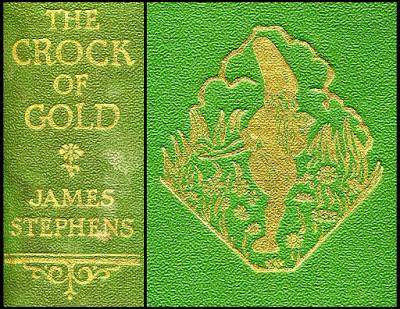
One of the side-readings I’ve escaped to also happens to be one of my favorite books, “The Crock of Gold,” by Joyce’s fellow Dubliner James Stephens. This is my third reading of “Crock,” which unlike “Ulysses” I never feel the urge to hurl across the room.
Stephens shares with Joyce a virtuosic mastery of language, but his primary concern is to entertain, inspire warmth through his insights into the human condition, and even to make the reader laugh, which he does so frequently. If you’re a person, like me, for whom a staggering accretion of whimsy and even nonsense can teeter over into profundity, then this is the book for you.
The story concerns two philosophers who live together in the woods with their termagant wives (there is much in the book concerning the complexities of friction and affection between the sexes). One of the philosophers inadvertently gets mixed up with the theft of a crock of gold from a local warren of leprechauns. The leprechauns are furious, but largely hindered in their attempts at revenge, on account of the philosopher’s wife being related to a powerful fairy folk. Creatures of Irish and Classical mythology abound, and the ending is as joyous as a vibrant spring day.
Conveying Stephens’ magic would be impossible without quoting the author himself, whose powers of observation fall somewhere between Mark Twain and Oscar Wilde. He has Twain’s ability to milk a laugh and Wilde’s talent to make the most incongruous observation ring true.
Here’s the enthralling opening:
“IN the centre of the pine wood called Coilla Doraca there lived not long ago two Philosophers. They were wiser than anything else in the world except the Salmon who lies in the pool of Glyn Cagny into which the nuts of knowledge fall from the hazel bush on its bank. He, of course, is the most profound of living creatures, but the two Philosophers are next to him in wisdom. Their faces looked as though they were made of parchment, there was ink under their nails, and every difficulty that was submitted to them, even by women, they were able to instantly resolve. The Grey Woman of Dun Gortin and the Thin Woman of Inis Magrath asked them the three questions which nobody had ever been able to answer, and they were able to answer them. That was how they obtained the enmity of these two women which is more valuable than the friendship of angels. The Grey Woman and the Thin Woman were so incensed at being answered that they married the two Philosophers in order to be able to pinch them in bed, but the skins of the Philosophers were so thick that they did not know they were being pinched. They repaid the fury of the women with such tender affection that these vicious creatures almost expired of chagrin, and once, in a very ecstasy of exasperation, after having been kissed by their husbands, they uttered the fourteen hundred maledictions which comprised their wisdom, and these were learned by the Philosophers who thus became even wiser than before.”
If the sexism rankles, well, there’s plenty of sexism by today’s standards, but none of it is mean-spirited and the women get plenty of moments to shine. It’s as if the book were written by the world’s most mischievous couple’s therapist.
Here’s a characteristic example of Stephens’ philosophical free association, from much later in the book:
“She taught that a man must hate all women before he is able to love a woman, but that he is at liberty, or rather he is under express command, to love all men because they are of his kind. Women also should love all other women as themselves, and they should hate all men but one man only, and him they should seek to turn into a woman, because women, by the order of their beings, must be either tyrants or slaves, and it is better they should be tyrants than slaves. She explained that between men and women there exists a state of unremitting warfare, and that the endeavour of each sex is to bring the other to subjection; but that women are possessed by a demon called Pity which severely handicaps their battle and perpetually gives victory to the male, who is thus constantly rescued on the very ridges of defeat. She said to Seumas that his fatal day would dawn when he loved a woman, because he would sacrifice his destiny to her caprice, and she begged him for love of her to beware of all that twisty sex. To Brigid she revealed that a woman’s terrible day is upon her when she knows that a man loves her, for a man in love submits only to a woman, a partial, individual and temporary submission, but a woman who is loved surrenders more fully to the very god of love himself, and so she becomes a slave, and is not alone deprived of her personal liberty, but is even infected in her mental processes by this crafty obsession. The fates work for man, and therefore, she averred, woman must be victorious, for those who dare to war against the gods are already assured of victory: this being the law of life, that only the weak shall conquer. The limit of strength is petrifaction and immobility, but there is no limit to weakness, and cunning or fluidity is its counsellor. For these reasons, and in order that life might not cease, women should seek to turn their husbands into women; then they would be tyrants and their husbands would be slaves, and life would be renewed for a further period.”
When recommending “The Crock of Gold,” I often add that the prose contains enough quotable material to fill a small Bartlett’s.
Joyce, who was a superstitious man, made Stephens, his friend, whom he believed was born in Dublin on the same date (they were actually born a week apart), promise that if he were to die before the completion of the task, that Stephens would take up the manuscript of “Finnegan’s Wake.” The two writers couldn’t be more different, but that’s how much Joyce believed in Stephens’ ability (or at any rate, how much he trusted in providence).
Because of my love of “The Crock of Gold,” I have hunted down and read many of Stephens’ other books, all in the days before the internet would have made such a search a snap. It’s inconceivable to me that he is now almost completely forgotten, except perhaps as a footnote to scholars of Irish literature. Walk into an Irish pub, and there will be pictures of Wilde and George Bernard Shaw, for crying out loud, before you will find one of James Stephens, who is one of the most Irish of writers.
That said, none of his other books quite recapture the magic of “The Crock of Gold.” If memory serves, “Deirdre” and “Irish Fairy Tales” share characteristics, but other books, like “Mary, Mary” (a.k.a. “The Charwoman’s Daughter”), are wistful, charming snapshots of domestic life. Stephens was also involved in the Irish nationalist movement and wrote about the Easter Rising of 1916 (“The Insurrection in Dublin”), at which he was present. I realize now I haven’t read any of these books in years.
I see “The Crock of Gold” was reprinted only last month by John Murray. I can’t vouch for the quality of the reissue. If you’re able to get a hold of a second-hand copy of a cloth edition with the color plates by Thomas Mackenzie, you’d be doing yourself a favor. (Arthur Rackham was originally assigned, but died before he could undertake the project.) Evocative woodcuts also open each chapter in the better editions. Do NOT read this as an e-book.
“The Crock of Gold” was actually quite popular in its day. Stephens was equally well-known as a poet, and you may encounter some of his verse from time to time in older anthologies. Truthfully, his prose is as poetic as anything written in stanzaic form.
Samuel Barber set some of the poems as songs. Here is “The Coolin” from Barber’s choral work, “Reincarnations.”