Although he recorded extensively as a soloist for Columbia Records (now Sony Classical), his career as a concert pianist never really seemed to catch fire. Or perhaps I should say, he never captured the public’s imagination quite to the extent of some of his more publicity-friendly contemporaries. This was certainly not for lack of skill or interpretive depth. He just wasn’t interested in playing the fame game. It could be argued that Eugene Istomin found his most comfortable fit away from the spotlight, as a conversational performer and equal voice in one the premier chamber ensembles of his time.
With violinist Isaac Stern and cellist Leonard Rose – as the Istomin-Stern-Rose Trio – he really seemed to find his niche. The trio was an unlikely creation, an all-star ensemble greater than the sum of its parts. And its parts were pretty great. All three musicians were known quantities, “name” soloists who worked very hard to shed their larger-than-life predilections and explore a shared intimacy in chamber music of the masters. Their recordings of the complete Beethoven piano trios, in particular, a Grammy Award winner in 1970, is still highly regarded. Too bad they couldn’t come up with a catchier name for the group.
On his own, Istomin, a contemporary of Leon Fleisher and Gary Graffman, never seemed to excite the way the other two pianists did. This, despite professional associations with Eugene Ormandy, Bruno Walter, Leonard Bernstein, Fritz Reiner, George Szell, Leopold Stokowski, and Pablo Casals. (Istomin later married Casals’ widow.) For one thing, he was more interested in the Viennese classics than he was the Russian showpieces that set audiences aflame. Not that he didn’t love those too. His recording of the Rachmaninoff 2nd with Ormandy and the Philadelphia Orchestra demonstrates that, when he wanted to be, he could be very much the virtuoso. Of course, Fleisher and Graffman’s careers were curtailed by focal dystonia, a repetitive stress malady that effects the fingers and is all-too-common among hard-driving classical performers, with their unforgiving practice regimens.
Istomin had, by his own admission, “pretentious” tastes. He was interested in the music he was interested in, even if it didn’t fit the paradigm of what critics thought he should be tackling at a given stage of his career. (Surely, he was too young to be playing Beethoven and Brahms. This is the time he should be playing Tchaikovsky and Rachmaninoff!) He was also an avid reader and a book collector, at one point hired by Harcourt Brace Jovanovich as an advisor on the publication of facsimile editions of works by Joseph Conrad, Thomas Hardy, and others.
Yet he also had a common touch. An ardent fan of the Detroit Tigers, he toured the Midwest with a twelve-ton truck full of his own Steinway pianos. He wanted to be sure to make the music he loved available to the people.
It’s said that his relationship with Rose, who could be touchy and unforgiving even under the best of circumstances, was damaged when Istomin maneuvered behind the scenes with Columbia to get a shot at a concerto recording at a time when he was supposed to be documenting all the Beethoven sonatas for violin and cello with his companions in the trio. The fact that these were left incomplete because of the resulting rift with the label left Rose with a festering resentment. But nothing was simple between Rose and Istomin. They suited one another perfectly, playing together beautifully, as long as they kept their mouths shut. But they also held very strong convictions and weren’t shy about expressing them. Clearly, they remained intimates, but Rose carried hard feelings over the Beethoven debacle for the rest of his life.
Unquestionably, Istomin found depth in the Viennese masters and fire in the Russians, but it was always on his own terms. He also commissioned and performed works by living composers, including Roger Sessions (his piano concerto), Henri Dutilleux, and Ned Rorem. Again, Istomin was more interested in the substance of music-making than in the publicity machine.
Like Josephine Baker and Jerry Lewis, it’s possible he found greater appreciation in France, where he was the recipient of the Légion d’honneur in 2001.
Istomin died in 2003, 16 days before his 78th birthday. He was a terrific pianist, if perhaps not the most enduringly famous. Remembering him today, with gratitude, on the 100th anniversary of his birth.
Tag: Isaac Stern
-

100 Years and 88 Keys of Eugene Istomin
-
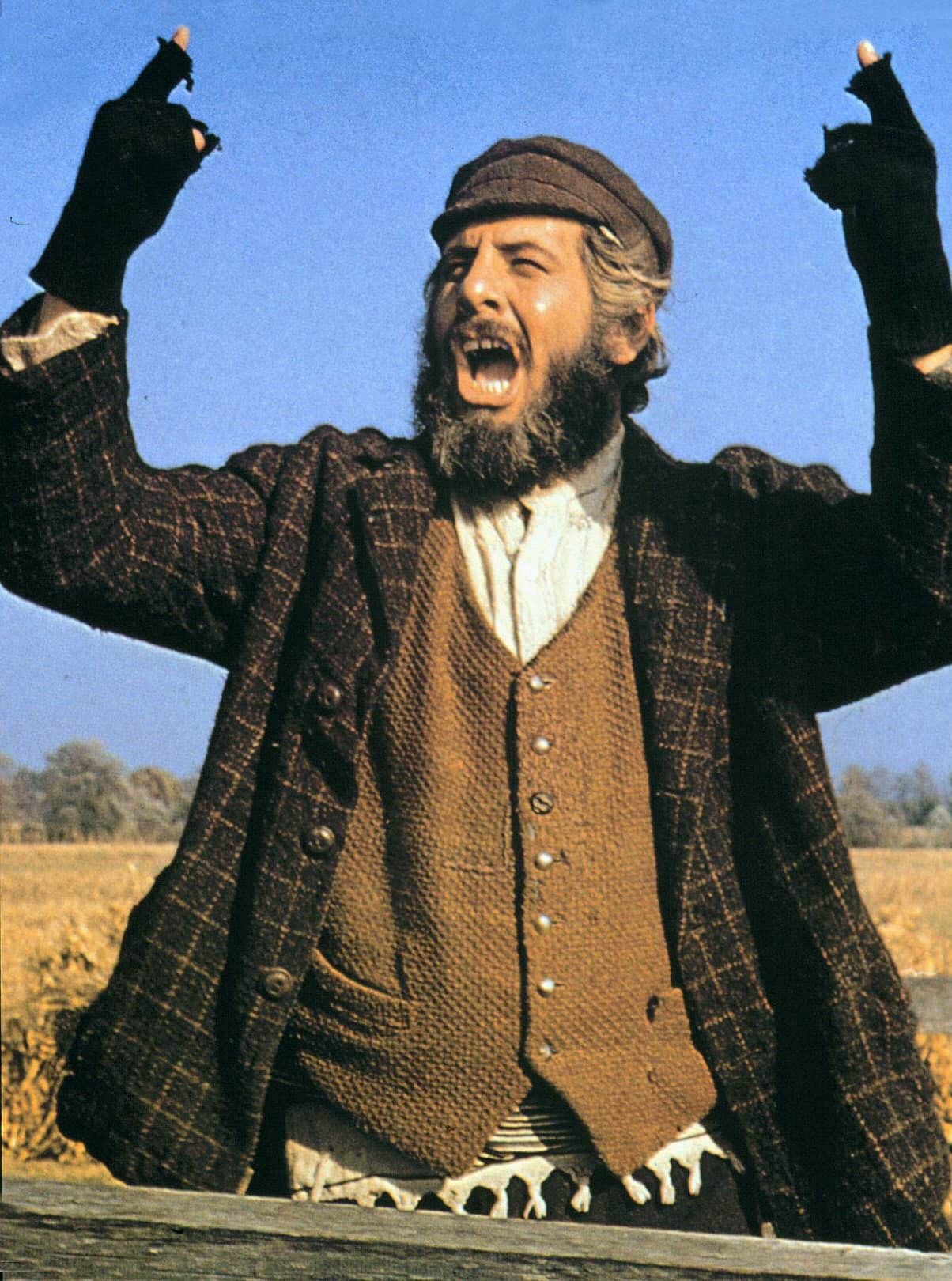
Remembering Topol Fiddler on the Roof Legend
In case you didn’t know, in the film version of “Fiddler on the Roof,” that’s Isaac Stern on the soundtrack, standing in for the titular musician. John Williams won his first Oscar for his adaptations and musical arrangements of the immortal songs of Jerry Bock and Sheldon Harnick. Zero Mostel created the role of Tevye, but for many the role was owned by Topol. With the acclaimed film version and numerous stage revivals, he was every bit as much Tevye as Yul was the King.
In the past few years, there have been rumblings about a film remake. Why? No doubt some studio executive at Metro-Goldwyn-Mayer, musing as Tevye did…
Topol died this morning at 87. R.I.P.
Isaac Stern
You can really hear John Williams’ influence here
Do You Love Me?
Tradition!
-

Isaac Stern a Centennial Celebration
A not-so-stern birthday observance for Isaac Stern, born 102 years ago today. The great violinist’s hands can be seen in the film “Humoresque” (1947), whenever John Garfield’s character “plays.”
Franz Waxman’s “Carmen Fantasie,” written for the film, took on a life of its own. Not surprisingly, Stern remained a champion of the piece.
He also appeared on the soundtrack of the film version of “Fiddler on the Roof” (1971), playing John Williams’ arrangements. No doubt his contributions helped Williams earn his first Oscar.
A decade later, a documentary about his trip to China, “From Mao to Mozart” (1979), won an Academy Award for Best Documentary Feature.
https://www.youtube.com/watch?v=SlDJ2aE7iGs
Of course, Stern’s impact ranged far beyond the silver screen. He was a prolific recording artist and kingmaker who held an enormous influence over other concert artist’s careers – many for the better, some for the worse.
Most famously, he is credited with having saved Carnegie Hall from the wrecking ball in 1960. Sure, it cost New York a parking lot, but the city seems to have done all right without it.
Happy birthday, Isaac Stern.
The Istomin-Stern-Rose Trio in music by Franz Schubert
Stern plays Bach
Stern plays Barber
Stern on “The Jack Benny Program”
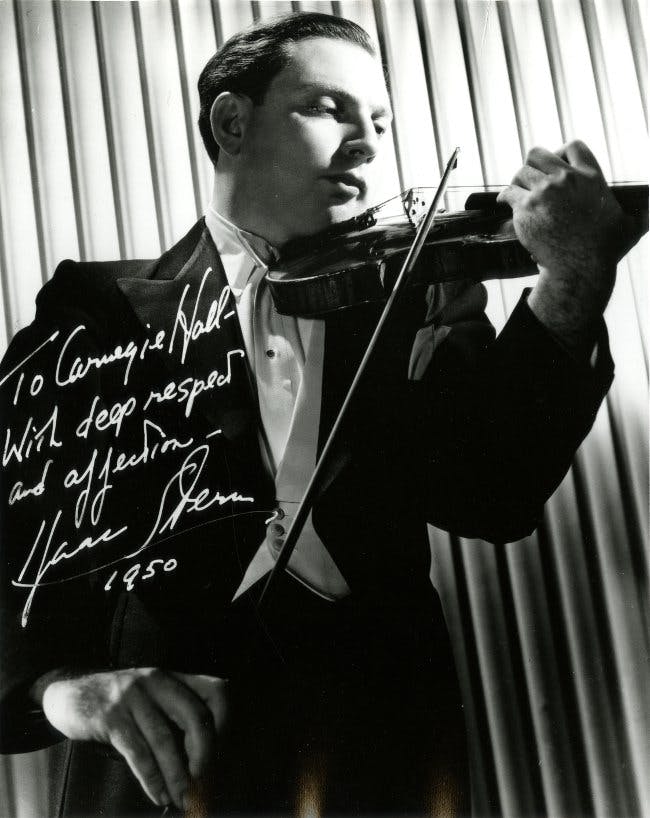
Stern in a photo inscribed to Carnegie Hall, ten years before he rescued it from demolition
-
Isaac Stern A Life in Music
On the 100th anniversary of his birth, here’s “Isaac Stern, Life’s Virtuoso,” a documentary that aired on PBS’ “American Masters,” back in the year 2000. The narrator is Meryl Streep.
I believe that’s Franz Waxman at the piano behind the end credits. Stern worked with Waxman on the Joan Crawford-John Garfield melodrama “Humoresque” (for which Waxman arranged his “Carmen Fantasy”). Stern’s hands can be seen in the film whenever Garfield’s character plays.
https://www.youtube.com/watch?v=RiqroKOZzpw
The Istomin-Stern-Rose Trio in music by Franz Schubert:
Stern plays Bach:
Stern plays Barber:
Stern on “The Jack Benny Program”:
Stern in a photo inscribed to Carnegie Hall, an institution he would save from the wrecking ball ten years later.
-

Jack Benny Violinist Comedian or Virtuoso?
How good a violinist was Jack Benny? Allegedly a competent one, the owner of a Stradivarius, who mined the comedic potential of “bad playing.”
Benny in duet with 12 year-old Talia Marcus:
Later, he repeats the gag with a young Dylana Jenson, who went on to make that classic record of the Sibelius concerto with Ormandy and the Philadelphia Orchestra.
https://www.youtube.com/watch?v=DdQa-TaQvPs
Benny with Jascha Heifetz (radio):
Benny episode (television) featuring Isaac Stern and “Man of 1000 Voices” Mel Blanc as Benny’s music teacher. Note how Blanc’s characterization morphs into Yosemite Sam in moments of pique.
Benny and Stern play Bach at Carnegie Hall to raise money for American symphony orchestras:
Jack Benny Fiddles with the Classics:
Dylana Jenson plays the Sibelius concerto at the old Academy of Music in Philadelphia. Norman Carol is the concertmaster. Ormandy conducts. The RCA recording, made under studio conditions, was issued shortly after.
Tag Cloud
Aaron Copland (94) Beethoven (95) Composer (114) Film Music (149) Film Score (143) Film Scores (255) Halloween (97) John Williams (197) KWAX (232) Leonard Bernstein (105) Marlboro Music Festival (125) Movie Music (164) Mozart (91) Opera (215) Philadelphia Orchestra (90) Picture Perfect (174) Princeton Symphony Orchestra (110) Radio (90) Ross Amico (244) Roy's Tie-Dye Sci-Fi Corner (290) The Classical Network (101) The Lost Chord (269) Vaughan Williams (107) WPRB (397) WWFM (881)