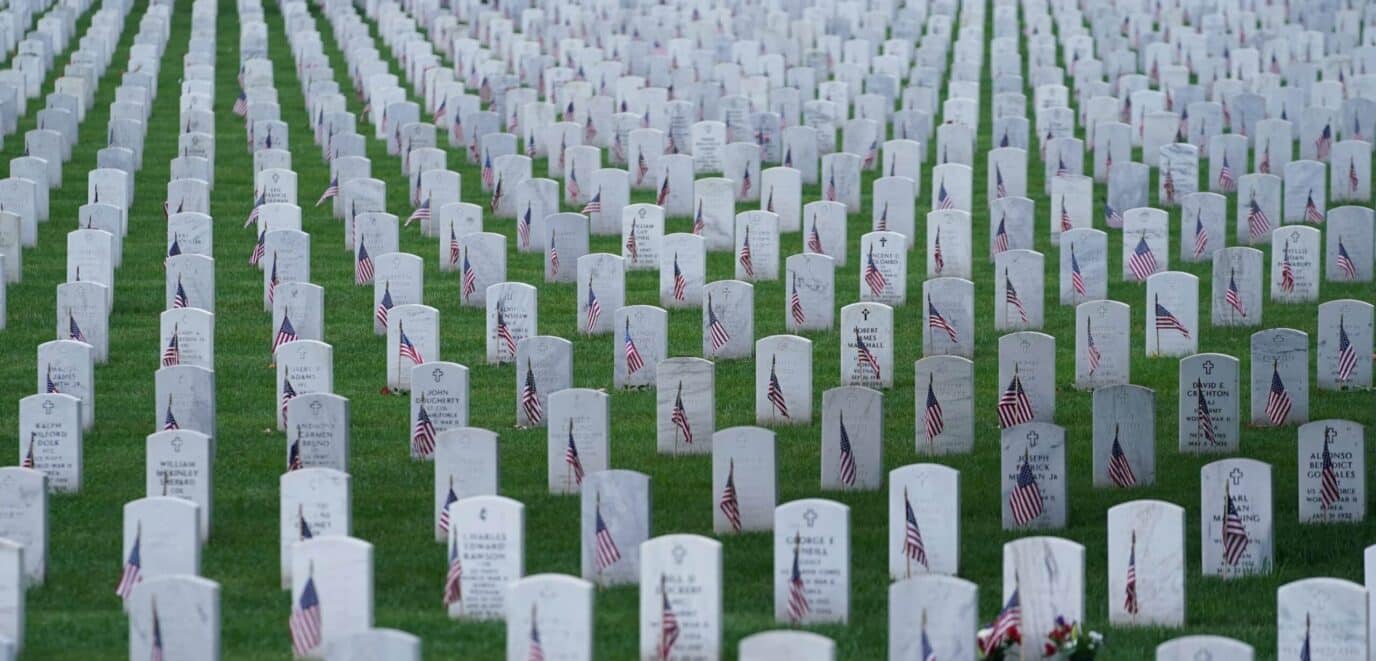
To a great many, Memorial Day is the unofficial start of summer, a time for picnics and trips to the shore, for Hollywood to flood the multiplexes with soulless blockbusters, a signifier of the end of school, and the beginning of three long, lazy months of way too much daylight.
But it didn’t always bear those associations. The precursor of Memorial Day was Decoration Day, first widely observed in 1868, to honor and remember those who died in the Civil War. It was a time for decorating graves, making solemn speeches, and marching in parades. These customs metamorphosed to the point where, after World War I, Memorial Day was seen as an occasion to honor those who died in ALL American wars.
Regardless of how one may perceive armed conflict, of whether any given war may be called just or unjust, it is not war itself or conflict in general that is being celebrated. Rather, it is the sacrifice of those who died in defense of a larger cause, and ostensibly that cause has been for the common good.
One would think, were one an idealist, that by this stage of our collective development, when any disruption in the global fabric obviously effects all of us, that wars would be considered obsolete. But sadly, human nature being what it is, there will probably always be reasons to remember.
This week on “The Lost Chord,” we’ll salute those who made the ultimate sacrifice, by listening to three works commemorating the dead of World War II, including “For the Fallen,” a berceuse for orchestra by Bernard Herrmann; Aaron Copland’s Violin Sonata, dedicated to Lt. Larry H. Dunham, who was killed in the Pacific in 1943; and the peace cantata “A Time for Remembrance,” by John Duffy.
Duffy himself was a World War II veteran, who lied about his age when enlisting. He became part of the Amphibious Scouts and Raiders, forerunners to the Navy SEALs, before deploying on the USS Hopping, a destroyer escort in the Pacific. His duties included detonating Japanese mines by shooting them from ship deck. When his ship took fire from shore batteries at Okinawa, the sailor standing next to him was killed. Duffy had to stand guard over the dead man’s body until burial at sea in the morning. That night watch determined the course of his life. “Since our time is so fleeting and unpredictable,” he later commented, “I knew I had to dedicate my life to music.”
War is no picnic. I hope you’ll join me for “Requiescat in pace,” on “The Lost Chord,” now in syndication on KWAX Classical Oregon.
——–
Clip and save the start times for all three of my recorded shows:
PICTURE PERFECT, the movie music show – Friday at 8:00 PM EDT/5:00 PM PDT
SWEETNESS AND LIGHT, the light music program – Saturday at 11:00 AM EDT/8:00 AM PDT
THE LOST CHORD, unusual and neglected rep – Saturday at 7:00 PM EDT/4:00 PM PDT
Stream them, wherever you are, at the link!
https://kwax.uoregon.edu
——–
John Duffy on his war experiences and his decision to become a composer:
Tag: John Duffy
-
No Picnic: “Requiescat in pace” on “The Lost Chord”
-

Remembering Pearl Harbor with John Duffy
In 1997, I was sitting behind the desk in my bookshop in Philadelphia, when an older couple wandered in. The man was evidently careful about his movements, understandable, even under the best of circumstances, since one had to navigate a foyer with some stairs and then usually a dog when entering the space.
After some time browsing, they approached the desk, and the man asked to see a piece of ephemera he noticed, a booklet on the composer and critic Virgil Thomson, that I had on low shelf beside me, waiting to be priced. This started a conversation, in the course of which it was revealed that he himself was a composer. When he told me his name, he seemed especially gratified that I knew who he was.
But John Duffy’s Emmy Award-winning music for the PBS television documentary “Heritage: Civilization and the Jews” was played quite often on the local classical music station, especially around the Jewish holidays. (Duffy himself was Irish Catholic.) He and I had a lovely exchange, and when he asked me how much I wanted for the book, I told him it was on the house.
The Duffys were in Philadelphia for the premiere of his new opera, “Black Water” (on a libretto by Princeton writer Joyce Carol Oates), at Plays and Players Theater, which was two blocks away from the shop. Perhaps in reciprocation for my generosity, he offered to comp me into the show.
This was on a weekday. At the time, I was working the weekend mornings at WWFM in Trenton-Princeton, so it would be around 1:30 or 2:00 by the time I got back to Philadelphia and found parking on a Saturday or Sunday afternoon.
That Saturday, I returned, and a friend of mine, who regularly sat the store in my absence, said that a kindly old gentleman had stopped by and dropped off something for me. John Duffy had gone to Tower Records and picked me up a copy of his CD “Freedom Works.” It was the only disc in stock that had selections from “Heritage.”
With the CD he left the following note, rendered in a shaky hand:
“Dear Ross: I wanted you to have a copy of FREEDOM WORKS. Tracks 6, 7 & 8 are based on my HERITAGE score. All best, John Duffy
“P.S. I hope you found BLACK WATER absorbing. Thank you for the Thomson book.”
Duffy already appeared unsteady when I met him, when he was only in his early 70s. He suffered from ill health later in life, but he held on until the 2015, reaching the ripe age of 89. He impressed me as an optimistic and gentle soul. In addition to his work as a creative artist, he went out of his way to help others in his field. He was founder and president of Meet the Composer, an organization that initiated countless programs to advance American music, from creation to performance and recordings.
On the same CD he left, with “Three Jewish Portraits” (from “Heritage”), was his Symphony No. 1 and “A Time for Remembrance” – a “peace cantata,” as he subtitled it – commissioned in 1991 by the U.S. government to mark the 50th anniversary of the attack on Pearl Harbor that killed 2,403 Americans, wounded 1,178 others – sailors, soldiers, airmen, marines, and civilians – and precipitated the United States’ entry into World War II. After listening to the music, I promptly added it to my regular repertoire for radio broadcast on December 7.
In his booklet notes, the composer writes that it is “Dedicated to my sister, Agnes Duffy, Ensign, U.S. Navy, Nurse, IN HER MEMORY: and in remembrance of all those who die in war: the men, women, and children killed and maimed at Pearl Harbor; my cousin, Edward Quirk, Machinist’s Mate, USS Shaw; the men entombed in the USS Arizona; those at Hiroshima, Normandy, Bergen-Belsen, and more. MAY PEACE PREVAIL IN THEIR NAMES.”
The texts are taken from a poem by Rupert Brooke, a speech by Franklin Delano Roosevelt, an African American spiritual, and actual letters written by sailors aboard the USS Arizona. On the recording, the performance features James Earl Jones, narrator, Cynthia Clarey, mezzo-soprano, and the Milwaukee Symphony, conducted by Zdenek Macal.
I would love to share it with you here, but the audio comes and goes online. Occasionally somebody will post it somewhere, but after a little while, it will get taken down. I can’t find it streaming anywhere, but perhaps you will have more success, if you really dig. John Duffy is a fairly common name!
Duffy himself lied about his age when enlisting during the war. He became part of the Amphibious Scouts and Raiders, forerunners to the Navy SEALs, before deploying on the USS Hopping, a destroyer escort in the Pacific. His duties included detonating Japanese mines by shooting them from ship deck. When his ship took fire from shore batteries at Okinawa, the sailor standing next to him was killed. Duffy had to stand guard over the dead man’s body until burial at sea in the morning. That night watch determined the course of his life. “Since our time is so fleeting and unpredictable,” he later commented, “I knew I had to dedicate my life to music.”
John Duffy on his own war experiences and his decision to become a composer:
https://www.youtube.com/watch?v=BBerCcmUyw4
-

Remembering War Memorial Day Music
To a great many, Memorial Day is the unofficial start of summer, a time for picnics and trips to the shore, for Hollywood to flood the multiplexes with soulless blockbusters, a signifier of the end of school, and the beginning of three long, lazy months of way too much daylight.
But it didn’t always bear those associations. The precursor of Memorial Day was Decoration Day, first widely observed in 1868, to honor and remember those who died in the Civil War. It was a time for decorating graves, making solemn speeches, and marching in parades. These customs metamorphosed to the point where, after World War I, Memorial Day was seen as an occasion to honor those who died in ALL American wars.
Regardless of how one may perceive armed conflict, of whether any given war may be called just or unjust, it is not war itself or conflict in general that is being celebrated. Rather, it is the sacrifice of those who died in defense of a larger cause, and ostensibly that cause has been for the common good.
One would think, were one an idealist, that by this stage of our collective development, when any disruption in the global fabric obviously effects all of us, that wars would be considered obsolete. But sadly, human nature being what it is, there will probably always be reasons to remember.
This week on “The Lost Chord,” we’ll salute those who made the ultimate sacrifice, by listening to three works commemorating the dead of World War II, including “For the Fallen,” a berceuse for orchestra by Bernard Herrmann; Aaron Copland’s Violin Sonata, dedicated to Lt. Larry H. Dunham, who was killed in the Pacific in 1943; and the peace cantata “A Time for Remembrance,” by John Duffy.
Duffy himself was a World War II veteran, who lied about his age when enlisting. He became part of the Amphibious Scouts and Raiders, forerunners to the Navy SEALs, before deploying on the USS Hopping, a destroyer escort in the Pacific. His duties included detonating Japanese mines by shooting them from ship deck. When his ship took fire from shore batteries at Okinawa, the sailor standing next to him was killed. Duffy had to stand guard over the dead man’s body until burial at sea in the morning. That night watch determined the course of his life. “Since our time is so fleeting and unpredictable,” he later commented, “I knew I had to dedicate my life to music.”
War is no picnic. I hope you’ll join me for “Requiescat in pace,” on “The Lost Chord,” now in syndication on KWAX, the radio station of the University of Oregon.
Here, for your convenience, are the start times for all three of my recorded shows:
PICTURE PERFECT, the movie music show – Friday at 8:00 PM EDT/5:00 PM PDT
SWEETNESS AND LIGHT, the light music program – ALL NEW! – Saturday at 11:00 AM EDT/8:00 AM PDT
THE LOST CHORD, unusual and neglected rep – Saturday at 7:00 PM EDT/4:00 PM PDT
Stream them, wherever you are, at the link:
John Duffy on his war experiences and his decision to become a composer:
-
Pearl Harbor Remembrance & Reflections
The years, they do fly by. It astonishes me how quickly important anniversaries make their laps. I don’t know if it’s because I’ve been doing this for nine years or because I’m now in my late 50s and time really does speed up when you’re older. Not OLD, mind you – for as nice as it would be to pass the days in a rocking chair on the front porch, I’m not collecting my Social Security benefits quite yet – but older.
Furthermore, I have to say, increasingly I am a little intimidated to go back and look at my past posts. For Krampus, for St. Nicholas, and now for Pearl Harbor Day, I sincerely don’t know how I could improve on what I wrote last year, or even the year before. It is daunting to be in competition with oneself!
Especially so, since I’ve been under the weather this week, and it’s difficult to do anything, so I hope you will excuse me for deferring to the more able-bodied Classic Ross Amico of yore for this day that has lived in infamy, as I do take it seriously, even as I puzzle over what has happened to my country in recent decades.
Now is not the time to go too much into it, since the entire point is for me not to overextend myself in my weakened state, but it’s sad that we do not honor the countless Americans who sacrificed so much, both in the service and at home, by walking the walk. “Thank you for your service” is all well and good, but how about earning it by being civil to our neighbors, not treating domestic affairs like they’re a wrestling match, not glorifying violence, bullying, and vengeance, upholding fair-play, extending a helping hand, and doing our best to leave a positive imprint on our communities? We, as citizens of the United States, carry the seeds of our own salvation or destruction. Do we really want to be the ones to accomplish what the Axis could not?
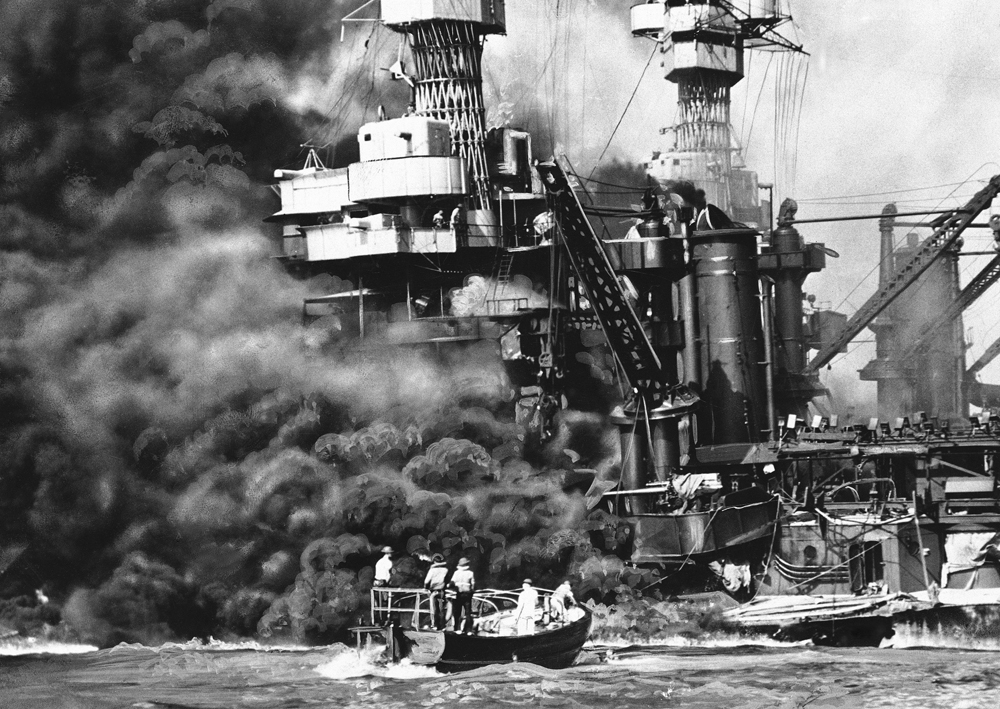
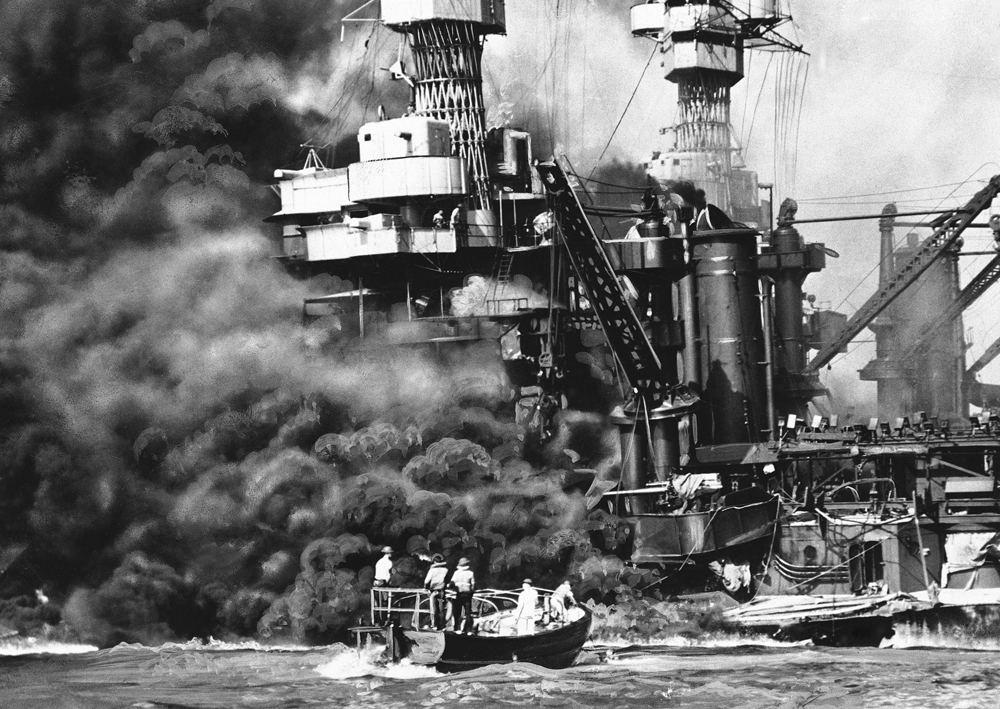
On December 7, 1941, a surprise strike by the Imperial Japanese Navy on the U.S. naval base at Pearl Harbor resulted in 2,403 American deaths, 1,178 wounded, and the United States’ entry into World War II. Sailors, soldiers, airmen, marines, and civilians were among the casualties.
Here is last year’s remembrance of composer John Duffy, who served in the U.S. Navy and had family at Pearl Harbor:
And, from two years ago, my reflections on American Christmas in 1941:
Hopefully, next year I will have the strength, the focus, the fire, and the time to pound out another mini-masterpiece. For today, I’m still getting over a flu and I’ve got a deadline looming.
Dona nobis pacem. Peace on earth, goodwill toward men.
-
Meeting Composer John Duffy in My Bookshop
In 1997, I was sitting behind the desk in my bookshop in Philadelphia, when an older couple wandered in. The man was evidently careful about his movements, understandable, even under the best of circumstances, since one had to navigate a foyer with some stairs and then usually a dog when entering the space.
After some time browsing, they approached the desk, and the man asked to see a piece of ephemera he noticed, a booklet on the composer and critic Virgil Thomson, that I had on low shelf beside me, waiting to be priced. This started a conversation, in the course of which it was revealed that he himself was a composer. When he told me his name, he seemed especially gratified that I knew who he was.
But John Duffy’s Emmy Award-winning music for the PBS television documentary “Heritage: Civilization and the Jews” was played quite often on the local classical music station, especially around the Jewish holidays. (Duffy himself was Irish Catholic.) He and I had a lovely exchange, and when he asked me how much I wanted for the book, I told him it was on the house.
The Duffys were in Philadelphia for the premiere of his new opera, “Black Water” (on a libretto by Princeton writer Joyce Carol Oates), at Plays and Players Theater, which was two blocks away from the shop. Perhaps in reciprocation for my generosity, he offered to comp me into the show.
This was on a weekday. At the time, I was working the weekend mornings at WWFM in Trenton-Princeton, so it would be around 1:30 or 2:00 by the time I got back to Philadelphia and found parking on a Saturday or Sunday afternoon.
That Saturday, I returned, and a friend of mine, who regularly sat the store in my absence, said that a kindly old gentleman had stopped by and dropped off something for me. John Duffy had gone to Tower Records and picked me up a copy of his CD “Freedom Works.” It was the only disc in stock that had selections from “Heritage.”
With the CD he left the following note, rendered in a shaky hand:
“Dear Ross: I wanted you to have a copy of FREEDOM WORKS. Tracks 6, 7 & 8 are based on my HERITAGE score. All best, John Duffy
“P.S. I hope you found BLACK WATER absorbing. Thank you for the Thomson book.”
Duffy already appeared unsteady when I met him, when he was only in his early 70s. He suffered from ill health later in life, but he held on until the 2015, reaching the ripe age of 89. He impressed me as an optimistic and gentle soul. In addition to his work as a creative artist, he went out of his way to help others in his field. He was founder and president of Meet the Composer, an organization that initiated countless programs to advance American music, from creation to performance and recordings.
On the same CD he left, with “Three Jewish Portraits” (from “Heritage”), was his Symphony No. 1 and “A Time for Remembrance” – a “peace cantata,” as he subtitled it – commissioned in 1991 by the U.S. government to mark the 50th anniversary of the attack on Pearl Harbor that killed 2,403 Americans, wounded 1,178 others – sailors, soldiers, airmen, marines, and civilians – and precipitated the United States’ entry into World War II. After listening to the music, I promptly added it to my regular repertoire for radio broadcast on December 7.
In his booklet notes, the composer writes that it is “Dedicated to my sister, Agnes Duffy, Ensign, U.S. Navy, Nurse, IN HER MEMORY: and in remembrance of all those who die in war: the men, women, and children killed and maimed at Pearl Harbor; my cousin, Edward Quirk, Machinist’s Mate, USS Shaw; the men entombed in the USS Arizona; those at Hiroshima, Normandy, Bergen-Belsen, and more. MAY PEACE PREVAIL IN THEIR NAMES.”
The texts are taken from a poem by Rupert Brooke, a speech by Franklin Delano Roosevelt, an African American spiritual, and actual letters written by sailors aboard the USS Arizona. On the recording, the performance features James Earl Jones, narrator, Cynthia Clarey, mezzo-soprano, and the Milwaukee Symphony, conducted by Zdenek Macal. You can listen to it here.
Duffy himself lied about his age when enlisting during the war. He became part of the Amphibious Scouts and Raiders, forerunners to the Navy SEALs, before deploying on the USS Hopping, a destroyer escort in the Pacific. His duties included detonating Japanese mines by shooting them from ship deck. When his ship took fire from shore batteries at Okinawa, the sailor standing next to him was killed. Duffy had to stand guard over the dead man’s body until burial at sea in the morning. That night watch determined the course of his life. “Since our time is so fleeting and unpredictable,” he later commented, “I knew I had to dedicate my life to music.”
John Duffy on his own war experiences and his decision to become a composer:
Tag Cloud
Aaron Copland (94) Beethoven (95) Composer (114) Film Music (149) Film Score (143) Film Scores (255) Halloween (97) John Williams (197) KWAX (232) Leonard Bernstein (105) Marlboro Music Festival (125) Movie Music (164) Mozart (91) Opera (215) Philadelphia Orchestra (90) Picture Perfect (174) Princeton Symphony Orchestra (110) Radio (90) Ross Amico (244) Roy's Tie-Dye Sci-Fi Corner (290) The Classical Network (101) The Lost Chord (269) Vaughan Williams (107) WPRB (397) WWFM (881)