There was a time when Arturo Toscanini was likely the most famous conductor in the United States. In fact, he was one of the most celebrated conductors of the 20th century. His intensity, perfectionism, and alleged fidelity to the score have been enshrined in legend. And when the legend becomes fact, I print the legend.
Toscanini served as music director of La Scala, Milan, the Metropolitan Opera, the New York Philharmonic, and the NBC Symphony Orchestra. He conducted first performances of Puccini’s “La bohème,” Leoncavallo’s “Pagliacci,” Respighi’s “Feste Romane,” and Barber’s “Adagio for Strings.” As a cellist, he played in the world premiere of Verdi’s “Otello.”
From 1937 to 1954, he reached millions of Americans via his weekly broadcast concerts on NBC radio. These originated at Rockefeller Center’s Studio 8-H, now the home of “Saturday Night Live.”
Toscanini was vehemently anti-fascist. He despised Hitler, and vowed never to conduct in Germany as long as “the Führer” remained in power. In Italy, he was beaten up by brownshirts and had his passport confiscated for refusing to conduct “Giovinezza,” the fascist anthem. He also worked closely with violinist Bronislaw Huberman in support of the Palestine Orchestra, made up of Jewish exiles from fascist Europe. He once confided to a friend, “If I were capable of killing a man, I would kill Mussolini.”
Il Duce really caught a break when Toscanini emigrated to America. It sounds to me as if the Maestro could have been borderline more than once. Ironically, for someone who hated dictators, he sure could dish out an autocratic tirade.
Happy birthday, Arturo Toscanini.
Conducting Verdi, “La Forza del Destino Overture” (on film, 1944)
It is ironic that one of the great conductors of opera would be comparatively unsung.
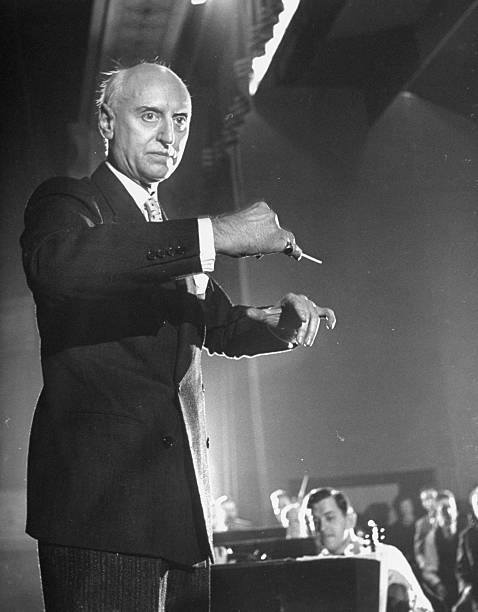
Victor de Sabata is fondly remembered by collectors largely for a single recording – a classic performance of “Tosca” with Maria Callas. The reasons for this have little to do with De Sabata’s merit. De Sabata was a creature of the theater, as opposed to the recording studio. Also, he happened to flourish at a time before the widespread adoption of stereo recording methods. His most cherished recordings were captured on the wing, which might be viewed as something of a mixed blessing. But while few of his performances were preserved under controlled circumstances, what we do have accurately reflects his volcanic temperament in all its terrible glory.
How much awe did De Sabata inspire? Apparently enough that a young Sergiu Celibidache was moved to hide overnight in the Bayreuth bathroom facilities in order to eavesdrop on his rehearsals of “Tristan und Isolde.”
For decades, De Sabata was principal conductor at La Scala. For a time, he was also its artistic director. One observer described his appearance while conducting as a cross between Julius Caesar and Satan. In 1953, a massive heart attack brought all that to an end. “Tosca” was planned to have been the first of a series of recordings for HMV which would have documented much of De Sabata’s operatic repertoire. In the event, he would return to conduct only twice more.
One of these “comebacks” was a molten performance of Giuseppe Verdi’s “Messa da Requiem,” a classic 1954 recording featuring soprano Elisabeth Schwarzkopf, mezzo-soprano Oralia Dominguez, tenor Giuseppe di Stefano, and bass Cesare Siepi. It’s a strikingly broad reading that yet manages to roil and sear.
Like that other titan of the podium, Wilhelm Furtwängler, De Sabata placed more importance on his activities as a composer than as a conductor, which might seem strange to us, given the nature of their respective legacies. There’s a good recording in modern sound of De Sabata’s symphonic poems on the Hyperion label, conducted by Aldo Ceccato. But Hyperion is pretty diligent about taking down unauthorized postings of its material from YouTube. So here’s “Juventus” (“Youth”) conducted by the composer in 1933:
Lorin Maazel conducts “La Notte di Plàton” (“The Night of Plato”)
New to me! Suite No. 2 for Orchestra
Verdi, “I Vespri Siciliani” Overture
Fragment of the Mozart Requiem
Rehearsing Brahms
“Dance of the Seven Veils”
Fly-on-the-wall “Tristan” from 1930
Sibelius!
Immortal “Tosca”
Celibidache remembers De Sabata
Happy birthday, Victor de Sabata, firebrand of the podium!
Aloof. Self-serious. Inordinately proud of his hair. In many ways, he’s like the anti-Yannick. You would never catch him in his workout clothes. Though, come to think of it, it would have been very interesting had Riccardo Muti been music director of the Metropolitan Opera while he held the reins of the Philadelphia Orchestra.
Like there’s not enough drama at the opera.
Muti served as music director at La Scala, one of the world’s most venerable opera houses, for 19 years (from 1986 to 2005). By the end of his tenure, the collective mood of the musicians and administration was as black and thick as a Milanese espresso. Following his departure, he would not set foot in the theater again for eleven years, tensions thawing only for the occasion of his 75th birthday. That was in 2016.
In May of this year, he returned – to lead the Vienna Philharmonic, no less, not the resident orchestra – to mark the 75th anniversary of La Scala’s reopening following World War II. But in-house conflict was still brewing.
When, after the performance, the opera’s current music director, Riccardo Chailly, came to congratulate Muti – to whom he’d lent his own dressing room for the occasion – Muti reacted by telling Chailly to get lost. (More specifically, to “get off my balls.”) At first, those present thought Muti had to be kidding. But he had already eviscerated a television crew, there to document the concert, mistaking them for intrusive journalists, and torn into La Scala’s press officer. Later, he claimed not to have recognized Chailly, because Chailly was wearing a mask.
Don’t ever change, Maestro.
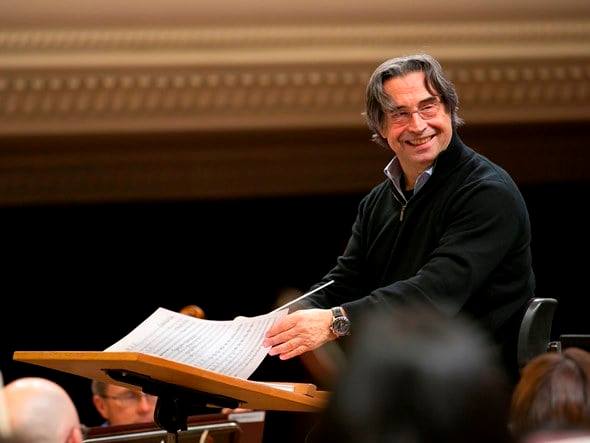
Muti is 80 years old today. If he has mellowed, it is perhaps only in the voltage of his performances. His ego is intact, his temper is in good health, and his hair has lost none of its bounce. And I say this as a Muti “fan.”
This is not an artist without his flaws. There are those who contend that he dismantled the “Philadelphia sound,” cultivated for nearly seven decades by Leopold Stokowski and Eugene Ormandy. A more objective assessment would be that he brought the orchestra up to modern standards of adapting performance practice to suit the given repertoire, as opposed to applying the same overarching technique to, say, Mozart and Mahler.
He certainly didn’t make any friends by dressing down his audience. If someone applauded at the wrong time, he or she would be met with, at the very least, a withering gaze. But it was also not unheard of for him to literally stop a performance to deliver a stern reprimand. I shudder to think how he would have reacted had it been the era of cell phones.
Muti was never accessible or touchy-feely in the manner of Yannick, Philadelphia’s current music director, who has gone out of his way to be the people’s conductor. Dressed down and tattooed. Loquacious. A smile for everyone. Muti maintained the maestro mystique, with a fair amount of old school contempt perched coolly beneath a veneer of civility. There was always something of the aristocrat about him, a high priest ever-alert to the threat of profanation in his Temple of High Art.
Now, nearly four decades later, Muti is one of classical music’s old lions. And I find I can’t help but agree with him on some points regarding the state of the art, as expressed in his interviews. I confess I haven’t really followed his career in Chicago. They seem to love him there. He currently commands the highest salary of any conductor (at roughly $3.5 million per annum).
This has turned out to be a harder-edged post than I intended, certainly more so than the one I wrote a few years ago, on the occasion of Muti’s 76th birthday. I don’t want to give the impression that I am not forever grateful for all the thrilling performances I attended at Philadelphia’s Academy of Music, throughout the 1980s and into the ‘90s. In many ways, for me, these concerts have never been surpassed. Part of it must be attributable to the intimate nature of the hall, since abandoned for the cavernous Kimmel Center for the Performing Arts. At the Academy, Muti was like an uncaged lion in a miniature Coliseum.
Muti wanted his new hall, and it frustrated him no end that it was so long coming. It’s no secret that the delays contributed to his departure from Philadelphia. As with La Scala, there was always the sense that the break was not entirely amicable. If memory serves, he has returned to conduct in Philadelphia only once.
He has his vanities and shortcomings, to be sure, but it is evident he sincerely loves music. And he believes in the integrity of his art. He may not be the greatest conductor since Toscanini, whom he professes to emulate in his claimed deference to “the score.” But in concert, very few of Muti’s performances are museum pieces – or at least they weren’t, in Philadelphia. There was always plenty of passion roiling beneath the ermine cloak of “authenticity.”
For the countless hours of thrilling performances, I thank you, Maestro Muti. Happy 80th birthday.
Since I have painted him as such a horrible person, here’s a speech he delivered, in acceptance of the honor of Musician of the Year from Musical America. It shows that Muti is capable of exhibiting a sense of humor, if only on his own terms.
Muti having the time of his life rehearsing – and singing! – “Nabucco” at La Scala:
Muti demonstrates some of that Philadelphia electricity in this live performance of Elgar’s concert overture “In the South”
A Muti specialty and an old favorite – Martucci’s “Notturno.” Good to see the old crew again – Norman Carol, William de Pasquale, Luis Biava, Joseph de Pasquale, Richard Woodhams, Anthony Gigliotti. A great orchestra. Although I do hate it when local news personalities are brought in to host these telecasts. They never can seem to talk enough. Totally stomps the enchantment woven by the music.
It is ironic that one of the great conductors of opera would be comparatively unsung.
Victor de Sabata is remembered fondly by collectors largely for a single recording – a classic performance of “Tosca” with Maria Callas. The reasons for this have little to do with De Sabata’s merit. De Sabata was a creature of the theater, as opposed to the recording studio. Also, he happened to flourish at a time before the widespread adoption of stereo recording methods. His most cherished recordings were captured on the wing, which might be viewed as something of a mixed blessing. But while few of his performances were preserved under controlled circumstances, what we do have accurately reflects his volcanic temperament in all its terrible glory.
How much awe did De Sabata inspire? Apparently enough that a young Sergiu Celibidache was moved to hide overnight in the Bayreuth bathroom facilities in order to eavesdrop on his rehearsals of “Tristan und Isolde.”
For decades, De Sabata was principal conductor at La Scala. For a time, he was also its artistic director. One observer described his appearance while conducting as a cross between Julius Caesar and Satan. In 1953, a massive heart attack brought all that to an end. “Tosca” was to have been the first of a series of recordings for HMV which would have documented much of De Sabata’s operatic repertoire. In the event, he would return to conduct only twice more.
We’ll have a chance to hear the results of one of these “comebacks” this afternoon, as we celebrate this firebrand of the podium on this, the anniversary of De Sabata’s birth, with a molten performance of Giuseppe Verdi’s “Messa da Requiem.” This classic 1954 recording features soprano Elisabeth Schwarzkopf, mezzo-soprano Oralia Dominguez, tenor Giuseppe di Stefano, and bass Cesare Siepi. It’s a strikingly broad reading that yet manages to roil and sear.
Like that other titan of the podium, Wilhelm Furtwängler, De Sabata placed more importance on his activities as a composer than as a conductor, which might seem strange to us, given the nature of their legacies. As time allows, we’ll fill in around the edges with some of De Sabata’s original music.
First, on today’s Noontime Concert, I hope you’ll join me for a recital by pianist Xuesha Hu, from a program presented at Merkin Concert Hall at Kaufman Music Center in New York City. She will perform Beethoven’s “Appassionata” Sonata, Liszt’s “Dante” Sonata, and Samuel Barber’s Piano Sonata.
As something of a bridge, we’ll also hear a piano concerto by Barber’s longtime companion, Gian Carlo Menotti, yet another musician of Italian origin, who, like Verdi and De Sabata, contributed much to the vitality of the operatic stage.
The music-making will all be heightened this afternoon, from 12 to 4 p.m. EDT, on WWFM – The Classical Network and wwfm.org.