Although he recorded extensively as a soloist for Columbia Records (now Sony Classical), his career as a concert pianist never really seemed to catch fire. Or perhaps I should say, he never captured the public’s imagination quite to the extent of some of his more publicity-friendly contemporaries. This was certainly not for lack of skill or interpretive depth. He just wasn’t interested in playing the fame game. It could be argued that Eugene Istomin found his most comfortable fit away from the spotlight, as a conversational performer and equal voice in one the premier chamber ensembles of his time.
With violinist Isaac Stern and cellist Leonard Rose – as the Istomin-Stern-Rose Trio – he really seemed to find his niche. The trio was an unlikely creation, an all-star ensemble greater than the sum of its parts. And its parts were pretty great. All three musicians were known quantities, “name” soloists who worked very hard to shed their larger-than-life predilections and explore a shared intimacy in chamber music of the masters. Their recordings of the complete Beethoven piano trios, in particular, a Grammy Award winner in 1970, is still highly regarded. Too bad they couldn’t come up with a catchier name for the group.
On his own, Istomin, a contemporary of Leon Fleisher and Gary Graffman, never seemed to excite the way the other two pianists did. This, despite professional associations with Eugene Ormandy, Bruno Walter, Leonard Bernstein, Fritz Reiner, George Szell, Leopold Stokowski, and Pablo Casals. (Istomin later married Casals’ widow.) For one thing, he was more interested in the Viennese classics than he was the Russian showpieces that set audiences aflame. Not that he didn’t love those too. His recording of the Rachmaninoff 2nd with Ormandy and the Philadelphia Orchestra demonstrates that, when he wanted to be, he could be very much the virtuoso. Of course, Fleisher and Graffman’s careers were curtailed by focal dystonia, a repetitive stress malady that effects the fingers and is all-too-common among hard-driving classical performers, with their unforgiving practice regimens.
Istomin had, by his own admission, “pretentious” tastes. He was interested in the music he was interested in, even if it didn’t fit the paradigm of what critics thought he should be tackling at a given stage of his career. (Surely, he was too young to be playing Beethoven and Brahms. This is the time he should be playing Tchaikovsky and Rachmaninoff!) He was also an avid reader and a book collector, at one point hired by Harcourt Brace Jovanovich as an advisor on the publication of facsimile editions of works by Joseph Conrad, Thomas Hardy, and others.
Yet he also had a common touch. An ardent fan of the Detroit Tigers, he toured the Midwest with a twelve-ton truck full of his own Steinway pianos. He wanted to be sure to make the music he loved available to the people.
It’s said that his relationship with Rose, who could be touchy and unforgiving even under the best of circumstances, was damaged when Istomin maneuvered behind the scenes with Columbia to get a shot at a concerto recording at a time when he was supposed to be documenting all the Beethoven sonatas for violin and cello with his companions in the trio. The fact that these were left incomplete because of the resulting rift with the label left Rose with a festering resentment. But nothing was simple between Rose and Istomin. They suited one another perfectly, playing together beautifully, as long as they kept their mouths shut. But they also held very strong convictions and weren’t shy about expressing them. Clearly, they remained intimates, but Rose carried hard feelings over the Beethoven debacle for the rest of his life.
Unquestionably, Istomin found depth in the Viennese masters and fire in the Russians, but it was always on his own terms. He also commissioned and performed works by living composers, including Roger Sessions (his piano concerto), Henri Dutilleux, and Ned Rorem. Again, Istomin was more interested in the substance of music-making than in the publicity machine.
Like Josephine Baker and Jerry Lewis, it’s possible he found greater appreciation in France, where he was the recipient of the Légion d’honneur in 2001.
Istomin died in 2003, 16 days before his 78th birthday. He was a terrific pianist, if perhaps not the most enduringly famous. Remembering him today, with gratitude, on the 100th anniversary of his birth.
Tag: Leonard Rose
-

100 Years and 88 Keys of Eugene Istomin
-
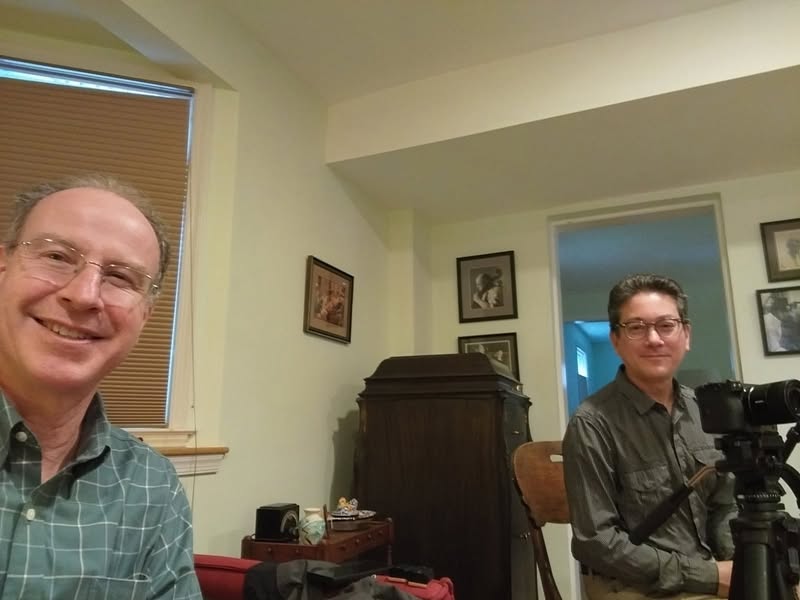
Filming Leonard Rose A Cello Legend’s Story
Here are a few photos of our most recent day of filming for an ongoing project, a documentary about the great American cellist Leonard Rose.
Rose was the first American-born and trained cellist to achieve a world-class solo career. He played in the NBC Symphony Orchestra under Arturo Toscanini, and as principal cellist in the Cleveland Orchestra and New York Philharmonic under Artur Rodzinski, before making the courageous decision to support himself as a star soloist. Unusually, he also developed into as a marvelous chamber musician, performing and recording with such artists as Isaac Stern, Eugene Istomin, and Glenn Gould. For most of his career he was also a perceptive teacher whose influence is still felt today. (Yo-Yo Ma was a pupil.)
I was in the DC area on Tuesday and Wednesday for our latest interview. This was an important one, as our subject was none other than Arthur Rose, the cellist’s son. Art was full of helpful information about, and insights into, Rose’s personality, his family life, and his personal dealings with his associates.
Art still works in radio after half a century as an engineer. This room is adorned with a Victrola, a vintage radio, and a harpsichord of Art’s own construction. In an adjacent room is a clavichord he also built. The walls are hung with inscribed photos of a number of Rose associates, including Pablo Casals, Jascha Heifetz, and Dimitri Mitropoulos.
Art also allowed us access to unpublished photos, a manuscript of a Rose memoir, with handwritten corrections, that the cellist was at work on at the time of his death, and rare audio recordings such as the world premiere performance of Alan Shulman’s Cello Concerto, which Rose never recorded commercially. All very exciting.
That’s H. Paul Moon behind the camera. Paul and I met when I interviewed him on the radio prior to the PBS broadcast of his award-winning documentary “Samuel Barber: Absolute Beauty.” I conduct all my interviews for the current project off-camera, with the intention of having the subjects tell Rose’s story themselves, through the magic of attentive editing.
We have a few more interviews before we wrap, at least one of them with a classical music legend. Paul has many projects going simultaneously, but we are getting there.
-

Leonard Rose Documentary NYC Interviews
I was in New York on Thursday for another round of interviews for a documentary being shot by filmmaker H. Paul Moon about the great American cellist Leonard Rose.
Here are some fun photos from the shoot, which took place at Bowery Poetry in the East Village. In various permutations, you’ll find Paul, musicologist Eric Wen (in one shot seen in the chair I usually occupy, asking questions from off-camera), cellist and Rose pupil Sara Sant’Ambrogio of the Eroica Trio, and violist Eric Shumsky, son of the legendary violinist Oscar Shumsky, who was Rose’s close associate and good friend.
There were lots of juicy stories about Toscanini, Glenn Gould, and Isaac Stern, among others, and some anecdotes about Yo-Yo Ma gone wild. I’m guessing not all of these will make it into the movie! This is an ongoing project that will continue to span many months, with more interviews in New York, Philadelphia, and D.C., and perhaps further afield.
All the interview subjects on Thursday were great, of course, but the highlight of the day, for me, surely was the realization that Wen, who is on the faculty of the Curtis Institute of Music, was a regular patron of my Philadelphia book store, back in the 1990s! He just couldn’t get over it. In particular, he treasures a Samuel Johnson facsimile he found there, and he says he and his wife still talk about the shop, despite the fact that it closed in that location all the way back in 2000. (That’s us together in another photo, taken, he says, to share with her.) As you can imagine, it made me feel really good that someone still remembers and values the space and the inventory I curated.
It turns out we have much else in common, including a shared adoration of Erich Wolfgang Korngold!
It was a real pleasure to meet everyone.
Tag Cloud
Aaron Copland (93) Beethoven (95) Composer (114) Film Music (144) Film Score (143) Film Scores (255) Halloween (94) John Williams (195) KWAX (229) Leonard Bernstein (104) Marlboro Music Festival (125) Movie Music (159) Mozart (90) Opera (212) Philadelphia Orchestra (89) Picture Perfect (174) Princeton Symphony Orchestra (109) Radio (88) Ross Amico (244) Roy's Tie-Dye Sci-Fi Corner (290) The Classical Network (101) The Lost Chord (269) Vaughan Williams (105) WPRB (397) WWFM (881)