Spring arrives at 11:33 a.m. EDT.
This Sunday night on “The Lost Chord,” we’ll welcome the vernal equinox with two works steeped in mythological lore.
Charles Martin Loeffler (1861-1935) long claimed to be of Alsation birth. In actuality, he was born outside Berlin. The composer turned against Germany after his father died in prison, where he had been sent for his subversive writings, when Loeffler was only 12 years-old.
Loeffler was a fastidious artist, who cut his teeth in Berlin and Paris, and indeed he is frequently identified as French-American. He settled in Boston in 1881, where he shared the first desk with the concertmaster of the Boston Symphony Orchestra and became an important figure in the city’s musical life. A man of wide culture and refined taste, he founded the Boston Opera Company. In 1887, he left the Symphony to devote himself wholly to composition.
Loeffler’s symphonic poem of 1906, titled “A Pagan Poem,” was inspired by the eighth Eclogue of Virgil, in which a maiden of Thessaly, abandoned by her lover, revives his ardor through the use of sorcery.
The work was first performed by the Boston Symphony, under Karl Muck. It was later championed by Leopold Stokowski, who recorded it for EMI. The piano plays such a prominent role, the piece sounds at times as if it could be a piano concerto.
“Spring Fire” from 1913-14, one of the earliest programmatic works by the English composer Arnold Bax (1883-1953), is meant to suggest the awakening of mythological beings in early spring.
The choice of subject matter was an attempt to cash in on the fashionable “paganism craze” sparked by the Ballets Russes and its composers. Bax’s affection for the writings of Algernon Swinburne had recently yielded the symphonic poem “Nympholept.” Quotations from Swinburne also adorn portions of the score to “Spring Fire.”
The piece was scheduled for performance several times, but repeatedly cancelled, first because of the outbreak of war, then because of the work’s difficulty. Ultimately, it would never be performed during Bax’s lifetime. The manuscript was consumed in a fire in 1964, and all hope of ever hearing the score vanished. Fortunately, a copy was discovered, and the piece was finally recorded in 1986.
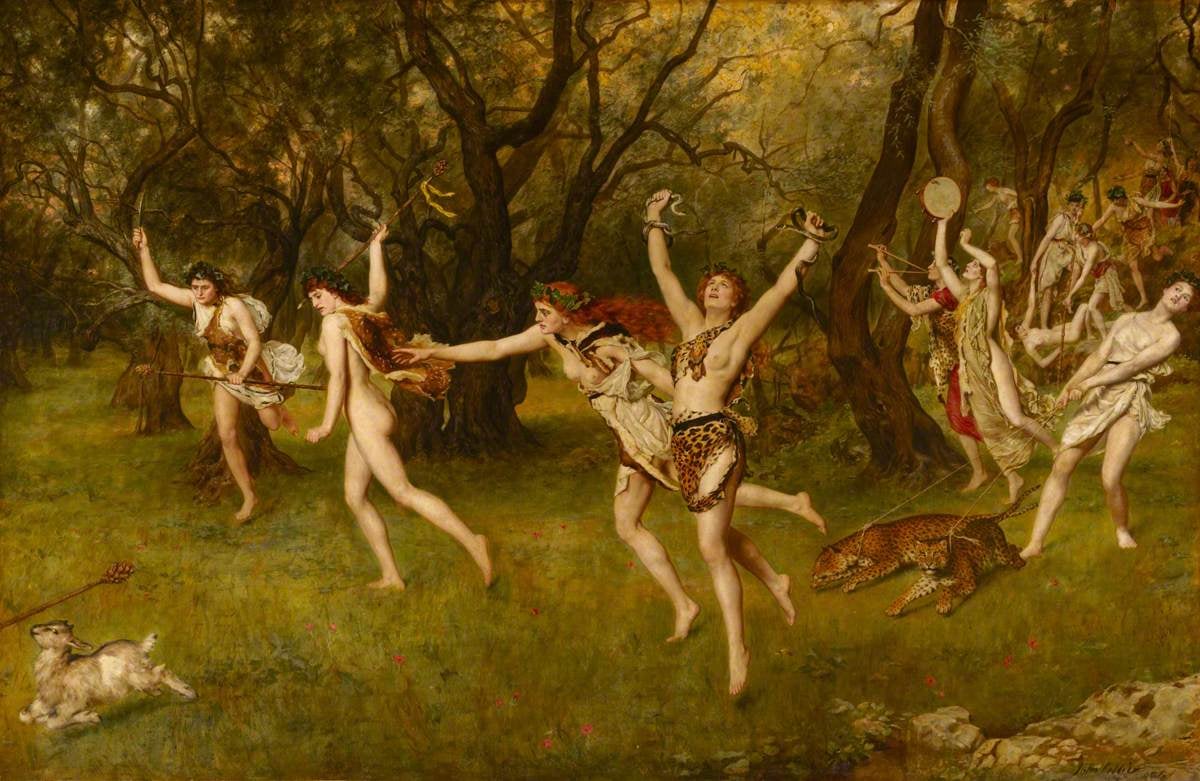
“Spring Fire” is meant to reflect a woodland sunrise in early spring, as ancient denizens of the forest shrug off their winter sleep. Half-human shapes skip with mad antics down the glades. Forest lovers loll in their ecstatic dreams, until they are rudely awakened by a turbulent rout of satyrs and maenads.
It’s shaping up to be a “Hot Spring,” on “The Lost Chord,” this Sunday night at 10:00 EDT, on WWFM – The Classical Network and wwfm.org.
