It’s a rainy day in Princeton town. Join me this afternoon on The Classical Network, as I’ll pay tribute to our meteorological sister city – London!
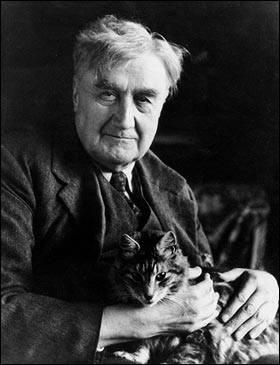
It was George Butterworth who suggested to Ralph Vaughan Williams that he compose a purely orchestral symphony. Of course, RVW had already composed “A Sea Symphony,” on texts of Walt Whitman, but that work was as much a cantata as anything else. Vaughan Williams told Butterworth it was never in his thoughts to write a symphony, but privately the suggestion got his gears turning.
The result was Vaughan Williams’ second symphony, advertised as “A London Symphony.” The piece would prove to be the first of RVW’s eight purely orchestral essays in the form that would go on to become some of the most frequently-played by any English composer. Unfortunately, Butterworth would not live to witness his friend’s enduring success. He would be killed by sniper fire on the Somme in 1916.
Vaughan Williams’ symphony underwent numerous revisions from its original version of 1914-15 to the final form of 1936 that we know today. The original, revived only in 2001, with the permission of the composer’s widow, Ursula, is a remarkable achievement in its own right. Like an x-rayed painting by an Old Master, the work reveals aspects of its creation previously undreamed of by even the most ardent RVW admirer.
Over time, Vaughan Williams not only revised the music, but also seemingly his thoughts on the piece, gradually transforming it from a nostalgic portrait of London to what he liked to refer to as a “Symphony by a Londoner.” In this way, he could downplay the descriptive elements of the work and push for its acceptance as “absolute” music.
Along the way, he jettisoned about a third of the original music. Heard as it was originally conceived, the piece is revealed to be more ambitious, darker perhaps, containing, as RVW later grumbled to Bernard Herrmann, “some horrible modern music – awful stuff.”
The composer dedicated the piece to George Butterworth, without whom it would not have been composed. The original version of “A London Symphony” will form the centerpiece of this afternoon’s playlist.
First, it’s off to New York town, for our Noontime Concert. The period instrument ensemble Juilliard415 will present a concert titled, appropriately enough, “Eye of the Storm.” The program will include works by Heinrich Ignaz Franz von Biber, Johann Joachim Quantz, Francois Couperin, and Jean-Marie Leclair.
It’s another concert brought to us by Gotham Early Music Scene, or GEMS. GEMS’ Midtown Concerts series is held at the chapel of St. Bartholomew’s Church, 325 Park Avenue, in New York City. Free concerts take place at St. Bart’s on Thursdays at 1:15 p.m. For more information, visit GEMS’ website, gemsny.org, and click on the events calendar.
Have an umbrella on hand and get ready to slip into a nice cup of tea, from 12 to 4 p.m. EDT, on WWFM – The Classical Network and wwfm.org.
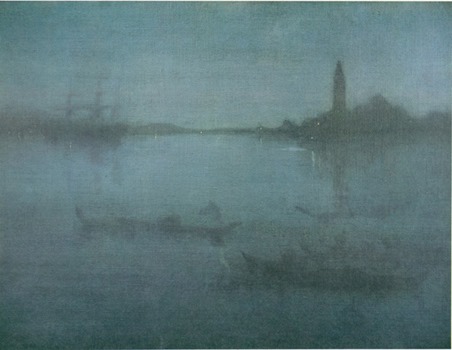
“There was no fog in London until Whistler started painting it.” – Oscar Wilde