Tag: Lukas Foss

  • Song of Songs Biblical Love & Music

    Song of Songs Biblical Love & Music

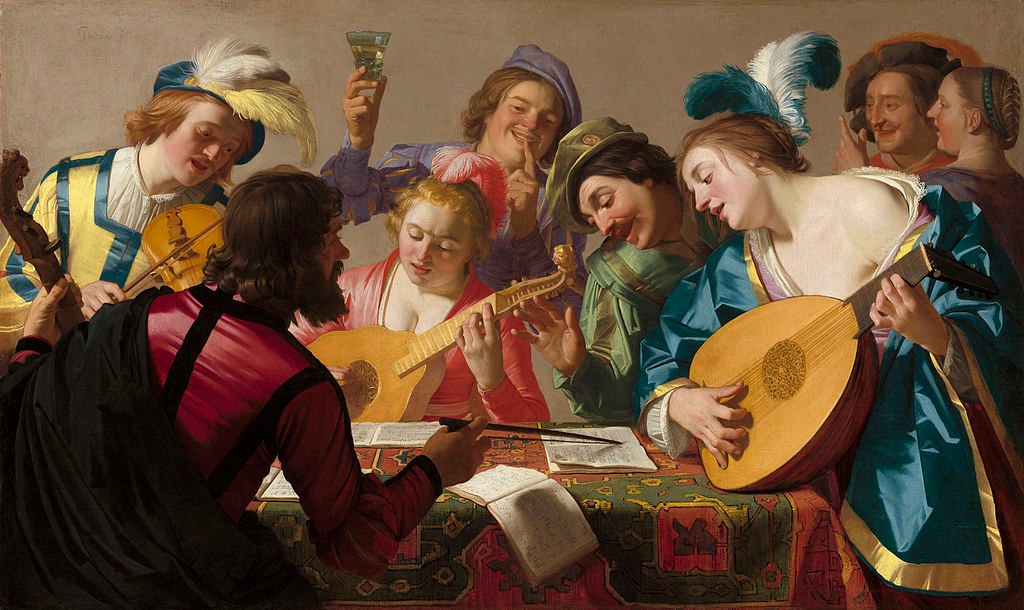
    The Song of Songs. Attributed to King Solomon, this Biblical book contains some of the most ardent poetry ever written. Whether interpreted as the communion of man and woman, or as something of a more allegorical nature – the relationship, depending upon one’s system of belief, between God and Israel, between God and the Church, or between Christ and the human soul – over the centuries it has inspired some meltingly lovely music.

    Since it is customary to read from the Song of Songs as part of the observance of Passover, this week on “The Lost Chord,” for Pesach, we’ll sample two complementary settings: one by Sir Granville Bantock – selections from his massive, 2 ½ hour oratorio – and one by Lukas Foss – a more intimate song cycle, in which divine and romantic love unite in understated metaphor.

    What if I told you your temples behind your veil are like the halves of a pomegranate? If you fall for that, there’s plenty more where that came from, on “King Solomon’s Lines,” on “The Lost Chord,” now in syndication on KWAX, the radio station of the University of Oregon!


    Clip and save the start times for all three of my recorded shows:

    PICTURE PERFECT, the movie music show – Friday at 8:00 PM EDT/5:00 PM PDT

    SWEETNESS AND LIGHT, the light music program – Saturday at 11:00 AM EDT/8:00 AM PDT

    THE LOST CHORD, unusual and neglected rep – Saturday at 7:00 PM EDT/4:00 PM PDT

    Stream them, wherever you are, at the link!
    https://kwax.uoregon.edu/

  • Remembering JoAnn Falletta A Generous Maestro

    Remembering JoAnn Falletta A Generous Maestro

    JoAnn Falletta is one of the nicest, most generous people in the business. Not only did she make time to drop by my morning radio shows during her summer visits to Princeton to conduct the New Jersey Symphony Orchestra Edward T. Cone Composition Institute concerts and to participate in multiple phone interviews for my syndicated radio program, “The Lost Chord,” but she’s actually gone out of her way to send me related material herself from her home. Where does she find the time? She’s in demand everywhere, and she’s constantly learning new material. The last time I saw her was at an all-Lukas Foss concert at Carnegie Hall last year. (The music was recorded, so a CD will materialize on Naxos at some point, I expect very soon.) She’s always on the lookout for worthy unusual and neglected repertoire. Is it any wonder I feel as if we are totally simpatico? Falletta’s recordings are well-represented on my radio programs and in my CD library. She holds a special place in my heart. Happy birthday, JoAnn Falletta! Thank you for your curiosity, your energy, your artistry, and your munificence.


    I almost forgot, I’ve got one of our interviews preserved on Soundcloud!

  • Early Music Month Modern Takes on Renaissance

    Early Music Month Modern Takes on Renaissance

    Yea, we changed the clocks last night, so we lost an hour’s sleep. But odd’s bodkins, man! It’s never too late to be Early!

    This Sunday night on “The Lost Chord,” for Early Music Month, we hearken to works by 20th and 21st century composers who found inspiration in music of the Renaissance.

    William Kraft (1923-2022), long associated with the Los Angeles Philharmonic, wrote “Vintage Renaissance” on a commission from the Boston Pops. The work incorporates two 15th century melodies: “Danza,” by Francesco de la Torre, and an anonymous “bransle.”

    George Frederick McKay (1899-1970), the so-called “Dean of Northwest Composers,” founded the composition department at the University of Washington, where he taught for over 40 years. His “Suite on Sixteenth Century Hymn Tunes” is based on works by Louis Bourgeois (c. 1510-1559), compiler of Calvinist hymn tunes and composer of the Protestant doxology known as the “Old 100th.”

    Lukas Foss (1922-2009), the German-born musical prodigy who settled in the United States in 1937, composed his “Renaissance Concerto” in 1986. The work, for flute and orchestra, falls into four movements: “Intrada;” “Baroque Interlude” (on a theme of Rameau); “Recitative” (after Monteverdi); and “Jouissance” (after a 1612 madrigal by a composer of the name David Melville).

    If the Academy Awards can exhibit scant regard in scheduling its broadcast at a time when it’s guaranteed to lose a sizable portion of its audience to Morpheus, so can I. I hope you’ll join me – if not tonight, then later on the webcast – as American composers cast an affectionate look back. “It’s Never Too Late to Be Early,” this Sunday night at 10:00 EDT, on WWFM – The Classical Network and wwfm.org.

  • Birds in Music From Mozart to Eighth Blackbird

    Birds in Music From Mozart to Eighth Blackbird

    This one goes out to all the red-winged blackbirds, grackles, starlings, and cowbirds that have been swarming my feeders for the past week.

    Jennifer Higdon’s “On a Wire,” named for the familiar sight of birds, well, hanging out on a wire, was composed for the contemporary music sextet eighth blackbird (which markets itself all in the lower-case). Interestingly the piano part includes passages that have adjacent musicians bow the strings inside the instrument. The technique is called (wait for it) “bowed piano.” You can identify the members of eighth blackbird by their instruments: flute, clarinet, piano, percussion, violin, and cello.

    eighth blackbird is named for Wallace Stevens’ “Thirteen Ways of Looking at a Blackbird,” a poem that’s been set by many composers. Lukas Foss’ response is one of the more frequently encountered.

    Starlings aren’t always an annoyance. Wolfgang Amadeus Mozart was so charmed by one during a visit to a Viennese pet shop that he brought him home to his family. From the evidence of one of the composer’s diary entries, we know that a theme used in his Piano Concerto No. 17 was inspired by a song that his fine feathered friend had sung to him. Admittedly, Mozart tidied it up a bit first. (Originally, there had been an out-of-place G-sharp.)

    I understand that everyone needs to eat, and I don’t begrudge a handful of any of these birds, but when it becomes a winged mob in leather jackets with chains, then I’m compelled to throw up the sash and trumpet through an old wrapping-paper tube.

    Gentle birds, be reasonable! Eat well, but then, please – go in peace!

    More about Mozart’s starling here

    https://interlude.hk/mozart-inspired-pet-starling/

    BONUS: From “Where’s Charley?” “My darling, my darling, I’ve fluttered and fled like a starling…”

  • Falletta Celebrates Lukas Foss at Carnegie Hall

    Falletta Celebrates Lukas Foss at Carnegie Hall

    What a great night last night at Carnegie Hall! JoAnn Falletta and the Buffalo Philharmonic Orchestra celebrated the centenary of the birth of Lukas Foss.

    In addition to being a brilliant composer, conductor, pianist, and educator (he succeeded Arnold Schoenberg as professor of music at UCLA), Foss was music director in Buffalo from 1963 to 1970.

    Falletta served as his associate conductor at the Milwaukee Symphony Orchestra (where Foss was director from 1981 to 1986), later assuming the directorship he once held in Buffalo. Falletta has been music director in Buffalo since 1999. Her recordings of opulent repertoire and music by unjustly neglected composers for the Naxos label, among others, hold an honored place in my CD collection.

    She’s also one heck of a nice person. She gives so much of herself (she’s been a guest on my radio shows three or four times over the years, twice in person), I honestly wonder where she finds the energy.

    Last night’s program was all (or mostly) Foss, including “Ode for Orchestra,” “Three American Pieces” (with concertmaster Nikki Chooi, violin), the “Renaissance Concerto” (with Amy Porter, flute), “Psalms” (with the Choir of Trinity Wall Street), and the Symphony No. 1. Also included, as kind of an encore after “Psalms,” was the famous “Alleluia” by Foss’ teacher, Randall Thompson.

    I never dreamt I’d get to hear so much Foss in one place. In a sense, I feel like I got more “Foss” than I did when I actually met him in person, over 30 years ago. His was a great era for American music. I wish that particular generation of American composers would be represented more frequently in our concert halls. To bring a full program to Carnegie was very special indeed.

    A truly memorable evening, then. Thanks to JoAnn Falletta, the Buffalo Philharmonic, and everyone else who helped to make it possible.

    And a special thank you to Paul Moon, who scored me my ticket and was my generous host for the day!

Tag Cloud

Aaron Copland (92) Beethoven (95) Composer (114) Film Music (119) Film Score (143) Film Scores (255) Halloween (94) John Williams (185) KWAX (229) Leonard Bernstein (99) Marlboro Music Festival (125) Movie Music (134) Opera (198) Philadelphia Orchestra (86) Picture Perfect (174) Princeton Symphony Orchestra (106) Radio (87) Ralph Vaughan Williams (85) Ross Amico (244) Roy's Tie-Dye Sci-Fi Corner (290) The Classical Network (101) The Lost Chord (268) Vaughan Williams (102) WPRB (396) WWFM (881)

DON’T MISS A BEAT

Receive a weekly digest every Sunday at noon by signing up here


RECENT POSTS