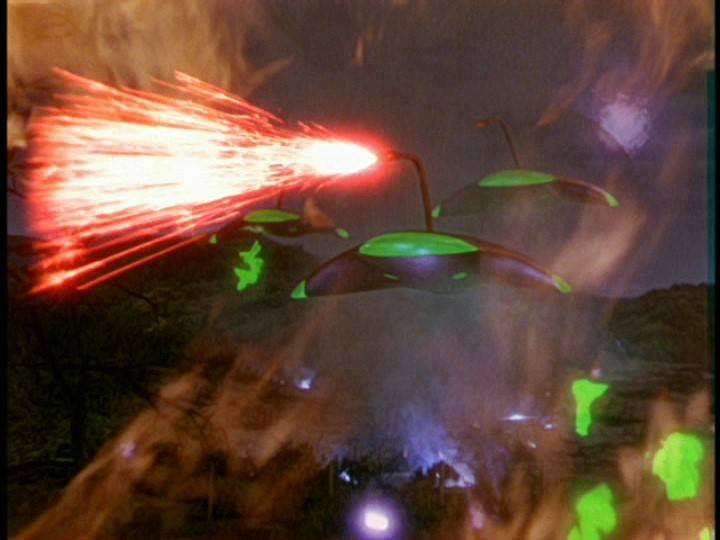
This week on “Picture Perfect,” with Halloween only days away, my thoughts turn to Grover’s Mill, the community located not far outside of Princeton, NJ, that became the focal point of Orson Welles’ notorious radio adaptation of H.G. Wells’ “The War of the Worlds.”
On October 30, 1938, Welles’ Mercury Theatre presented the classic’s dramatization after the manner of “breaking news,” with simulated live reports interrupting a program of regularly scheduled dance music. What the alleged reports described was chilling – a Martian invasion of rural America by hostile aliens bearing fiery weapons and poisonous gas. The whole story was authenticated, in real time, by a “Professor Richard Pierson of Princeton Observatory.”
Those who tuned in late or were only half-listening completely freaked out, and reacted in a manner unimaginable in an era of social media. Panicked mobs choked the streets, phone lines were jammed, and police flooded CBS Studios. Welles had dropped the biggest firecracker right in the middle of a United States already on edge, thanks to widespread access to radio reports of mounting tensions in Europe.
You might say Welles’ (and Wells’) fame skyrocketed. Orson Welles would match his early notoriety a few years later with his Hollywood debut, as producer, director, co-writer, and star of “Citizen Kane,” which inflamed William Randolph Hearst, while H.G. Wells’ novel has remained his most popular, the work having been adapted to film several times.
We’ll hear music from the classic 1953 version, produced by George Pal, with music by Leith Stevens; then the Steven Spielberg blockbuster, from 2005 (titled, simply, “War of the Worlds”), with music by John Williams.
After that, we’ll take it to the Red Planet, when an American astronaut is stranded with his test monkey, in 1964’s “Robinson Crusoe on Mars,” with music by Van Cleave.
Finally, we’ll turn to Edgar Rice Burroughs’ John Carter. Why Disney dropped “of Mars” from the title – something that would have actually elaborated on the subject matter, for uninitiated – is anybody’s guess. The belated 2012 adaptation was undertaken 100 years after the character was introduced.
Unfortunately, the intervening decades robbed Burroughs’ creation of much of its freshness, with dozens, if not hundreds, of science fiction novels and movies having plundered the author’s pulp treasure trove. “John Carter” was less striking than it might have been, but the film was certainly not the train wreck the press made it out to be. Michael Giacchino’s score concludes the hour on a romantic note, a welcome relief after dodging so many Martian heat rays.
I hope you’ll join me for this interplanetary exchange program (albeit not always a peaceful one), on “Picture Perfect,” music for the movies, this Saturday evening at 6:00 EDT, on WWFM – The Classical Network and wwfm.org.