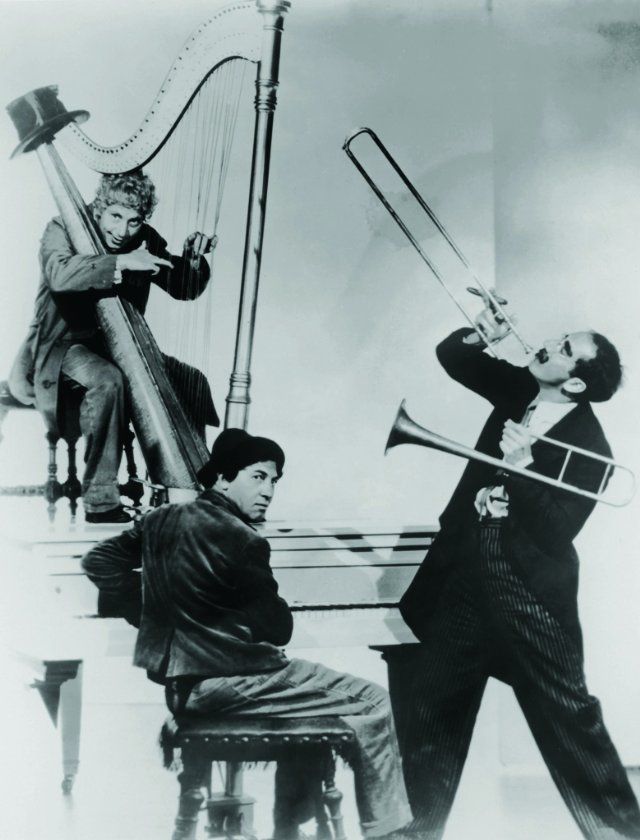
According to family lore, my stepfather is somehow related to Harry Ruby. Of course, I am proud of this, being an inveterate Marx Brothers fan. With Bert Kalmar, Ruby composed some of the funniest and most enduring songs in the Marxes’ best films, including “Hooray for Captain Spaulding” (from “Animal Crackers,” later Groucho’s signature tune), “I’m Against It,” “I Always Get My Man,” and “Everyone Says I Love You” (from “Horse Feathers”), and “Hail, Hail Freedonia” (from “Duck Soup”). Kalmar & Ruby also received writing credits. (“Animal Crackers” was based on one of their Broadway shows.) Not composed for the films, but nevertheless beloved by Groucho, who continued to sing them throughout his career, were Ruby’s “Show Me a Rose” (again, with Kalmar) and this gem, for Father’s Day.
BONUS: From “Horse Feathers,” Groucho as the college president and Zeppo as his son:
Yesterday, a rainy day in Princeton, I finally got around to rewatching a Marx Brothers documentary I hadn’t seen in decades (“The Marx Brothers in a Nutshell,” 1982), kindly sent to me by a friend over Christmas. Naturally, among the clips were some from “A Night at the Opera,” which got me thinking about all the classical music used as grist for musical interludes and parody in the Marxes’ films – and soberingly, by extension, how far we’ve fallen as a culture that broader audiences today would likely not recognize some of these once indelible melodies.
Toward the end of the documentary, Dick Cavett remarks, prophetically, although perhaps not in the way he had hoped, “50 years from now, will the Marx Brothers be funny? Will the films live? I would have to say, I hope so, and I think so. Because if not, there’s something wrong with the people, not the films.”
At a time when so many are so easily offended at the first whiff of anything subversive (which, I would argue, is a substantial root of humor), and younger people such as my nephews claim never even to have heard of Groucho Marx, I’m not much encouraged to believe in the continued “life” of their films. It’s a source of amazement to me that the Marxes and the Universal monster movies of the 1930s still held such sway over all of us youngsters in the 1970s – 40 years later! I’d go further and say that Groucho Marx was one of my biggest, and perhaps least helpful, influences during my teens in the 1980s.
Hopefully, someday the pendulum will swing again – like Harpo through the painted backdrops of “Il trovatore” – but I can’t say that I think it is likely. How is it that, with everything seemingly spinning out of control, the world has become such an anodyne place? The Marxes were up against the Great Depression and World War II. Maybe a little inappropriate laughter, once in a while, would do us some good.
“I want my shirt” (“The Cocoanuts”)
“Il trovatore” (“A Night at the Opera”)
Earlier “Anvil Chorus” parody at 5:30 (“Animal Crackers”)
Rachmaninoff Prelude in C-sharp minor (“A Day at the Races”)
Harpo fantasy on Liszt’s Hungarian Rhapsody No. 2 (“A Night in Casablanca”)
Medley of Chico Marx numbers, in which he references the Hungarian Rhapsody No. 2, the Pizzicato from Leo Delibes’ “Sylvia,” and more.
Whenever I stumble across anything of interest, rather than bookmark it, I have a habit of simply leaving the screen open. This is why I always wind up with literally hundreds of tabs crowning multiple browser windows. This morning, I thought I’d distill a few of these to provide a touch of pre-Covid fantasy about taking your “sugar” to Sunday tea at the Ritz.
The song, “When I Take My Sugar to Tea,” was written by Sammy Fain, Irving Kahal & Pierre Norman. Though it was destined to become a popular standard, it was actually introduced in knockabout fashion by Chico Marx in “Monkey Business” (1931), as part of a piano medley that also features the pizzicato from Delibes’ ballet “Sylvia.”
This is from a 20-minute montage of Chico performances from all the Marx Brothers movies, which you are welcome to view in its entirety, but I’ve cued the link to start at the relevant clip.
Here’s the actual song, with vocals by Nat King Cole.
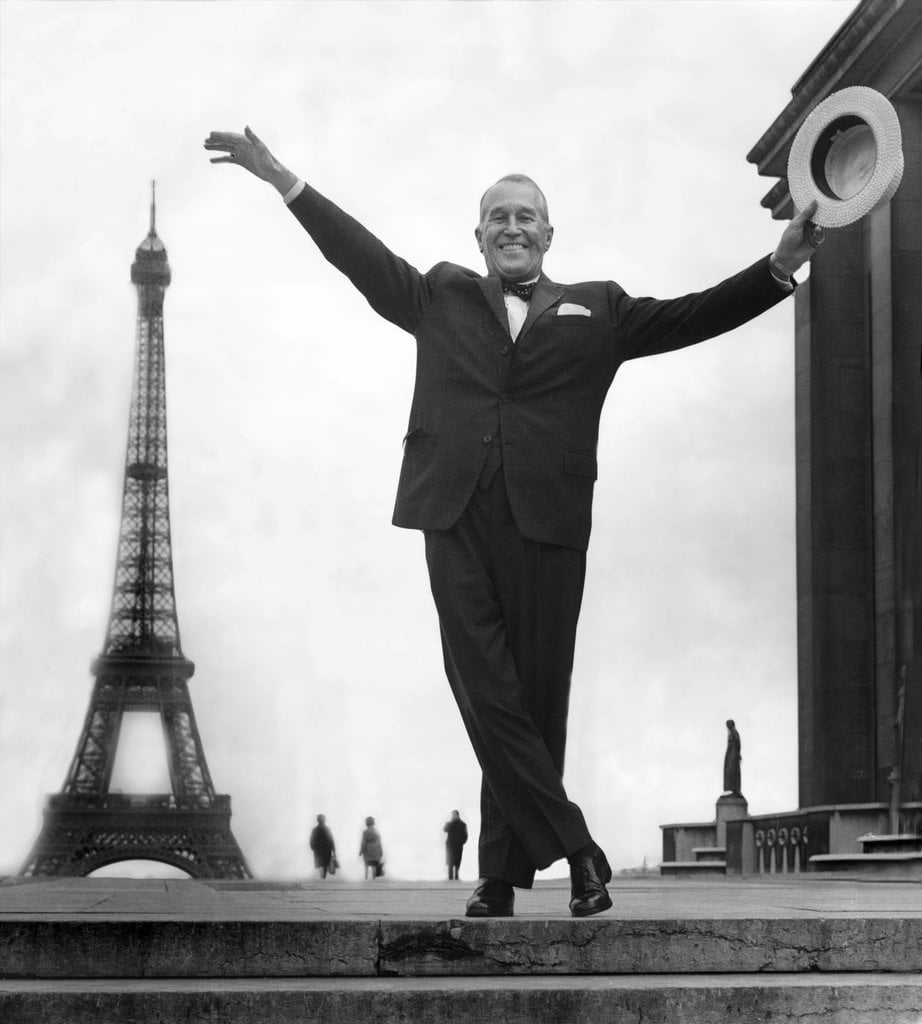
Interestingly, “Monkey Business” is also the film in which the Marxes, who play stowaways, attempt to slip off a boat by using a passport allegedly stolen from Maurice Chevalier. (Chevalier does not appear in the film.) Each brother, in turn, does his Chevalier impression for an increasingly exasperated customs official. Naturally, this involves multiple, ludicrous renditions of “You Brought a New Kind of Love to Me.” Chevalier introduced the song the year before in the film “The Big Pond.” “You Brought a New Kind of Love” was also composed by the team of Fain, Kahal & Norman.
The Marxist take on Chevalier:
Chevalier sings it:
Though it’s my practice always to start the day with tea, by now I’m well on to my java jive. With a debonair doff of a dapper boater, I wish you all a sweet, caffeinated Sunday.
The stowaway Marx Brothers do their Chevalier impressions in an attempt to get off the boat in “Monkey Business” (1931). This routine had been used in at least two of their stage shows and one promotional film short.
“Monkey Business” was banned in several countries, notably Ireland, over concerns that it fosters anarchic tendencies. God bless the Marxes. And thank you, Chevalier, for making even the worst days bright.