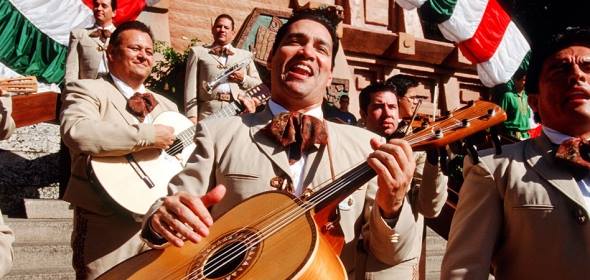
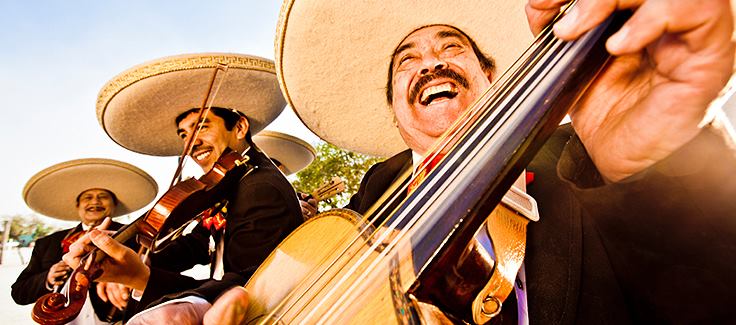
Cinco de Mayo. A day to celebrate Mexican victory over the French with most excellent margaritas. And of course music. Much music.
Join me this morning as we travel south of the border for works ranging from colonial times, to the birth of Mexican nationalism in music, to pieces by contemporary Mexican composers and those in the United States who were influenced by Mexican culture.
We’ll have our mouth full of nachos from 6 and 11 EDT, on WPRB 103.3 FM and at wprb.com. The oranges with our mezcal will take care of the vitamin C, on Classic Ross Amico.
In the wake of the Mexican Revolution, Carlos Chávez (1899-1978) appeared like Quetzalcoatl, the creator-deity of Aztec lore, to forge a distinctive sound in Mexican music.
Chávez was regarded as the foremost Mexican composer and conductor. He became director of the Orquesta Sinfónica Mexicana, the country’s first permanent symphony orchestra. He was appointed director of the National Conservatory of Music. Later, he served as director-general of the National Institute of Fine Arts. At the same time, he formed the National Symphony Orchestra, which supplanted the old OSM.
In 1937, he conducted the world premiere of “El Salón México,” the work which essentially launched Aaron Copland into the mainstream.
Chávez himself was one of the first exponents of Mexican nationalism in music, writing ballets on Aztec themes. His most famous work is probably the Symphony No. 2, composed in 1935-36. Known as the “Sinfonia India,” it is based on melodies by indigenous tribes of northern Mexico.
The percussion section originally included a large number of traditional Mexican instruments, including the jicara de agua (half of a gourd inverted and partly submerged in a basin of water, struck with sticks), güiro, cascabeles (a pellet rattle), tenabari (a string of butterfly cocoons), a pair of teponaxtles, tlapanhuéhuetl, and grijutian (a string of deer hooves).
However, when the score was published, the composer sensibly substituted the nearest equivalents commonly used by most orchestras, though he requested that the originals be employed wherever possible.
Here is Chávez’s recording of the “Sinfonia India”:
Everyone else seems to take it a tad slower. Here’s a spirited live performance with the SCM Symphony Orchestra (Sydney Conservatorium of Music), under the direction of Mexican conductor Eduardo Diazmuñoz:
This Sunday night on “The Lost Chord,” it’s all Mexican music on the eve of Cinco de Mayo. We’ll hear a fun solfeggio piece (“Sol-fa de Pedro”) by the baroque composer Manuel de Zumaya. Zumaya, born in Mexico around 1678, is believed to have written the first opera in the western hemisphere. He became chapel master of Mexico City Cathedral in 1715.
Blas Galindo is best known in the United States for the evocative “Sones de Mariachi.” But he composed over 150 works, including seven ballets. One of these was “La Manda,” or “The Vow,” written in 1951. The scenario is a bit of downer, about an ailing wife on a pilgrimage who believes she is losing her husband to another woman, but the music is full of distinct nationalist character.
Manuel Ponce is one of Mexico’s most famous composers. He’s probably best recognized for his guitar music, thanks to his association with Andrés Segovia. Less frequently heard is his Violin Concerto of 1942. We’ll have the soloist who gave the work its premiere, Henryk Szeryng, in a recording made some forty years later.
Pour yourself a Corona, mix up some guacamole, and enjoy “Mayo My,” Mexican music for Cinco de Mayo, Sunday night at 10 ET, with a repeat Thursday night at 11, or listen to it later as a webcast at http://www.wwfm.org.