Tag: Michael Tippett

  • Tippett’s Piano Sonata Rediscovered

    Tippett’s Piano Sonata Rediscovered

    One of the pleasures of attending the Bard Music Festival – which focuses on a primary composer and his or her world – is the chance to listen to music by dozens of ancillary figures that in one way or another further illuminate the year’s subject. This makes for some felicitous discoveries. One of these, in this year devoted to Ralph Vaughan Williams, was surely the Piano Sonata No. 1 by Michael Tippett.

    I went through a Tippett phase, back in the late ‘80s, early ‘90s, when I first discovered his Concerto for Double String Orchestra, his oratorio “A Child of Our Time,” the “Suite in D (for the Birthday of Prince Charles),” and the opera “The Midsummer Marriage,” which I was lucky to see in a revival at New York City Opera. But then I kind of cooled on him, still liking the pieces I liked, of course, but not going out of my way to revisit the thornier, more perplexing works of his later development. There are exceptions, of course. I’ve always been partial to his Symphony No. 4, for instance, which the composer compares to a birth-to-death cycle, complete with intermittent “breathing” effects. And of course, I have recordings of his piano sonatas, which, if I ever listened to them at all, have sat dormant on the shelf. In the case of No. 1, no longer!

    The sonata was composed in 1939, it turns out not long after the Concerto for Double String Orchestra. You would never know it from the music, but at the time the composer was going through quite a lot of turbulence. He’d recently weathered a particularly messy break-up. Tippett was homosexual, so even under the best of circumstances, there would have been a degree of stress at a time when same-sex relationships were viewed as criminal offenses. But the break-up was acrimonious and threw the composer into turmoil. Furthermore, Europe was full to bursting with political and military tension. Tippett always leaned far to the left, which placed him in further jeopardy with the authorities, especially when he not only refused to fight, but to participate in the war effort in any way.

    Vaughan Williams always did much to assist and support younger composers, not only as a teacher but as a colleague, even if he didn’t particularly care for the kind of music they happened to be writing. Tippett was one such composer. I don’t believe it ever came up during any of Bard’s panels or pre-concert talks, but Vaughan Williams, as one of the country’s most venerated composers, volunteered himself as a character witness during Tippett’s trial as a conscientious objector.

    Tippett admitted to, as a young man, having despised Vaughan Williams and all that he stood for. But probably in part because of the elder composer’s unusual kindness, he came to realize “there was an essential goodness about the man.”

    Later, after Vaughan Williams’ death, Tippett began to perceive that it was Vaughan Williams more than anyone else “who had made us free.” After two hundred years of German cultural domination following the death of Henry Purcell, when the most popular composers in England were Handel, Haydn, and Mendelssohn, Elgar brought new hope; but it could be argued, and to Tippett’s way of thinking, it was Vaughan Williams who allowed English composers to be comfortable in their own skins. He had bequeathed to all who followed the freedom to be “English.”

    Tippett talks about Vaughan Williams here:

    The first movement of Tippett’s sonata is cast in the form of a theme and variations; the second is based on a Scottish folksong, “Ca’ the yowes” (which Tippett also employs in the Concerto for Double String Orchestra); the third movement scherzo, in sonata form, unusually bears the greatest weight (I hear flashes of Beethoven); only to have that weight lifted in the fourth movement by a cakewalk. Tippett was always interested in Black music, with jazz, blues, boogie-woogie, and spirituals frequent influences on his work.

    Tippett’s sonata was performed at Bard by Orion Weiss. Here’s a recording with Phyllis Sellick, who introduced the piece, from the 1940s.

    And Daniel Harding and the London Symphony Orchestra with the lovely Concerto for Double String Orchestra:


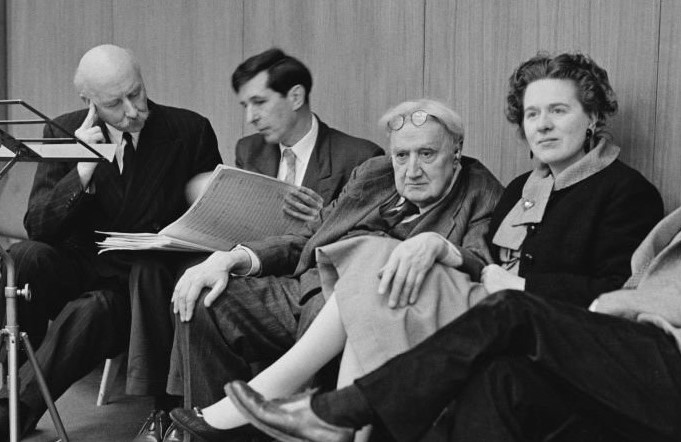
    PHOTO (left to right): Sir Adrian Boult, Michael Tippett, Ralph Vaughan Williams, and Ursula Vaughan Williams in 1958. Tippett would be knighted in 1966. Decades earlier, Vaughan Williams declined a knighthood. In 1935, he was awarded the Order of Merit by King George V.

  • Tippett & Tomlinson New Year’s Music

    Tippett & Tomlinson New Year’s Music

    This Sunday night on “The Lost Chord,” we’ll have contrasting works for the New Year by two English composers whose surnames begin with “T.”

    Sir Michael Tippett’s fifth and final opera is an especially abstruse one, even by Tippett standards. Composed on his own libretto, “New Year” is set in Terror Town, an imaginary city that exists “somewhere today.” The dramatis personae includes such diverse characters as a child psychiatrist, her Rastafarian foster brother, a shaman, and three time-travelers from the future – or, as Tippett specifies, “nowhere tomorrow.”

    The orchestral suite opens and closes with music for the arrival and departure of a spaceship, represented electronically, on New Year’s Eve. Other striking touches include the use of saxophones, and, at the work’s climax, a quotation of “Auld Lang Syne,” pitted against a rather turbulent backdrop.

    “New Year” was first performed at Houston Grand Opera in 1989, with the British premiere taking place at Glyndebourne the following year. The opera was not well received. The wholly reimagined suite was commissioned by the San Francisco Symphony in 1990. Tippett noted that the primary metaphor of the opera is dance. Hey, man, whatever.

    The balance of the program will be devoted to works by a composer of a very different sensibility – master of British Light Music, Ernest Tomlinson. It is Tomlinson’s tongue-in-cheek assertion that the melody of “Auld Lang Syne” underlies most of the world’s great masterpieces. He goes on to support his thesis with no less than 152 examples in his dizzyingly clever “Fantasia on ‘Auld Lang Syne.’”

    We’ll conclude with a waltz from Tomlinson’s “Cinderella,” someone else who clearly understands the transformative power of 12.

    The kettle is on. Turn over a new leaf and join me for a cuppa, with “’T’ Time” – welcoming the New Year with music by Tippett and Tomlinson – this Sunday night at 10:00 EST, on WWFM – The Classical Network and wwfm.org.

  • New Year’s Music Tippett & Tomlinson

    New Year’s Music Tippett & Tomlinson

    This Sunday night on “The Lost Chord,” we’ll have two works appropriate for the New Year, and both of them will be by English composers.

    Sir Michael Tippett’s “New Year” was the composer’s fifth and final opera. Set in Terror Town, an imaginary city, the location of which is described as “Somewhere Today,” the time is New Year’s Eve. The character personae features such unusual and diverse elements as a child psychiatrist, her Rastafarian foster brother, a shaman, and three time travelers from the future – or, as Tippett specifies, “Nowhere Tomorrow.”

    The suite opens and closes with the arrival and departure of a spaceship, which is represented electronically in the score. Other striking touches included the use of saxophones, and, at the work’s climax, a quotation of “Auld Lang Syne,” against a rather turbulent backdrop.

    The opera was first performed at the Houston Grand Opera in 1989, with the British premiere at Glyndebourne the following year. It was not well received. The wholly reimagined suite was commissioned by the San Francisco Symphony in 1990. Tippett noted that the primary metaphor of the opera is dance.

    The remainder of the hour will be devoted to works by a composer of a very different sensibility: master of British Light Music, Ernest Tomlinson. It is Tomlinson’s tongue-in-cheek assertion that the melody of “Auld Lang Syne” underlies most of the world’s greatest masterpieces. He goes on to support his thesis with no less than 152 examples in his dizzyingly clever “Fantasia on ‘Auld Lang Syne.’”

    In the few minutes left at the end of the show, I include a Tomlinson encore. It’s not a New Year’s piece, strictly speaking, though the subject of the work has to be home by the stroke of twelve.

    I hope you’ll join me for “T Time,” – music for the New Year by English composers whose surnames happen to begin with T – this Sunday night at 10 EST, on WWFM – The Classical Network and wwfm.org.

Tag Cloud

Aaron Copland (92) Beethoven (95) Composer (114) Film Music (120) Film Score (143) Film Scores (255) Halloween (94) John Williams (185) KWAX (229) Leonard Bernstein (100) Marlboro Music Festival (125) Movie Music (135) Opera (198) Philadelphia Orchestra (88) Picture Perfect (174) Princeton Symphony Orchestra (106) Radio (87) Ralph Vaughan Williams (85) Ross Amico (244) Roy's Tie-Dye Sci-Fi Corner (290) The Classical Network (101) The Lost Chord (268) Vaughan Williams (103) WPRB (396) WWFM (881)

DON’T MISS A BEAT

Receive a weekly digest every Sunday at noon by signing up here


RECENT POSTS