Tag: Microtonal Music

  • Gloria Coates American Composer Dies at 89

    Gloria Coates American Composer Dies at 89

    American composer Gloria Coates has died. Coates displayed an unconventional, though highly-developed sense of texture, grasping the power of microtones and clusters from an early age. But these were often tied to comprehensible forms: canons, palindromes, simple structures. A prolific artist, she composed 16 symphonies, 11 string quartets, orchestral works, song cycles, and a chamber opera.

    Hers was a unique voice. I often programmed her String Quartet No. 8 – with its three movements “On Wings of Sound,” “In Falling Timbers Buried,” and “Prayer” – during my broadcast memorials of 9/11. In the context, her sinking glissandi were especially effective, both visceral and chilling.

    Coates was also an abstract expressionist painter. Some of her artwork has graced the covers of her albums. For much of her life, she made her living solely from her compositions. Allegedly, she was the most prolific female symphonist.

    Born in Wisconsin in 1933, Coates largely made her home in Munich since 1969. At the time of her death, she was 89 years-old.


    String Quartet No. 8 (2001/02)

    Symphony No. 1 “Music on Open Strings” (1972)

    “Holographic Universe” for violin and orchestra (1975)

    “Cette blanche agonie” (1988), after Stephane Mallarmé

    In English:

    The virgin, vivid and beautiful today
    Will it tear for us with a blow of its drunken wing
    This hard, forgotten lake that haunts beneath the frost
    The transparent glacier of flights that have not fled!
    A swan of other times remembers that it is he
    Magnificent but without hope of freeing himself
    For not having sung the region where to live
    When of the sterile winter glistened the tediousness.
    His whole neck will shake off this white agony
    By space inflicted on the bird which denies it
    But not the horror of the soil in which his plumage is caught.
    Phantom that to this place his pure brightness assigns,
    It immobilizes itself in the cold dream of scorn
    That clothes during the useless exile of the Swan.

    Symphony No. 8 “Indian Sounds” (1990/91)

    Symphony No. 15 “Homage to Mozart” (2004/05)

    A conversation with Bruce Duffie
    http://www.bruceduffie.com/coates4.html

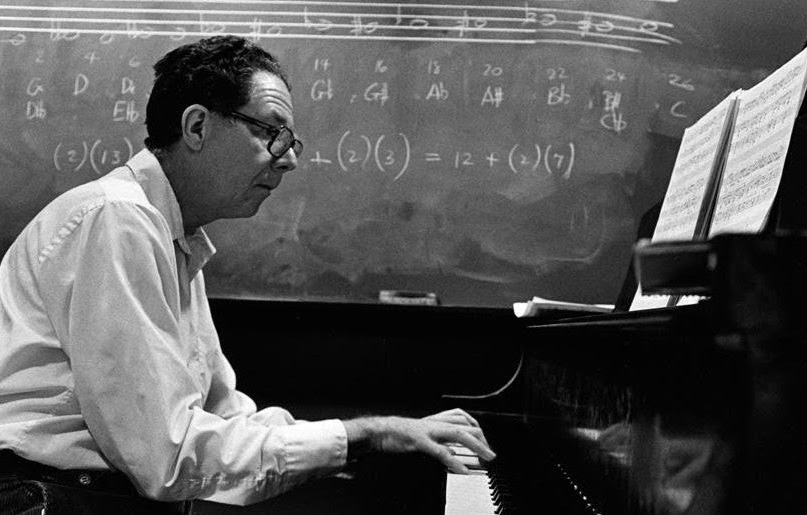
  • Easley Blackwood Composer Dies at 89

    Easley Blackwood Composer Dies at 89

    A black day for admirers of Easley Blackwood. The composer, pianist, theorist, and teacher has died at the age of 89. Blackwood, who taught at University of Chicago for 40 years, studied with Olivier Messiaen, Paul Hindemith, and Nadia Boulanger. He was a founding pianist of the chamber group Chicago Pro Music, otherwise made up of musicians from the Chicago Symphony Orchestra. Among his original compositions are five symphonies, sundry concertos, and “Twelve Microtonal Etudes for Electronic Music Media.” His book, “The Structure of Recognizable Diatonic Tunings,” was published by Princeton University Press. A cross-section of his music and recordings of his performances of other composer’s piano works are available on Cedille Records. And yes, his father was the famed contract bridge player. R.I.P.


    Symphony No. 2, with George Szell and the Cleveland Orchestra

    Microtonal Compositions

    String Quartet No. 3

    Chaconne for Carillon!

    Blackwood’s arrangement of Rimsky-Korsakov’s “Capriccio espagnol”

    Interview with Bruce Duffie

    http://www.bruceduffie.com/blackwood.html

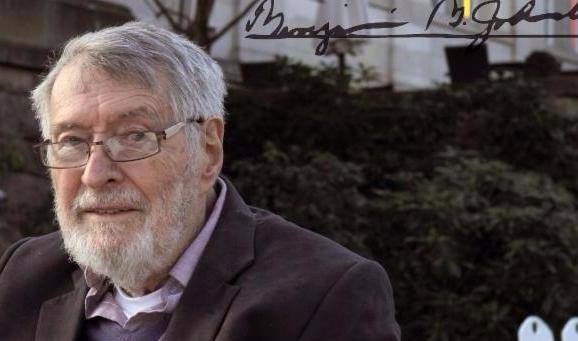
  • Ben Johnston Microtonal Pioneer Dies at 93

    Ben Johnston Microtonal Pioneer Dies at 93

    The pioneering microtonalist Ben Johnston has died at the venerable age of 93. Johnston, born in Macon, GA, in 1926, apprenticed with Harry Partch, whom he assisted in the construction and tuning of one-of-a-kind instruments fashioned from scrap. He then studied at Mills College with Darius Milhaud and, later in New York City, with John Cage. Cage encouraged Johnston to drop the idea of writing for newly created instruments and instead to focus on expanding the potentials and perceptions of more traditional sources.

    Johnston exceeded even Partch in his experiments with “just intonation,” a method of tuning based on the intervals of the harmonic series. For hundreds of years, equal temperament, in which the intervals of the chromatic scale are distorted to create major and minor scales, with the ability to modulate from key to key, has been the standard in Western music.

    However, to get something, you often have to give something up. The compromise of equal temperament is a finite system. Johnston (and Schoenberg before him) realized that by the 20th century the musical resources available through an adherence to equal temperament were on the verge of exhaustion. The exploration of microtones opened up new horizons by allowing for an expandable scale of more than forty divisions to an octave.

    Johnston’s great achievement was to take a radical concept and render it in such a way as to make it comparatively accessible to untutored listeners. The pay-off of his String Quartet No. 10 is the realization that (spoiler alert) the entire thing is constructed on the traditional melody “Danny Boy.” His String Quartet No. 4 is based on “Amazing Grace.”

    I’ll remember Johnston today, among my featured composers, during my afternoon air shift. We’ll also sample from a new release on Bridge Records, Inc., “Sonata Dementia,” consisting of works by Johnston’s mentor, Harry Partch. Satisfy your thirst for unusual music, between 4 and 7 p.m. EDT, on WWFM – The Classical Network and wwfm.org.


    The ensemble Partch performs “Sonata Dementia:”

    Those are some impressive mallets!

  • Harry Partch’s Unique Sounds on Noontime Concert

    Harry Partch’s Unique Sounds on Noontime Concert

    Are you parched for new music? Then you’ll want to tune in to today’s Noontime Concert for music of Harry Partch.

    Partch’s vision encompassed unusual, often microtonal scales, but also striking combinations employing handmade instruments of his own design. Partch, a percussion ensemble that shares the composer’s name, will join the PRISM Quartet for “Castor and Pollux: A Dance for the Twin Rhythms of Gemini,” part of concert which took place at Philadelphia’s Kimmel Center for the Performing Arts in June.

    Also on the program will be “Skiagraphies” (“Shadow Etchings”), for saxophones and Partch instruments, by Stratis Minakakis, who is on the faculty of the New England Conservatory, and “Radical Alignment,” by jazz saxophonist and experimental composer Steve Lehman.

    Then, from a concert given at the Kauffman Center for the Performing Arts in Kansas City in October of 2015, PRISM will join the University of Missouri – Kansas City Conservatory Wind Symphony for “Ba Yin” (“The Eight Sounds”), a concerto for saxophone quartet, by Chen Yi. The title refers to a type of Ancient Chinese music played on eight kinds of traditional instruments made of – or with – metal, stone, silk, bamboo, gourd, clay, leather and wood.

    PRISM’s next set of concerts will take place at Drexel University’s URBN Annex Black Box Theater, 3401 Filbert Street, in Philadelphia, this Thursday at 7 p.m., and at 3LD Art & Technology Center + 3-Legged Dog Media & Theater, 80 Greenwich Street, in New York City, this Friday at 8 p.m. For more information, visit prismquartet.com.

    I hope you’ll join me for music by American original Harry Partch, part of today’s Noontime Concert, and that you’ll stick around. I’ll be on until 4:00 EDT, on WWFM – The Classical Network and wwfm.org.

  • Ben Johnston at 90 Microtonal Music Pioneer

    Ben Johnston at 90 Microtonal Music Pioneer

    Today is the 90th birthday of American original Ben Johnston. Johnston, born in Macon, GA, in 1926, is regarded as one of the foremost composers of microtonal music.

    A former apprentice of Harry Partch, Johnston exceeded even his master in his experiments with just intonation, a method of tuning based on the intervals of the harmonic series. Equal temperament, in which the intervals of the chromatic scale are distorted to create major and minor scales, with the ability to modulate from key to key, had been the standard in Western music for hundreds of years.

    However, to get something, you often have to give something up. The compromise of equal temperament is a finite system. Johnston (and Schoenberg before him) realized that by the 20th century the musical resources bestowed by an adherence to equal temperament were on the verge of exhaustion. The exploration of microtones opened up new horizons by allowing for an expandable scale of more than forty divisions to an octave.

    Johnston’s great achievement is to take a radical concept and render it in such a way as to make it comparatively accessible to untutored listeners. Check out his String Quartet No. 4 “Amazing Grace,” composed in 1973:

    To coincide with the composer’s nonagintennial, the Kepler Quartet has completed a recording project encompassing all ten of Johnston’s string quartets. The final installment is scheduled for release next month.

    Here’s a fascinating article, which appeared today on NewMusicBox, by the quartet’s second violinist, Eric Segnitz, on the process of documenting these challenging works.

    http://www.newmusicbox.org/articles/ben-johnston-celebrating-90-years-with-10-string-quartets/

    Happy birthday, Ben Johnston!

    #BenJohnston90

Tag Cloud

Aaron Copland (92) Beethoven (95) Composer (114) Film Music (120) Film Score (143) Film Scores (255) Halloween (94) John Williams (185) KWAX (229) Leonard Bernstein (100) Marlboro Music Festival (125) Movie Music (135) Opera (198) Philadelphia Orchestra (88) Picture Perfect (174) Princeton Symphony Orchestra (106) Radio (87) Ralph Vaughan Williams (85) Ross Amico (244) Roy's Tie-Dye Sci-Fi Corner (290) The Classical Network (101) The Lost Chord (268) Vaughan Williams (103) WPRB (396) WWFM (881)

DON’T MISS A BEAT

Receive a weekly digest every Sunday at noon by signing up here


RECENT POSTS