Tag: Mily Balakirev

  • Mily Balakirev Russian Musical Kingmaker

    Mily Balakirev Russian Musical Kingmaker

    Mily Balakirev was Russia’s musical kingmaker.

    Balakirev, of course, was the founder of the “Mighty Handful,” or “The Russian Five,” that collective of Russian nationalist composers that also included Nikolai Rimsky-Korsakov, Modest Mussorgsky, Alexander Borodin, and Cesar Cui.

    He had very strong ideas about what Russian music should be, and he was not at all bashful about telling other composers what to do. He essentially micromanaged the early careers of his acolytes, which included not only “The Five,” but on several occasions Peter Ilych Tchaikovsky.

    In his later years, though Balakirev’s influence was on the wane, he made two final, important contributions. He was responsible for introducing the prodigy Alexander Glazunov to Rimsky-Korsakov, and he was blessed with one last, very talented disciple, Sergei Lyapunov.

    I hope you’ll join me later today, as we listen to music by this last of the Russian nationalists, who was as much influenced by the keyboard prowess of Liszt as he was the patriotic zeal of his mentor. Among our featured works will be his “Solemn Overture on Russian Themes” and “Rhapsody on Ukrainian Themes.” He also wrote the music that became “The Lost Chord” signature tune. This will be included, without my voice, for a change, with selections from his “Transcendental Etudes.”

    That’s “One Past Five,” music by Sergei Lyapunov, on “The Lost Chord,” now in syndication on KWAX, the radio station of the University of Oregon!


    Remember, KWAX is on the West Coast, so there’s a three-hour difference for those of you listening in the East. Here are the respective air-times for all three of my recorded shows (with East Coast conversions in parentheses):

    PICTURE PERFECT, the movie music show – Friday on KWAX at 5:00 PM PACIFIC TIME (8:00 PM EASTERN)

    SWEETNESS AND LIGHT, the light music program – ALL NEW! – Saturday on KWAX at 8:00 AM PACIFIC TIME (11:00 AM EASTERN)

    THE LOST CHORD, unusual and neglected rep – Saturday on KWAX at 4:00 PM PACIFIC TIME (7:00 PM EASTERN)

    Stream all three, at the times indicated, by following the link!

    https://kwax.uoregon.edu/


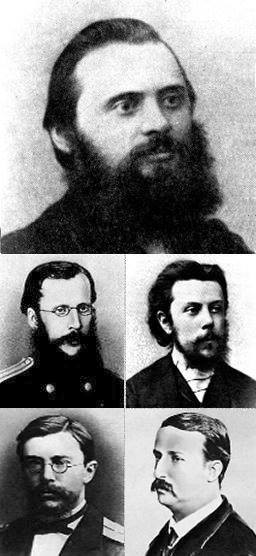
    WHEN BEARDS WERE IN: Top left, Mily Balakirev; bottom left (clockwise), Cesar Cui, Modest Mussorgsky, Alexander Borodin, Nikolai Rimsky-Korsakov; right, Sergei Lyapunov

  • Mily Balakirev and Russia’s Mighty Five

    Mily Balakirev and Russia’s Mighty Five

    Mily Balakirev was Russia’s musical kingmaker.

    Balakirev, of course, was the founder of the “Mighty Handful,” or “The Russian Five,” that collective of Russian nationalist composers that also included Nikolai Rimsky-Korsakov, Modest Mussorgsky, Alexander Borodin, and Cesar Cui.

    He had very strong ideas about what Russian music should be, and he was not at all bashful about telling other composers what to do. He essentially micromanaged the early careers of his acolytes, which included not only “The Five,” but on several occasions Peter Ilych Tchaikovsky.

    In his later years, though Balakirev’s influence was on the wane, he made two final, important contributions. He was responsible for introducing the prodigy Alexander Glazunov to Rimsky-Korsakov, and he was blessed with one last, very talented disciple, Sergei Lyapunov.

    This Sunday night on “The Lost Chord,” we’ll hear music by this last of the Russian nationalists, who was as much influenced by the keyboard prowess of Liszt as he was the patriotic zeal of his mentor. He also happens to be the composer of “The Lost Chord” signature music.

    I hope you’ll join me for “One Past Five,” music of Sergei Lyapunov – one hour later than usual, due to the length of today’s opera broadcast – this Sunday night at 11:00 EDT, on WWFM – The Classical Network and wwfm.org.


    WHEN BEARDS WERE IN: Top left, Mily Balakirev; bottom left (clockwise), Cesar Cui, Modest Mussorgsky, Alexander Borodin, Nikolai Rimsky-Korsakov; right, Sergei Lyapunov

  • Mily Balakirev Russian Music’s Kingmaker

    Mily Balakirev Russian Music’s Kingmaker

    Mily Balakirev was Russia’s musical kingmaker.

    Balakirev, of course, was the founder of the “Mighty Handful,” or “The Russian Five,” that collective of Russian nationalist composers that also included Nikolai Rimsky-Korsakov, Modest Mussorgsky, Alexander Borodin, and Cesar Cui.

    He had very strong ideas about what Russian music should be, and he was not at all bashful about telling other composers what to do. He essentially micromanaged the early careers of his acolytes, which included not only “The Five,” but on several occasions Peter Ilych Tchaikovsky.

    In his later years, though Balakirev’s influence was on the wane, he made two final, important contributions. He was responsible for introducing the prodigy Alexander Glazunov to Rimsky-Korsakov, and he was blessed with one last, very talented disciple, Sergei Lyapunov.

    This Sunday night on “The Lost Chord,” we’ll hear music by this last of the Russian nationalists, who was as much influenced by the keyboard prowess of Liszt as he was the patriotic zeal of his mentor. He also happens to be the composer of “The Lost Chord” signature music.

    I hope you’ll join me for “One Past Five” – music of Sergei Lyapunov – this Sunday night at 10:00 EDT, on WWFM – The Classical Network and wwfm.org.


    WHEN BEARDS WERE IN: Top left, Mily Balakirev; bottom left (clockwise), Cesar Cui, Modest Mussorgsky, Alexander Borodin, Nikolai Rimsky-Korsakov; right, Sergei Lyapunov

  • César Cui The Forgotten Mighty Handful

    César Cui The Forgotten Mighty Handful

    Among the followers of Mily Balakirev that collectively came to be known as “The Mighty Handful” or “The Five,” unquestionably the least well-known is César Cui. Nikolai Rimsky-Korsakov, Modest Mussorgsky, and Alexander Borodin all went on to attain a kind of immortality in Russian music, each having left his indelible mark.

    Cui wrote 15 operas, believe it or not – one of them, “William Ratcliff,” earning the highest praise from Franz Liszt – but today, he is remembered, if at all, as a miniaturist, or perhaps as a composer of art song, and at that, the least Russian-sounding of the five.

    He shared in common with the others the fact that for him music was an avocation. He paid his bills as a military engineer. Beyond that, however, he was a bit of an outsider – born in Vilnius (now in Lithuania) to a father who had been a general in Napoleon’s army, who stayed and married a local. In addition to Russian, Cui grew up speaking French, Polish and Lithuanian. Perhaps this broader cultural perspective led to a more cosmopolitan approach to music.

    As a critic, he was prolific, and he could be blistering in his sarcasm. Perhaps most notorious was his reception of Rachmaninoff’s First Symphony:

    “If there were a conservatory in Hell, and if one of its talented students were to compose a program symphony based on the story of the Ten Plagues of Egypt, and if he were to compose a symphony like Mr. Rachmaninoff’s, then he would have fulfilled his task brilliantly and would delight the inhabitants of Hell. To us this music leaves an evil impression with its broken rhythms, obscurity and vagueness of form, meaningless repetition of the same short tricks, the nasal sound of the orchestra, the strained crash of the brass, and above all its sickly perverse harmonization and quasi-melodic outlines, the complete absence of simplicity and naturalness, the complete absence of themes.”

    The assessment plunged Rachmaninoff into a two-year depression, during which he was unable to compose until being lifted out of his funk by hypnotic therapy. Of course, today everyone knows Rachmaninoff’s music (if not his First Symphony). How many, I wonder, know Cui’s?

    Join me this afternoon, on the anniversary of Cui’s birth, when we’ll listen to his “Deux morceaux” for cello and orchestra. We’ll also mark the birthdays of composers Emmanuel Chabrier, Berthold Goldschmidt, and Alfonso Ferrabosco the Elder, as well as conductor János Ferencsik, from 4 to 7:00 EST, on WWFM – The Classical Network and at wwfm.org.


    IMAGE: With so many whiskers in the room, you know you must be in the company of The Five. Center, left to right: Modest Mussorgsky (standing, by the piano), Nikolai Rimsky-Korsakov, Mily Balakirev (seated), César Cui (standing, with spectacles), and Alexander Borodin. I don’t know who the chap is standing in the center.

Tag Cloud

Aaron Copland (92) Beethoven (95) Composer (114) Film Music (123) Film Score (143) Film Scores (255) Halloween (94) John Williams (187) KWAX (229) Leonard Bernstein (101) Marlboro Music Festival (125) Movie Music (138) Opera (202) Philadelphia Orchestra (89) Picture Perfect (174) Princeton Symphony Orchestra (106) Radio (87) Ralph Vaughan Williams (85) Ross Amico (244) Roy's Tie-Dye Sci-Fi Corner (290) The Classical Network (101) The Lost Chord (268) Vaughan Williams (103) WPRB (396) WWFM (881)

DON’T MISS A BEAT

Receive a weekly digest every Sunday at noon by signing up here


RECENT POSTS