I devoted one of my posts the other day to news of a limited-time revival of “Ben-Hur,” back on the big screen, courtesy of Fathom Entertainment. The film has been showing at select theaters across the country over the past four days, with today being the last. If you’re at all interested in seeing it in its new 4K restoration, search for theaters in your area by clicking on “get tickets” at https://www.fathomentertainment.com/releases/ben-hur-2026/. Screenings tonight will likely begin sometime between 6:00 and 7:00.
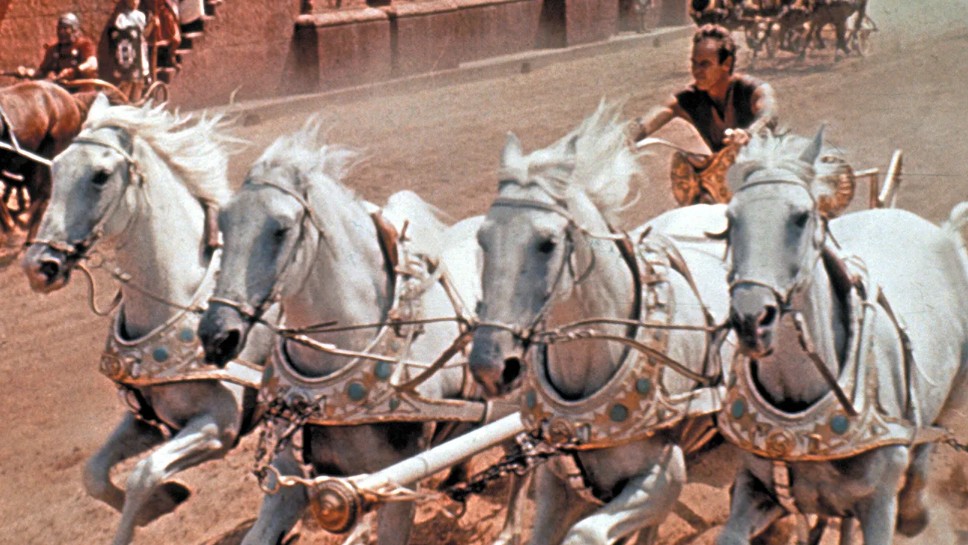
And let me tell you, the film looks great. Also, I don’t know that it’s ever sounded better. Miklós Rózsa’s fanfares and choruses soar, the clatter, thundering horse hoofs, and roar of the crowd during the chariot race thrill, and the earthquake following Jesus’ crucifixion terrifies.
Granted, the film is four hours long (presented with a brief intermission), but it is an absorbing story told on a grand scale. Why, then, was I the ONLY PERSON IN THE THEATER when I saw it last night? I mean, this was the most-decorated film of all-time, with a record-breaking 11 Academy Awards. It was also the highest grossing picture since “Gone with the Wind.” Everything about it is immaculately rendered (no pun intended).
Were people put off because it’s an old movie? By the length? By the religion? Because it was a work night? Here, the film was over by 9:50.
Most likely, they stayed away because it doesn’t have Ryan Gosling in a spaceship. Also, it’s less demanding to stay home and stream “content” as background to scrolling on the phone and texting friends.
If any of these is the case, I feel sorry for those people. But I am also concerned for the future of everything I hold dear. A large segment of the population, it seems, possibly a majority, lacks the curiosity and the attention spans of our parents and grandparents, who might have considered this a deeply satisfying, even transformative night out.
Concerning the religion, “Ben-Hur” is a peculiar movie. On the surface, it has a Christian outlook (Lew Wallace’s book bears the subtitle “A Tale of the Christ”), but the hero, blue-eyed Charlton Heston as the Judean prince Judah Ben-Hur, is proudly Jewish. Of course, the conflict in the film is more political than religious. Ethnic distinctions are drawn mainly along the lines of those in occupied lands who bristle under their Roman conquerors. There’s one scene wherein the Romans make a sneering remark about a proposed chariot race with Judah. “A Jew?” one remarks, incredulously (sponsored by an Arab, no less). But the Romans, in general, are a proud, supercilious lot.
The other day, I mentioned an alleged gay subtext (according to Gore Vidal) in the establishing scene between Judah and his childhood friend, Messala (played by Stephen Boyd), which does exude a certain, unusually ardent quality, though things very quickly go south as the men’s allegiances drive a wedge between them. However, given that Judah’s later relationship with the Roman general Arrius (played by Jack Hawkins) deepens into an equally unguarded affection, it would be easy to chalk it up to simple phileō. This was, after all, the ancient world.
That said, if there’s a more homoerotic mainstream American movie, I can’t think of it. There are half-naked, well-oiled men everywhere. They stop just short of snapping each other with their towels. And if it’s an historical or Biblical epic, you can bet Heston will be standing around in a loin cloth for at least some of it. It must have been in his contract.
The film is adapted from a bestselling novel by Civil War general Lew Wallace, the most-read American novel in the period between “Uncle Tom’s Cabin” and “Gone with the Wind.” Wallace claimed not to be particularly religious at the time he took up his pen, but on completion of the manuscript, he found he had become a believer.
The story is really a mash-up of “The Count of Monte Cristo” and a Jesus movie. Jesus pops in every once in a while, always viewed from the back of the head, as Rózsa’s score strikes a mystic tone. But the film is not really about Jesus, or rather it isn’t JUST about Jesus, as much as it is about getting in touch with your own humanity and embracing your better angels. Yes, the ideals advocated by Jesus point the way, but Judah himself, as a good and thoughtful person, grapples with the complexity and corrupting nature of the impulse to revenge. Heston delivers a nuanced performance, a career best, that conveys much of his character’s conflict and evolution through his thoughts, facial expressions, and physical bearing, as much of it is not explicit in the dialogue, though certainly supported by the compassionate exchanges in Judah’s encounters with Jesus.
Interestingly, Judah recognizes the extraordinary in these silent encounters, but he remains a Jew to the end (as opposed to converting to Christianity). Throughout the film he touches his mezuzah reverently, even tenderly, when entering his house. When his family’s fortunes plummet, still he adjusts the scroll and carefully tends to this symbol of his identity and faith. At a point, he covers his head and prays for forgiveness for his desire to seek vengeance. Whether or not he embraces Christianity beyond the action of the movie is unclear, but I think not. Nevertheless, he is transformed.
In a way, Jesus is an external symbol of Judah’s inner goodness. Or perhaps, putting it another way, Jesus becomes a catalyst for Judah’s self-awareness. A Roman early in the film remarks that Jesus teaches that God exists inside every one of us. (“It’s quite profound, actually,” he adds, with a far-away look.) Whether or not you are a “religious” person, whether you are Jewish or Christian, the film should still work for you. It’s interesting that, for such an earnest, at times histrionic presentation, it manages to satisfy when viewed from multiple perspectives.
Judah’s journey leads him through physical trials and into the emotional abyss. But he does believe in a higher power. He makes it clear several times throughout the film, most especially when he tells Arrius he cannot believe that God would keep him alive in the galleys for three years only to have him drowned at the bottom of the sea.
It’s an inspiring movie, not least of all for all the craftsmanship that went into it. The starfield in the film’s prologue, as the Three Magi travel to Bethlehem to pay homage at the manger, is magical. The kings, captured in profile, are like a Rembrandt brought to life. The stable scene is touchingly reverent, but the chance cavorting of a rambunctious calf saves it from stiffening into sanctimonious kitsch. And then the credits! My god, Miklós Rózsa’s music!
There were no computers back then, remember, so everything you see was made by hand. The sets, the expert matte paintings, the costumes on the cast of thousands. Those nine chariots racing around the arena with their teams of frothing horses are real. Stuntmen risked life and limb, and Heston and Boyd can be seen in some of the shots actually maneuvering their rigs. I know it’s a hackneyed phrase, but they really don’t make ‘em like this anymore!
I should add, the film is not for ironists. It is absolutely in earnest from beginning to end, but as I suggest, it’s open to a range of interpretations. It is the visual equivalent of reading a book. It feels like a literary experience. Whether or not it reflects Wallace’s original in that regard, I cannot say. I have yet to read it, but I’ll get around to it one of these days. For now, and as has been the case for decades, I hold the movie very close.
Heston, Boyd, Hawkins, Finlay Currie (as the king Balthasar), and Frank Thring (who plays Pilate as a consummate politician) have never been better. William Wyler (who was Jewish) was one of the most skilled Hollywood directors of all time. Google him and just look at his credits. He directed all kinds of pictures, from “Wuthering Heights” and “The Heiress” to “Roman Holiday” and “Funny Girl,” with very few of them being less than wholly satisfying. Several of them, including “The Best Years of Our Lives” and “The Big Country,” are among my all-time favorites.
You have one more chance to catch “Ben-Hur” on the big screen in its 4K restoration. I don’t care how good your system is at home. Watching it on your couch with distractions of the phone, the refrigerator, and easy access to a bathroom is not the same experience. Go, and prepare to be overwhelmed.