At the heart of Beethoven’s opera “Fidelio” is the struggle against tyranny and the triumph of liberty and justice. However, lofty ideals mean little in the face of an impending blizzard.
With the threat of perhaps a foot and a half of snow falling over the weekend, the period instrument orchestra Grand Harmonie made a prudent decision late last night to move their Saturday performance to this evening. So the U.S. premiere of “Fidelio” on authentic instruments will take place TONIGHT at 7:30 p.m. at Princeton University’s Richardson Auditorium.
One additional tidbit which may be of interest – the performance will be streamed live over YouTube. You can enjoy it in real time here:
Everything else remains as stated in my article in today’s Trenton Times:
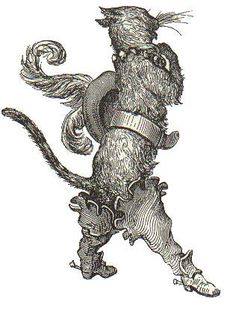
It looks as if there’s a pretty good storm brewing for the weekend. As I shop online for new boots, enjoy these selections from the one-act opera “El Gato con Botas,” by the Catalan composer Xavier Montsalvatge.
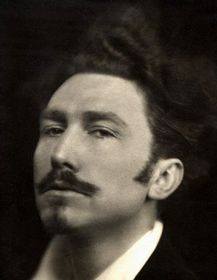
As a blow against Debussy and the pernicious influence of “Pelleas,” Pound contrived to write music of such rhythmic complexity as to leave “Le sacre du printemps” in the shade. Characteristically, the freewheeling poet described his method as “improving a system by refraining from obedience to all its present ‘laws.’” In other words, he was a proud contrarian.
In 1919, when Pound was 34 years-old, he conceived “Le Testament de Villon,” an operatic setting of François Villon’s poem of 1461. An ardent champion of Trenton’s own George Antheil from the composer’s early days in Paris, Pound enlisted Antheil’s help in developing a system of micro-rhythms the better to express the vitality of Villon’s Old French. The two worked at it in 1923. In 1924, Pound wrote a book titled “Antheil and the Treatise of Harmony,” a piece of hagiography so extravagant that it succeeded even in embarrassing the composer.
Preview performances in 1924 and 1926 brought criticism from the performers of the utter impracticality of the score. There are no rests or breath marks. There are crushing dissonances. The work’s demands call for scratches, hiccoughs, and the use of human bones in the percussion part.
Virgil Thomson praised the piece. “The music was not quite musician’s music,” he wrote, “though it may well be the finest poet’s music since Thomas Campion.” Pound’s colleague, the poet William Carlos Williams, described him thus: “…He knows nothing of music, being tone-deaf. That’s what makes him a musician.”
Excerpts from Pound’s “Le Testament de Villon” will receive a rare performance at the London Contemporary Music Festival on December 15. It is being advertised as the work’s UK premiere in its original version for two tins and a washboard. The first complete performance, in Antheil’s arrangement for small orchestra, was given over BBC radio in 1933.
Subsequently, Pound began work on two other operas. Neither was ever completed.
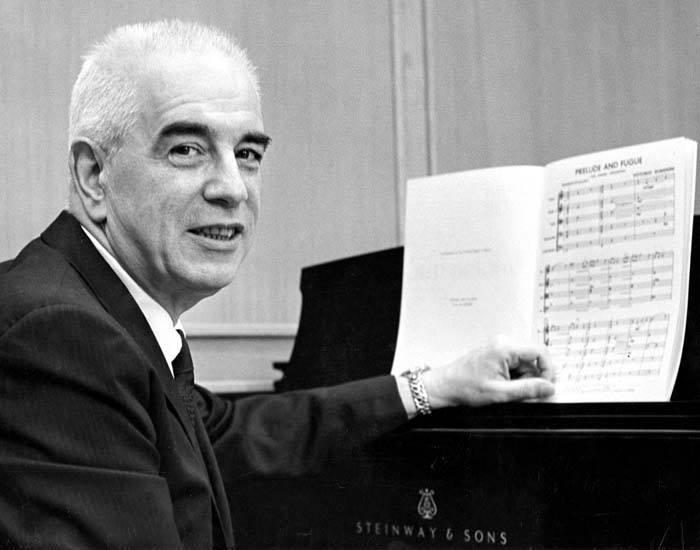
My newspaper duties have kept me off Facebook for most of the day, thereby frustrating my desire to send a shout-out to Philadelphia composer Vittorio Giannini on the occasion of his birthday anniversary.
Giannini was born in Philadelphia in 1903. He studied at the Milan Conservatory, after which he earned his graduate degree from Juilliard. He then taught at Juilliard, the Manhattan School of Music and the Curtis Institute.
Arguably his most important contribution as an educator was the foundation in 1965 of the North Carolina School of the Arts, which he envisioned as a Juilliard of the South. The school attracted to its faculty such luminaries as Ruggiero Ricci and Janos Starker. Giannini died the year after it opened, in 1966.
He was from a family of opera singers. His father founded the Verdi Opera House in Philadelphia. One sister taught voice at the Curtis Institute of Music and the other sang at the Metropolitan Opera. Giannini himself composed 14 operas, including “Lucedia,” “The Scarlet Letter,” “The Taming of the Shrew,” and one for radio, “Beauty and the Beast.” Two, “Casanova” and “Christus,” remain unperformed.
Not surprisingly, then, in his day he was known largely for his vocal music, but his Symphony No. 3 for wind band has fared best on disc. There are seven recordings in the current catalogue, from the classic release directed by A. Clyde Roller on the Mercury label to one of the later-in-life, digital recordings of Frederick Fennell.
Daniel Spalding, music director of the New Jersey Capital Philharmonic, recorded the Symphony No. 4 with the Bournemouth Symphony, for Naxos. The companion piece is Giannini’s Piano Concerto, with Gabriela Imreh, the soloist.
Spalding will conduct the New Jersey Capital Philharmonic Orchestra this Saturday, Oct. 24, at the Trenton War Memorial. The program will include Philip Glass’ “Concerto Fantasy for Two Timpanists and Orchestra” and Tchaikovsky’s Symphony No. 5. You can read all about it in the Friday edition of the Trenton Times.