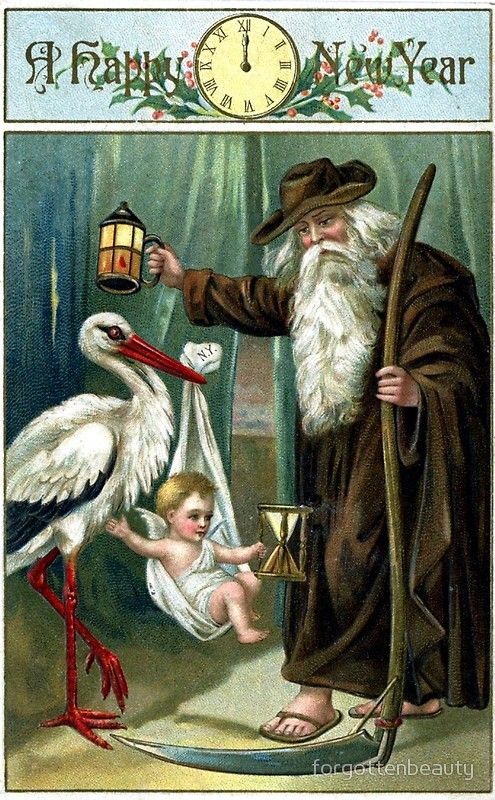
It’s always good practice to pay proper obeisance to a man with a scythe and nothing to lose. So try not to make too big a fuss about the kid in the diaper this week on “Sweetness and Light.”
I hope you’ll join me for a playlist that will blend the wisdom of experience with the exuberance of innocence. We’ll flip the hourglass to enjoy a few selections from operetta, including a concert overture on themes from Franz Lehár’s “The Merry Widow,” a duet from Oscar Straus’ “A Waltz Dream,” and the irresistible “Song of the Laugh,” an insert aria employed in Sidney Jones’ “The Geisha,” in a vintage recording, performed by Ukrainian soprano Claudia Novikova. Trust me, it will put a smile on your face.
In addition, we’ll have some variations on the familiar New Year’s melody “Auld Lang Syne” – one a playful multi-movement set in the styles of different composers by Franz Waxman (who wrote scores for such classic films as “The Bride of Frankenstein,” “Sunset Boulevard,” and “The Nun’s Story”), conceived for an informal New Year’s Eve get-together with his neighbor, Jascha Heifetz, and friends; the other, an orchestral showpiece incorporating parodies of no less than 129 familiar melodies, by British Light Music master Ernest Tomlinson.
Erich Wolfgang Korngold, who enjoyed a successful run of reviving the operettas of Johann Strauss II, brought some of that same breezy Old World elegance to his own Hollywood film scores, proving that you can take the composer out of Vienna, but you can’t take Vienna out of the composer, as demonstrated in his “Flirtation Waltz” from the 1936 Errol Flynn classic “The Prince and the Pauper.”
With only days left in 2024, Father Time still has a few tricks up his sleeve. I hope you’ll join me in raising a mimosa (or two) to the old man this week on “Sweetness and Light,” this Saturday morning at 11:00 EST/8:00 PST, exclusively on KWAX, the radio station of the University of Oregon!
Victor Herbert died 100 years ago today. Although perhaps we don’t hear very much of his music now, unless you’re a nostalgia buff with a sweet-tooth like mine, audiences of our grandmothers’ and great-grandmother’s generations were crazy for him. My grandmother was always singing his stuff. He was simply part of the cultural consciousness, as were the operettas of Gilbert & Sullivan. You didn’t have to love them (in the case of G&S, I did and I do), but everyone knew them.
And of course there were film adaptations of Herbert’s musicals, which, as they slipped further out of fashion, were ripe for parody. Haha, look at Nelson Eddy, singing this fruity song…!
But guess what? There’s a reason this stuff resonated the way it did. Herbert was a master of his craft and finely attuned to the tastes of his public. Even on those occasions when he displayed more ambition, he never did come across as “putting on airs.”
Born on the island of Guernsey in 1859, Herbert was told by his mother that he was born in Dublin – no doubt because of complications surrounding his parentage (apparently he was conceived out of wedlock) – and Herbert believed it for the rest of his life. He spent his early years in the home of his grandfather, Irish novelist and poet Samuel Lover. This ensured his continued affinity for Irish lore and culture.
When his mother remarried, Herbert followed her to Germany. His stepfather was a physician, and Herbert himself seemed destined for a medical career. But medical studies were expensive, so, possibly recollecting the colorful visitors of his grandfather’s circle, he decided to take up music instead.
The cello was his instrument. He performed in a number of orchestras, including that of Eduard Strauss, and he was selected by Johannes Brahms to play in a chamber orchestra for a concert celebrating the life and career of Franz Liszt. In meantime, he had begun to compose.
He married the soprano Therese Förster, and when she was invited to join the Metropolitan Opera in New York City, Herbert followed her to the United States. Förster, singing in German, became the Met’s first “Aida.” Anton Seidl conducted. Seidl would become an important mentor, fostering Herbert’s interest in conducting. In 1888, Herbert was installed as Seidl’s assistant conductor with the New York Philharmonic for its summer season at Brighton Beach. In 1898, he became principal conductor of the Pittsburgh Symphony Orchestra.
In the meantime, he continued to compose concertos, works for chorus and orchestra, symphonic poems, and lighter music. He was acutely aware of the importance of being properly compensated for his work. He became an activist for composers’ rights, testifying before Congress and influencing the development of the Copyright Act of 1909. This allowed composers to collect royalties for sound recordings. As a founding member of ASCAP (in 1914), and its director until his death in 1924, he also brought a landmark lawsuit before the U.S. Supreme Court, securing the right for composers to charge fees for public performance of their music.
Herbert composed two grand operas. One of them, “Natoma” (set in Santa Barbara, California, in 1820), allowed him to fabricate both Native American and Spanish motifs. The work was given its first performance in Philadelphia (by the Chicago Grand Opera Company) in 1911, with Mary Garden (Debussy’s Melisande) and John McCormack as the leads.
Here, the great Risë Stevens sings some of it.
The other opera, a one-acter called “Madeleine,” received its premiere at the Met in 1914.
But it was with his operettas that he struck gold. He would write 43 in all, beginning in the 1890s. By World War I, detecting Americans’ shifting tastes, he shrewdly transitioned to musical comedies. Composers like Irving Berlin and Jerome Kern would ask him to write ballet music for their shows, and he was a regular contributor to the Ziegfeld Follies.
After his death, the tiniest selection of his concert works may have lingered in a dusty corner of the repertoire, but beginning with the compact disc era, a few of these began to experience a resurgence. While Herbert was enormously successful as a musical theater composer, his most enduring contribution to the concert hall has proved to be his Cello Concerto No. 2.
Herbert was serving on the faculty of the National Conservatory of Music in New York at the time that Antonin Dvořák was its director. It’s said that Dvořák was not overly-fond of the cello as an instrument. It was a performance of Herbert’s dramatic piece that caused the scales to drop from his eyes, and Dvořák was spurred to compose his own masterful Cello Concerto in B minor, which remains the benchmark for all performers on the instrument and for any composer with the hubris to attempt their own.
Dvořák, of course, was the spiritual godfather of American music, advising our native artists to look no further than their own soil for inspiration, specifically to the music of Black and Native Americans. He led by example in writing works like his own “New World” Symphony. Victor Herbert was principal cello in the New York Philharmonic for the work’s world premiere at Carnegie Hall in 1893.
Rest well, Victor Herbert. Your music may have inspired snickers of derision from those of us who found fun in the treasures of our forebears, but in the end, you have the last laugh on us all.
Victor Herbert, Cello Concerto No. 2
For this holiday weekend, here’s Herbert wrapping himself in the flag as proudly as any American native-born. Be sure to read the comments under the video, as they offer some interesting insights into the recording.
Undeniably, Herbert had his vulgar streak, but I must too, because I can’t help but love his “Irish Rhapsody.”
Jeanette MacDonald sings “Ah! Sweet Mystery of Life” from “Naughty Marietta” (ruined forever by “Young Frankenstein”)
Madeline Kahn sings it, without the assistance of “the Monster”
Given the Ernie Kovacs treatment
Beverly Sills and Sherill Milnes sing “Thine Alone” from “Eileen”
Mario!
“March of the Toys” from “Babes in Toyland,” given the Laurel and Hardy treatment
I hope you’ll join me on this Saturday morning, the last of 2023, for some uplifting music calculated to charm and to cheer, on an all-new episode of “Sweetness and Light.”
We’ll enjoy selections from operetta, including a concert overture on themes from Franz Lehár’s “The Merry Widow,” a duet from Oscar Straus’ “A Waltz Dream,” and the irresistible “Song of the Laugh,” an insert aria employed in Sidney Jones’ “The Geisha,” in a vintage recording, performed by Ukrainian soprano Claudia Novikova. Trust me, it will put a smile on your face!
In addition, we’ll have some variations on the familiar New Year’s melody “Auld Lang Syne” – one a playful multi-movement set in the styles of different composers by Franz Waxman (who wrote scores for such classic films as “The Bride of Frankenstein,” “Sunset Boulevard,” and “The Nun’s Story”), conceived for an informal New Year’s Eve get-together with his neighbor, Jascha Heifetz, and friends; the other, an orchestral showpiece incorporating parodies of no less than 129 familiar melodies, by British Light Music master Ernest Tomlinson.
Erich Wolfgang Korngold, who enjoyed a successful run of reviving the operettas of Johann Strauss II, brought some of that same breezy Old World elegance to his own Hollywood film scores, proving that you can take the composer out of Vienna, but you can’t take Vienna out of the composer, as demonstrated in his “Flirtation Waltz” from the 1936 Errol Flynn classic “The Prince and the Pauper.”
I’ll be wishing you a sweet New Year this week on “Sweetness and Light.” Sweeten your morning and lighten your spirit by listening to it on KWAX, the radio station of the University of Oregon, this morning at 11:00 Eastern Time (8:00 on the West Coast). Stream it effortlessly at the link!
Here he is at the piano, in rare footage, with his great champion, tenor Richard Tauber, performing a selection from his operetta, “Paganini” – “Gern hab’ ich die Frau’n gekusst.” In English, it’s been circulated as “Girls are made to hug and kiss.”
Somehow, with a title like that, I don’t exactly see this music being embraced by a new generation. More’s the pity.
A literal translation would be more along the lines of “I was happy to kiss the woman.” Tauber presents it as “How I love to kiss a girl.”
Can you imagine going to a cinema today and having this offered as entertainment for the masses? And the masses being genuinely receptive? Take me back!
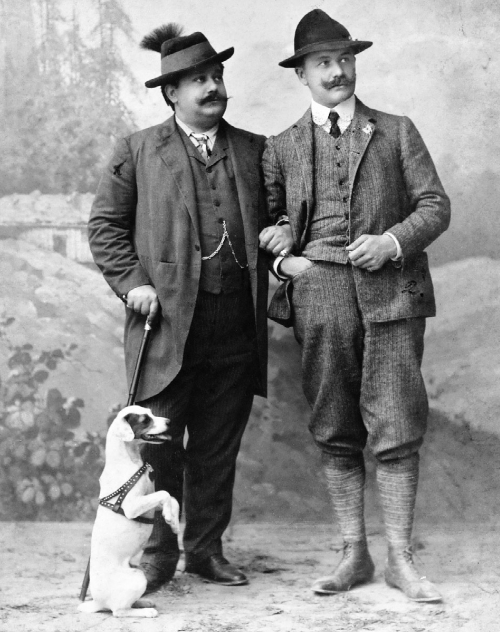
PHOTO: Lehár (right) with Heinrich Reinhardt, composer of the 1901 operetta, “Das süße Mädel” (“The Sweet Girl”)
Today marks the 200th anniversary of the birth of Jacques Offenbach.
Like Victor Herbert, who was born 40 years later, Jacques Offenbach was a master of operetta who gained experience as a cellist in theater orchestras. (Herbert even made it as far as the Metropolitan Opera.)
In Offenbach’s case, he finally attained a permanent position at Paris’ Opéra-Comique. Of course, his temperament was such that he was always getting busted down in pay for playing pranks. Once, he rigged everyone’s music stands to collapse in mid-performance.
Nevertheless, he managed to make a favorable impression on composer and conductor Fromental Halévy, who gave him private lessons in composition and orchestration. (Offenbach had left the Paris Conservatory out of boredom a year into his formal studies.)
With the help of Friedrich von Flotow, another future luminary of the musical stage, Offenbach gained access to the salon circuit. In this way, he bolstered his reputation as a performer and a composer. He toured France and Germany, performing with musicians such as Liszt and Anton Rubinstein. In England, he met Mendelssohn and Joseph Joachim.
Upon his return to Paris, he subtly altered his image from a cellist who happened to compose to a composer who played the cello. When the salons began to dry up, Offenbach gained employment as the musical director of the Comédie Française. There, he gained valuable experience actually writing for the stage, though his success did not transfer to the Opéra-Comique. Debussy noted that the musical establishment of the time had difficulty coping with the composer’s sense of irony.
By the time Offenbach finally did crack the Opéra-Comique with “The Tales of Hoffmann,” he was already in the grave. Though he died before putting the finishing touches on his opera, the orchestration was completed by other hands, and the work has not been out of the repertoire since.
Somewhere in heaven, undoubtedly, Offenbach is sawing half-way through the columns of the harps and enjoying the last laugh.