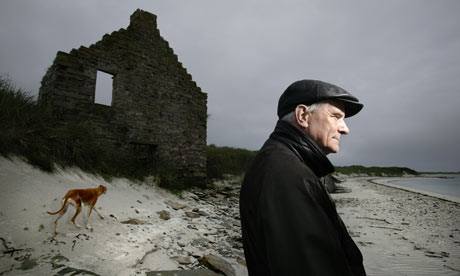
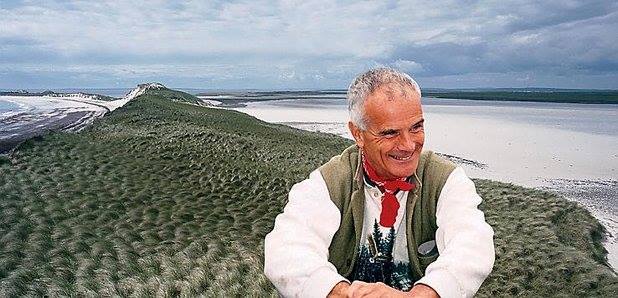
He burst onto the British musical scene as a fiery iconoclast. Then late in life he ascended to the ultimate Establishment post of Master of the Queen’s music. He was a passionate advocate both of music education for the young and the importance of music in (and from) the community, yet a good many of his major works could be rather forbidding. He wrote pieces that seem to thumb their nose at centuries-old traditions, lacing them with trifling foxtrots. Yet he embraced and elevated that most standardized of forms, the symphony. He ping-ponged back and forth from irreverence to austerity to genuine popular acceptance with folk-inflected works like “An Orkney Wedding with Sunrise” (which he wrote for the Boston Pops). To say that Sir Peter Maxwell Davies was a man of contradictions is an understatement.
This Sunday night on “The Lost Chord,” we remember Max, who died on March 14 at the age of 81. It was exceedingly difficult to find three works that could encapsulate the most distinctive and disparate aspects of his creative personality, but I believe I’ve finally done so. Part of the challenge is that the symphonies are so blooming long, with all of them (of the ones I know, with the exception the Fifth) running to an hour in length. At last, I struck upon “The Beltane Fire,” which grew out of a ballet commission, but took on a life of its own. The work is meant to suggest the historical conflict between the Reformation clergy and the pagan traditions of the Orkney Islands, located off the northern coast of Scotland. Max enlivens the rather austere sound world of the symphonies with populist interludes in the kind of folk style that worked so well in “An Orkney Wedding.”
We’ll begin with a cheeky little piece from his “enfant terrible” period inspired by Henry Purcell – a “realisation” (so called) of a “Fantasia and Two Pavans.” The Fantasia employs a shrill piccolo, suggestive of a baroque organ, and the “pavans” are actually foxtrots. Listen for some great aural jokes in the second of them, including a simulation of a Victrola winding down and being wound up again, and then of the “white noise” at the end of a record.
We’ll conclude with one of Max’s most beloved pieces, a moving work for piano called “Farewell to Stromness.” It was actually written in protest against a proposed uranium mine, which would have been located not far from the town of the title, again located in the Orkney Islands. Though Max was born in Lancashire, he made his home in the Orkneys since 1971.
A point of local interest: Max, a product of the University of Manchester and the Royal Manchester College of Music (later amalgamated into the Royal Northern College of Music), traveled to Princeton in 1962 to study with Roger Sessions, Milton Babbitt and Earl Kim.
I hope you’ll join me for “Farewell to Max,” as we remember Sir Peter Maxwell Davies, this Sunday night at 10 EDT, with a repeat Wednesday evening at 6; or that you’ll listen to it later as a webcast at wwfm.org.