Luxon made more than one hundred recordings, many of them devoted to English song. One of my favorites was a recital on Chandos Records devoted to the songs of Peter Warlock. Of course, Warlock being Warlock, a percentage of those songs are about drinking and milkmaids.
As an up-and-coming singer, Luxon joined Benjamin Britten’s English Opera Group and went on to appear in a number of the composer’s productions. Britten conceived the title role of his television opera “Owen Wingrave” specifically for Luxon’s voice.
Luxon sang at Covent Garden, the Glyndebourne Opera Festival, and most of the major European houses. He also performed at the Metropolitan Opera in New York City. In his quiver of roles were Falstaff, Wozzeck, Don Giovanni, Eugene Onegin, and Papageno.
As a recitalist, his repertoire was broad, ranging from early music to lieder to contemporary song, music hall, and folk music. With tenor Robert Tear, he worked to revive forgotten and dimly-recollected parlor songs. In recital, he was frequently accompanied by pianist David Willison.
Beginning around 1990, Luxon began to experience hearing loss. He retired from singing, but continued to appear as a reader and narrator and to give masterclasses and direct. He lived his final years in the Berkshires of Western Massachusetts, also home to the Tanglewood Music Center, where he had been a frequent guest.
Luxon died on Thursday at the age of 87. R.I.P.
Channeling “MacArthur Park”-era Richard Harris (but in better voice)
Since I am such a musical anglophile, and since Halloween happens to be my favorite holiday, I suppose it’s hardly surprising that my thoughts would gravitate to the influence of the occult on English music.
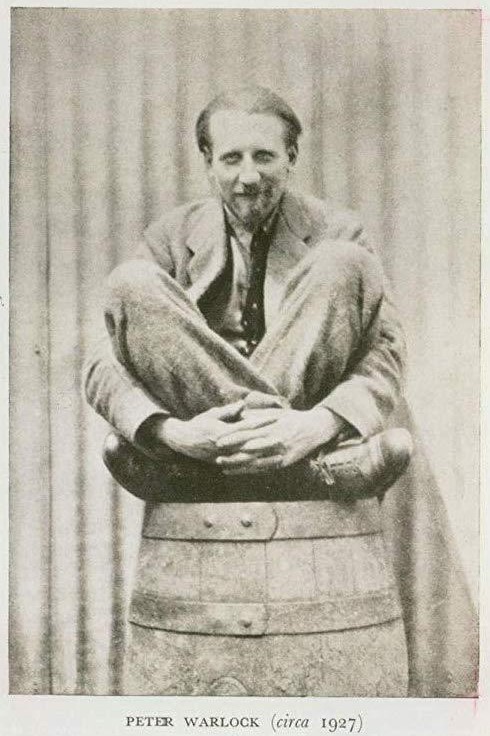
Most notorious, perhaps, would be the case of Philip Heseltine, who composed under the name of Peter Warlock. Heseltine was born on this date in 1894. He lived a scandalous life – carousing, trolling his enemies, riding naked on a motorcycle, and using one of D.H. Lawrence’s manuscripts as toilet paper – while pursuing his fascination with “the science known as Black Magic.” His life ended when he was only 36 years-old, his body found in his flat – the cause of death: gas poisoning. He left behind 100 songs, a number of choral works, and a handful of orchestral pieces. Whether or not his end was accidental has never been unanimously accepted.
The first time Heseltine assumed the pen name Warlock was for a 1916 article on the chamber music of Eugene Goossens. Goossens, who would later be honored with a knighthood, spent the better part of a decade in Australia, conducting the Sydney Symphony Orchestra and directing the NSW State Conservatorium of Music.
It wasn’t all work and no play, however. During his leisure hours, Goossens entered into a passionate affair with Rosaleen Norton, soon to be known as the Witch of Kings Cross. Norton was an artist and occultist, whose paintings of demons and phalluses were decidedly out-of-step with the spirit of the time.
In 1955, a scandal involving a mentally ill woman who claimed she had participated in a Satanic Black Mass at Norton’s flat had a domino effect. Sure, Norton had her own coven, but she denied ever being a Satanist. She did however stand by her charms and hexes. Her paintings were removed from public exhibitions and photographs were confiscated from her home. Arrests on obscenity and blasphemy charges came fast and furious. The tabloids had a field day.
Unfortunately, Goossens became collateral damage. Incriminating letters, which he had asked Norton to destroy after reading, were found stashed beneath her sofa. Though he was in England when the storm broke, wholly ignorant of the antipodean moral panic, the authorities lay in wait upon his return. Among his luggage were found 800 “pornographic” photos, film, masks, and incense. As a high-profile musical figure, for all intents and purposes, the conductor’s Goossens was cooked.
Then there was the matter of the Hermetic Order of the Golden Dawn. The order, which sported Aleister Crowley among its members, was a secret society devoted to occult, metaphysical, and paranormal activities. I once wrote a post about the composer John Ireland’s relationship with Welsh writer of the supernatural Arthur Machen, who also belonged to the society. Ireland wrote several works profoundly influenced by Machen’s philosophies and dedicated his piece for piano and orchestra, “Legend,” to him.
Even Sir Edward Elgar, composer of “Land of Hope and Glory,” had his brush with the occult, by way of supernatural writer Algernon Blackwood, also a member of the Hermetic Order. Elgar provided incidental music for “The Starlight Express,” based on Blackwood’s “A Prisoner in Fairyland.” The two men struck up a friendship, and though there is no evidence to link Elgar to actual involvement with the Golden Dawn, there are those who allege there to be Rosicrucian symbols in the “Enigma Variations,” completed years earlier, in 1899.
Sir Arthur Conan Doyle, Gustav Meyrink, Sax Rohmer, Bram Stoker, and William Butler Yeats were also members of the secret order. I imagine them all, like something out of Dennis Wheatley, gathering in their robes to offer up sacrifices to the Goat of Mendes!
Since I am such a musical anglophile, and since Halloween happens my favorite holiday, I suppose it’s hardly surprising that my thoughts would gravitate to the influence of the occult on English music.
Most notorious, perhaps, would be the case of Philip Heseltine, who composed under the name of Peter Warlock. Heseltine was born on this date in 1894. He lived a scandalous life – carousing, trolling his enemies, riding naked on a motorcycle, and using one of D.H. Lawrence’s manuscripts as toilet paper – while pursuing his fascination with “the science known as Black Magic.” His life ended when he was only 36 years-old, his body found in his flat – the cause of death: gas poisoning. He left behind 100 songs, a number of choral works, and a handful of orchestral pieces. Whether or not his end was accidental has never been unanimously accepted.
The first time Heseltine assumed the pen name Warlock was for a 1916 article on the chamber music of Eugene Goossens. Goossens, who would later be honored with a knighthood, spent the better part of a decade in Australia, conducting the Sydney Symphony Orchestra and directing the NSW State Conservatorium of Music.
It wasn’t all work and no play, however. During his leisure hours, Goossens entered into a passionate affair with Rosaleen Norton, soon to be known as the Witch of Kings Cross. Norton was an artist and occultist, whose paintings of demons and phalluses were decidedly out-of-step with the spirit of the time.
In 1955, a scandal involving a mentally ill woman who claimed she had participated in a Satanic Black Mass at Norton’s flat had a domino effect. Sure, Norton had her own coven, but she denied ever being a Satanist. She did however stand by her charms and hexes. Her paintings were removed from public exhibitions and photographs were confiscated from her home. Arrests on obscenity and blasphemy charges came fast and furious. The tabloids had a field day.
Unfortunately, Goossens became collateral damage. Incriminating letters, which he had asked Norton to destroy after reading, were found stashed beneath her sofa. Though he was in England when the storm broke, wholly ignorant of the antipodean moral panic, the authorities lay in wait upon his return. Among his luggage were found 800 “pornographic” photos, film, masks, and incense. As a high-profile musical figure, for all intents and purposes, the conductor’s Goossens was cooked.
Then there was the matter of the Hermetic Order of the Golden Dawn. The order, which sported Aleister Crowley among its members, was a secret society devoted to occult, metaphysical, and paranormal activities. A couple of weeks ago, I wrote about the composer John Ireland’s relationship with Welsh writer of the supernatural Arthur Machen, who also belonged to the society. Ireland wrote several works profoundly influenced by Machen’s philosophies and dedicated his piece for piano and orchestra, “Legend,” to him.
Even Sir Edward Elgar, composer of “Land of Hope and Glory,” had his brush with the occult, by way of supernatural writer Algernon Blackwood, also a member of the Hermetic Order. Elgar provided incidental music for “The Starlight Express,” based on Blackwood’s “A Prisoner in Fairyland.” The two men struck up a friendship, and though there is no evidence to link Elgar to actual involvement with the Golden Dawn, there are those who allege there to be Rosicrucian symbols in the “Enigma Variations,” completed years earlier, in 1899.
Sir Arthur Conan Doyle, Gustav Meyrink, Sax Rohmer, Bram Stoker, and William Butler Yeats were also members of the secret order. I imagine them all, like something out of Dennis Wheatley, gathering in their robes to offer up sacrifices to the Goat of Mendes!
It’s the end of October already. Time to fortify ourselves against the harsher months. A simple click of the mouse can help us squirrel away a little something against a snowy day.
If you love what we do at The Classical Network, and classical music is an indispensable part of your life, please support it by contributing right now at wwfm.org (click on “donate”), or by calling us at 1-888-232-1212.
We’ll be on the air today and tomorrow, from 9 a.m. to 7 p.m. EDT, to remind you why The Classical Network is your radio station of choice.
Join me this afternoon, from 4 to 7, to celebrate autumn, to acknowledge the birthdays of Peter Warlock and Frans Brüggen, and to get a jump a Halloween. At 6:00, we’ll have a special performance of André Caplet’s “Conte fantastique,” inspired by Edgar Allan Poe’s “The Masque of the Red Death,” on “Music from Marlboro.”
Help make this a gathering of gratitude. If you’re nutty for great music, keep us bright-eyed and bushy-tailed, by calling us right now at 1-888-232-1212, or by leaving us a little seed money (bird seed, that is) at wwfm.org.
With your help, we can make our nut. Thank you for your support of WWFM – The Classical Network.