Tag: Philadelphia Orchestra

  • A Convergence of John Williams Concert Music

    A Convergence of John Williams Concert Music

    This is a good season for John Williams’ concert music, at least where I live. I’m not talking about his film scores, which are likely being listened to somewhere in the world every day. I’m talking about his concertos, of which he has composed many, beginning with the Flute Concerto of 1969. My personal favorites are his first Violin Concerto (in its original version of 1974-76), the bassoon concerto “Five Sacred Trees” (1995), the Cello Concerto (1994; still undecided between the original and revised versions), and the Trumpet Concerto (1996).

    I’ve been lucky enough to attend performances of the revised Violin Concerto, the Cello Concerto (in both versions), and Violin Concerto No. 2 (2021) on concerts of the Philadelphia Orchestra. However, the first one I ever actually heard was on the radio, when the Tuba Concerto (1985) was included on a broadcast of the Cleveland Orchestra. Somehow, over 40 years later, I have never heard it live.

    This is perhaps the most immediately appealing of Williams’ concertos for those who enjoy his film scores. The first movement, especially, shares some of the wide-open exuberance of, for instance, the lighter moments in “Jaws.” So it is with some pleasure that I look forward to finally hearing it on Friday afternoon on a concert of the Philadelphia Orchestra, with principal tubist Carol Jantsch.

    The performance will take place at Philadelphia’s Kimmel Center for the Performing Arts. Also on the program will be Julius Eastman’s Symphony No. 2 and Felix Mendelssohn’s “Italian” Symphony. Dalia Stasevska will conduct.

    Friday afternoon no good for you? The program will be repeated on Saturday at 8:00. The Tuba Concerto and “Italian” Symphony will also be performed, without the Eastman, as part of the orchestra’s Happy Hour Concert series on Thursday at 6:30. Get there at 5:00 for pre-concert specials on food and drink and free activities. Happy Hour concerts are followed by post-concert talks with the artists.

    I’m also locked in for Williams’ new Piano Concerto, given its premiere this past summer at Tanglewood. Soloist Emanuel Ax will be bringing it to the New York Philharmonic for four performances at Lincoln Center’s David Geffen Hall, February 7-March 3. Also on the program will be Ralph Vaughan Williams’ “Fantasia on a Theme by Thomas Tallis” and Mieczyslaw Weinberg’s Symphony 5. Mirga Gražinytė-Tyla will conduct.

    As a little cherry on top, I hold a ticket to a Philadelphia Orchestra concert on May 1 that will open with a suite from Williams’ “Close Encounters of the Third Kind.” I don’t generally like Williams’ arrangements of his film scores for the concert hall. There are exceptions, but I don’t think he’s always the best at distilling what makes his movie music so magical, beyond the recognizable themes, and translating it for use on symphony concerts. This is frustrating, because the music is excellent, as it was written, and I do wish it could be worked into something more along the lines of “The Firebird Suite.” A lot could be done with 20 minutes. Williams takes 10.

    Anyway, it’s on the same program with Aaron Copland’s Symphony No.3 and, in between, Matthias Pintscher’s “Assonanza” for Violin and Orchestra. Leila Josefowicz will be the soloist, and Pintscher himself will conduct. There will be three performances, April 30-May 2.

    I am only in the last 35 pages or so of Jane Austen’s “Persuasion,” which I picked up dutifully to honor the 250th anniversary of her birth. I really want to knock it out today, because I’m dying to start the new John Williams biography by Tim Greiving, a 640-page doorstep issued by Oxford University Press.

    February 8 will mark the composer’s 94th birthday. Williams is said to be at work on the score for Steven Spielberg’s upcoming extraterrestrial opus “Disclosure Day,” which has been slated for a June 12 opening.

  • Battle of the Barbers:  Augustin Hadelich and Randall Goosby Play Samuel Barber’s Violin Concerto

    Battle of the Barbers: Augustin Hadelich and Randall Goosby Play Samuel Barber’s Violin Concerto

    It’s the battle of the Barbers!

    Early last week, I posted about how I had inadvertently scheduled two concerts on the same day, both of them featuring the Samuel Barber Violin Concerto.

    How did it happen? I impulsively acquired a seat to Friday afternoon’s Philadelphia Orchestra concert, practically as an afterthought, to fill-out the quota for a package deal for deeply-discounted tickets. What I’d failed to take into account was that I was already set to hear the concerto in Princeton on Friday evening, on a program presented by the New Jersey Symphony!

    An embarrassment of riches, then, and a rare opportunity to juxtapose two interpretations of the same work, which turned out to be quite different from one another.

    Classical music enthusiasts tend to toss around a lot of comparatives, and most of them incline toward the hyperbolic: This is the best recording. That performance was terrible! He was the greatest violinist of all time, and so forth. But really, is life always screwed to such a fever pitch? Is there no room for nuance?

    I’ll offer my personal assessments of this weekend’s performances at the end of this post – and I can’t promise that they will be without overzealous comparatives – but first, a few words on my history with this particular concerto:

    The first time I encountered the work was on a concert of the Philadelphia Orchestra, back in 1986. Elmar Oliveira was the soloist, and – can you imagine? – the concerto was on the same program as Prokofiev’s Symphony No. 6! Riccardo Muti, then the orchestra’s music director, conducted. What an evening! I hasten to add that Prokofiev was probably my favorite composer at the time, and I was devouring all of his music that I could.

    Of course, I was still learning the repertoire, and as a young person, the frontier seemed wide-open. Whenever I encountered something I liked, I raced to the record store as soon as I had the funds to acquire it. I very quickly figured out that the most efficient way for me to accomplish this was to actually get a job as a record clerk – which I did, at a Sam Goody at 11th and Chestnut Streets, which at the time had the most extensive classical music section in the city. (This was before the arrival of Tower Records.)

    Can you believe we had three people working the classical department? That’s what record stores were like in those days, when the technological development of the compact disc injected new life into the industry, with collectors eager to upgrade their libraries and push the limits of their audio equipment. It was there that I acquired Neeme Järvi’s Prokofiev cycle. Essentially, I wound up turning over most of my paycheck for the blister-packaged merchandise I had squirreled away in a cardboard cubby in the basement. I was still quite green, frankly, but I did have a greater-than-average knowledge of classical music, and as they say, in the kingdom of the blind, the man with one eye is king.

    This may seem like another one of my flighty digressions, but I offer it as backdrop to the acquisition of my first recording of the Barber concerto. I was still buying used LPs, and some of the new soundtrack albums were still being released exclusively on vinyl, but by this point CDs had become an obsession. Isaac Stern’s classic recording of the Barber, with Bernstein and the New York Philharmonic, had yet to be reissued, and there really wasn’t very much competition on compact disc. The recording we had in stock, on the ProArte label, featured Joseph Silverstein as the soloist. He also conducted the rest of the selections, with the Utah Symphony, including Barber’s “The School for Scandal Overture” and the Second Essay for Orchestra. It actually turned out to be a very satisfying disc.

    Oliveira finally recorded the concerto himself, with Leonard Slatkin and the Saint Louis Symphony Orchestra, his performance released on EMI in 1987. On the same disc was Howard Hanson’s “Romantic” Symphony. I remember my heart was beating so fast when I discovered this at the local mall. Now there are so many recordings of each.

    For a time in the early ‘90s, I used a lugubrious passage from the slow movement of the concerto as a music bed on my answering machine. I was in my early 20s, licking my wounds from having been dumped by my college girlfriend. We were together for five years, basically, and it was not a clean break. Also, I had no idea what I wanted to do with my life. I’d taken a year to pound out some stories and send them to some magazines, while working at a Holiday Inn, delivering pizzas, etc.

    Now I was caught in a series of dead-end retail jobs, mostly bookstores, with a bunch of other drifters, and it took me a few years to finally figure out that I could start my own. Of course, as soon as I moved on it and signed a lease on a store front, I was called to come in for the interview that landed me my first paid job as a classical music radio host. A Ross divided against himself cannot stand! Nevertheless, I continued the balancing act for the next 13 years, sleeping very little, I might add. Then I packed in the books (not that I’ve unloaded them all) and kept on with the radio.

    But at the time I mention, in the early ‘90s, I was still wallowing in an impecunious quagmire, on my feet all day, working myself into exhaustion at a Barnes & Noble superstore, then coming home and blacking out on a fold-out sleeper sofa for an hour or so, before sitting down to a bowl of potato gruel and an evening of Wagner or Mahler on the old hi-fi.

    It won’t surprise you to learn, I was often late on the rent. This is always stressful, but especially so, when your landlord lives in the same building. In this case, I was on the first floor, in an efficiency in the back of the building, with very little sunlight, but a tiny yard where I could enjoy my coffee in the morning and air out my clothes after a night downing Yuengling at a local dive bar.

    Awkwardly, the fire escape was right behind the sofa bed, so that every morning I would see my landlord walk down the steps with his bicycle, before pedaling off to his university job. As he was a professor of English literature, I had hoped that maybe he could pass along some leads to some employment opportunities (this was in the days before the internet) – I was, after all, an English major – but he never knew of anything. Anyway, sometimes he would phone my machine. Once, he left a message, probably hoping for the rent, in which he remarked, “Samuel Barber is not half so ominous as you are.”

    At work, I was always ordering books for myself, taking advantage of the employee discount. So another time, I was standing right next to one of my coworkers, whose task it was to call customers to notify them that their orders had come in. I wasn’t really paying attention, but after she hung up the phone, she muttered, “That guy’s machine sounds like a funeral parlor.” I took a look at the slip and busted out laughing. Of course that guy was me, my funereal manner enhanced by the Barber Violin Concerto.

    Barber’s concerto, composed in 1939, is unapologetically lyrical, with long-limbed melodies and, in its first two movements, a yearning, even elegiac, quality. The final movement is an about-face, a grotesque moto perpetuo, during which the soloist is let off the leash for a thrilling romp around the park.

    The first public performance was given by violinist Albert Spalding, with the Philadelphia Orchestra conducted by Eugene Ormandy at the Academy of Music at Broad and Locust Streets in 1941. I wonder if Barber, who died in 1981, could ever have anticipated just how much this concerto would take off. I doubt if there’s a major violinist in the world today who doesn’t have it in their repertoire.

    But times were different in the 1940s. WPA-style composers were writing big, populist ballets and symphonies to boost morale during World War II, but all the while avant-gardists, many of whom embraced Arnold Schoenberg’s rejection of tonality, were engaged in subverting what they regarded as dangerously subjective, overly emotional (i.e. irrational) tendencies that had propelled civilization into two cataclysmic wars. In their place, they advocated a coolly rational, more objective music. Big, Romantic gestures were eyed with suspicion, if not disdain, and academics and public (the latter always appreciative of a good tune) parted ways.

    Like Rachmaninoff, Barber was viewed as something of an anachronism. Unlike Rachmaninoff, he didn’t make the piano the center of his output. Nor did he possess the virtuosic technique as a performer to whip audiences into a frenzy. Anyway, Barber, though clearly capable of expressing emotion (as in his famous “Adagio for Strings”), preferred to do so with dignity and restraint. His preferred idiom was post-Brahmsian. There are flashes of anguish, but he never allows himself to wallow or teeter over into hysteria.

    Perhaps this explains Augustin Hadelich’s interpretative decisions on Friday afternoon in Philadelphia. His take on the Violin Concerto was restrained to a fault – intimate, surely, but practically interior, for most of it nearly to the point to disengagement. There is something to be said for subtlety, and Barber himself would have been horrified ever to be caught blubbering. But there is a difference between drawing the listener in and leaving him or her out in the cold. Others may have reacted differently – there were cheers and the requisite standing ovation – but I didn’t find it particularly involving. As with “Hamnet,” I never would have survived without a cup of coffee. In the last movement, Hadelich proved – as if he needed to – that he was up to the work’s technical challenges, He’s a super violinist, who played a memorable Sibelius concerto when I last saw him in Philadelphia a few seasons ago – but I’m afraid it was too little, too late, and I came away feeling as if the whole thing had been underpowered.

    I wonder too if trying too much to sculpt the music robbed it of some of its allure. On the second half of the concert, I felt Mahler’s Symphony No. 4, though one of his more intimate works, was also marred, a few passages aside, for the same reason – by babying it too much. Ironically, the work is infused with suggestions of childhood – quotations of folk song from the collection “Des Knaben Wunderhorn” and the final text relating a child’s vision of Heaven. (Once she settled in, soprano Joélle Harvey was radiant.) But there are also insinuating, sinister forces at play – dances of death, suggestions of funeral marches, and so forth. Except for those moments when, for instance, timpanist Don Liuzzi was allowed to rip, the performance turned out to be no more than up to the Philadelphia Orchestra’s usual fine standard, but in no way exceeding it.

    It pains me to say so, since I am an admirer of the conductor, Dalia Stasevska. A few years ago, she conducted a Sibelius 5th Symphony that so far exceeded Esa-Pekka Salonen’s rendition when I heard him with the orchestra the following season, it wasn’t even in the same universe. Though Stasevska was born in Ukraine, both conductors are Finnish-bred. However, Stasevska does Salonen one better by being married to Sibelius’ great-grandson!

    The whole experience was eclipsed by what I heard in Princeton on Friday evening, when Randall Goosby joined the New Jersey Symphony for a richly-satisfying performance of the Barber. I wonder if the individual venues might also have influenced my judgment. Hadelich played at somewhat of a remove in the cavernous Marian Anderson Hall at Philadelphia’s cathedral-like Kimmel Center for the Performing Arts. Goosby played in the much more intimate Richardson Auditorium at Princeton University, where the performers are practically in your lap. So Goosby’s instrument could be heard even in the work’s orchestral climaxes. But overall, my impression was that Hadelich was living in his head, while Goosby was letting us into his heart.

    Of course, the conductor was the New Jersey Symphony’s Xian Zhang, whose podium manner makes Leonard Bernstein seem positively restrained by comparison. Zhang works hard, sometimes distractingly so, as she attempts to convey a sense of energy to her players, and I have to admit, it sometimes lends to the excitement of the performance. At others, it can be so over the top, you can’t help but smile. But is that such a bad thing? Especially when the second half of the program was Tchaikovsky’s Symphony No. 2, once commonly nicknamed in English-speaking countries the “Little Russian,” until world events precipitated a shift toward identifying it as the “Ukrainian.” Tchaikovsky lived and composed in Ukraine for part of the year, and the work is infused with Ukrainian folk song. The music is infectious, totally sidestepping the pathos of the later, more commonly-performed symphonies, with a march in place of the standard slow movement. The piece is downright balletic at times, and the climax is so manic that I couldn’t help but burst into laughter a few bars before the end.

    This is the work George Plimpton wrote about after touring with the New York Philharmonic as a celebrity guest percussionist. Of course, Plimpton wasn’t a musician. That was his whole schtick – join the professionals, whether they be football players, boxers, or musicians, and then write about the experience. Plimpton had one job. He had to strike the gong in an exposed, pregnant moment, before a final mad crescendo to the double-bar line. He tells us that in his adrenaline rush, he smacked the thing so hard, he saw Bernstein’s eyes widen, and the shock wave travel out across the musicians into the audience to the back of the hall, and then the orchestra had to wait for the sound to decay so that they could start to play again.

    Friday night’s gong-strike was not quite that egregious, but the performance itself was thrilling in the extreme, and altogether much more satisfying than anything I heard from the orchestra’s starrier rivals in Philadelphia that afternoon. I mean, come on. The concert opened with “Finlandia,” for crying out loud. If that doesn’t prime an audience, I don’t know what will.

    So in the battle of the Barbers, the championship belt goes to Goosby. I still have faith in Hadelich, a marvelous violinist. Both artists are very much in their prime, and I look forward to, if not a rematch, then many happy musical experiences with them in the years ahead.

    ——–

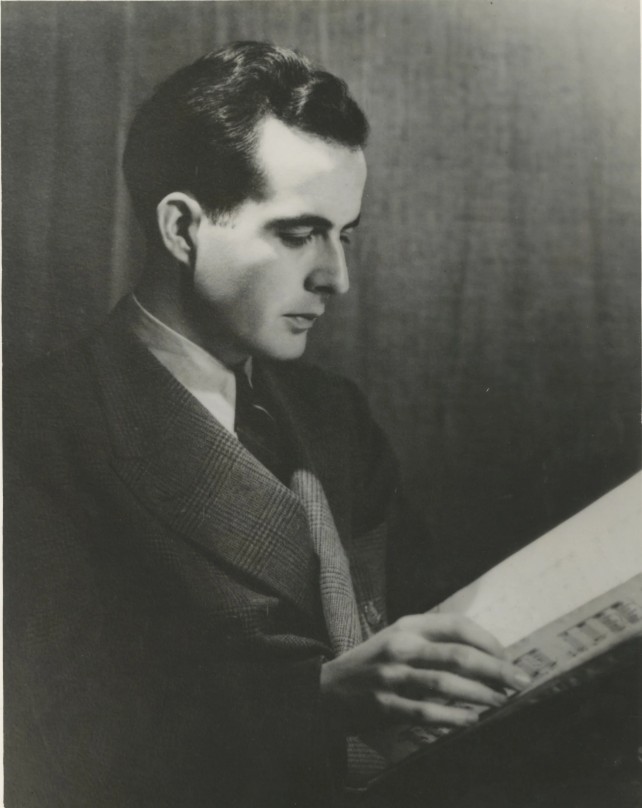
    PHOTO: Samuel Barber in 1941
  • From Out of the Wilderness to the Land of Plenty

    From Out of the Wilderness to the Land of Plenty

    Holy smokes! Now that the holiday “routine” is finally winding down (getting ahead on my radio shows, visiting and hosting family, and generally being festive to the point I have no idea what day of the week it is), I glance at the calendar and realize that I’ve totally, inadvertently crammed next weekend with concerts. And somehow two of those concerts feature the Barber Violin Concerto – on the same day!

    How did it happen? I impulsively acquired a seat to Friday afternoon’s Philadelphia Orchestra concert as part of a package deal for deeply-discounted tickets. Of course, I leaped at those programs that really appealed to me, the ones I regarded as must-see (or hear), and then to fill the quota, I picked the Friday concert.

    And what’s not to like? The program includes, beside the lovely and moving Barber concerto (with the excellent Augustin Hadelich as soloist), Mahler’s winning Symphony No. 4, and John Adams’ “Short Ride in a Fast Machine” (John Adams for people who think they don’t like John Adams). Furthermore, Dalia Stasevska will be conducting, and I confess I am a little bit in love with her. (The fact that she’s married to Sibelius’ great-grandson further endears her to me.)

    What I had forgotten was that I was already holding a ticket to the New Jersey Symphony, which had also lured me at some point with a 50-percent off sale. So I’ll be hearing the Barber concerto again on Friday night in Princeton, this time with Randall Goosby as the soloist. It was an offer I couldn’t refuse, especially with a program that opens with Sibelius’ “Finlandia” and concludes with my personal favorite of the Tchaikovsky symphonies, the Symphony No. 2.

    This Second Symphony, which assimilates Ukrainian folk themes, has always been subtitled, in English-speaking countries anyway, as the “Little Russian,” but world events have precipitated a shift toward identifying it as the “Ukrainian.” (I didn’t mention that Stasevska, who moved to Finland with her family at the age of 5, was born in Kyiv – yet another detail that binds the Friday concerts.) In this instance, the NJS’s music director, Xian Zhang, will conduct at Princeton University’s Richardson Auditorium.

    Then on Saturday evening, I’ll be back at Richardson for a concert of the Princeton Symphony Orchestra. Yet another violinist, Bella Hristova, will be the soloist for Prokofiev’s Violin Concerto No. 1. On the second half will be the Symphony No. 1 of Dmitri Shostakovich.

    The program will open with a recent work by Portuguese composer Andreia Pinto Carreia. “Ciprés” takes its inspiration from a poem by Federico Garcia Lorca. The structure of the piece is said to be influenced by the poem’s imagery of trees and water. I’ll be interested to see (and hear) what that’s all about. PSO music director Rossen Milanov will conduct.

    I’ll give my ears a rest on Sunday. I’m certainly not complaining – it will be great to get back to attending concerts – but you’ll understand, I hope, that it is a bit like emerging from the desert and trying not to drink too fast!

    ——–

    PHOTO: Dalia Stasevska in her Chuck Taylors. She’ll remain in Philadelphia to oversee John Williams’ Tuba Concerto, with the orchestra’s principal tubist Carol Jantsch, January 15-17. You know I’ll be there for that too!

  • The Philadelphia Orchestra and Mark Twain’s Daughter:  One Degree of Separation

    The Philadelphia Orchestra and Mark Twain’s Daughter: One Degree of Separation

    Happy birthday, The Philadelphia Orchestra! Looking pretty good for 125.

    The Fabulous Philadelphians gave their first public concert under Fritz Scheel on this date in 1900. The event took place at the orchestra’s former home of the Academy of Music, located on the southwest corner of Broad and Locust Streets. On the program were works by Carl Goldmark (“In Spring” Overture), Beethoven (Symphony No. 5), Tchaikovsky (Piano Concerto No. 1), Weber-Berlioz (“Invitation to the Dance”), and Wagner (“Entry of the Gods into Valhalla”).

    The soloist on that occasion was Ossip Gabrilowitsch. Gabrilowitsch’s teachers at the Saint Petersburg Conservatory included Anton Rubinstein and Nikolai Medtner. He then studied for two years in Vienna under the legendary pedagogue Theodor Leschitizky. Not only was Gabrilowitsch a prominent pianist, he was also offered the music directorship of the Boston Symphony Orchestra, which he politely declined. Later, he became founding director of the Detroit Symphony in 1918. He was also Mark Twain’s son-in-law. In my possession is a biography I picked up for $3 at a public library sale, “My Husband, Gabrilowitsch,” that I noticed had been inscribed by Twain’s daughter, Clara Clemens!

    Fritz Scheel was succeeded as music director of the Philadelphia Orchestra by Carl Pohlig in 1908. Leopold Stokowski (pictured) followed in 1912; Stoky would lead the group for the next 24 years. Then came Eugene Ormandy, who held the podium until 1980 – 44 years. Ormandy passed the baton to Riccardo Muti, who directed from 1980 to 1992. Muti was followed Wolfgang Sawallisch, who remained with the orchestra for the next decade. Sawallisch was succeeded by Christoph Eschenbach in 2003. Eschenbach was followed by Charles Dutoit, appointed “Chief Conductor” in 2008. And, bringing us up to the present, Yannick Nézet-Séguin arrived, with vitality to burn, in 2012. What a history!

    Since I lived in Philadelphia for over three decades, this was my resident orchestra. I saw many of the greats there, with some particularly unforgettable nights at the Academy of Music, especially when I was in my 20s. Also in the summers, at the Mann Center in Fairmount Park, when the orchestra played three or four different programs a week. A lot of those artists aren’t around anymore. I have some cherished memories of the orchestra at its current home at the Kimmel Center for the Performing Arts, too, but perhaps inevitably I view those earlier concerts through rose-tinted glasses, halcyon experiences preserved in the amber of my youth. It’s astonishing to realize that I have been attending concerts with this ensemble over a span of 41 years! It’s been an indispensable part of my life.

    Thank you, and a happy 125th, Philadelphia Orchestra!

    —————

    A great read about Clara Clemens and Ossip Gabrilowitsch in the Star-Gazette of Elmira, NY

    https://www.stargazette.com/story/news/local/2024/03/08/mark-twain-daughter-clara-clemens-studied-music-performed-in-elmira/72775353007/

    The Twain plaque was stolen from a joint monument dedicated to the author and Gabrilowitsch at Elmira’s Woodlawn Cemetery, but returned, in 2015

    https://www.syracuse.com/state/2015/09/mark_twain_stolen_plaque_returned_to_tomb.html

    An account of Gabrilowitsch, guest conducting the Philadelphia Orchestra, addressing the audience on the subject of applause. (He was in favor of it; apparently Stokowski was not.)

    https://www.nytimes.com/1930/02/01/archives/gabrilowitsch-urges-audience-to-applaud-takes-issue-with-stokowskis.html

    —————

    PHOTO: Stokowski and the Philadelphia Orchestra at the Academy of Music in 1916, ready to go for the American premiere of Gustav Mahler’s “Symphony of a Thousand”

  • Wagner’s “Tristan”: The Agony and the Ecstasy

    Wagner’s “Tristan”: The Agony and the Ecstasy

    At the conclusion of Sunday’s marathon performance of Wagner’s “Tristan und Isolde” by the Philadelphia Orchestra, after having been stretched on the rack for five hours, the elastic finally snapped. Spine and scalp were atingle with the thrilling Romantic sublimity of it all, as Isolde clears that final, hysterical hurdle to ecstasy and death with the Liebestod.

    But that’s the magic of “Tristan,” surely the most extreme example of deferred gratification in the repertoire. And by the time that gratification is achieved, most everyone is dead. And the audience is not spared. It’s classical music’s equivalent of making love to a praying mantis. No matter how flippant I can be about “Tristan,” it exists on a very high plain, perhaps the highest. The greatest works of art can tear a hole in the fabric of the world and reveal the emotional truth of existence. They tap into something primal and irrational and leave you shaken to the core. On Sunday, the work hit me with three times its usual power. And I live to tell the tale.

    Of course, there was Wagner’s music, achieving apotheosis and release at the end of five glorious hours of portentous woodwinds and passionate, seething strings, and superhuman voices cresting terrifying waves of sound.

    Then there was the audience reaction, which could only be described as ecstatic. All three acts were greeted with volcanic applause, but the final curtain was received most rapturously, with the lava flowing long and lovingly, and deservedly so.

    Either one of those in themselves would have been enough to wreck me, but the performance also marked Nina Stemme’s farewell to the role of Isolde, a part she sang to great acclaim for a very long time, and she was visibly moved, wiping away tears at the end. I’m getting choked up now, nearly two days later, just thinking about it. There’s something to be said about going out on top, but Stemme, at 62, was so powerful and secure, with perhaps only two or three times where she might have landed a tad sharp on a high note (I do not have perfect pitch), but she kept her toes near the chalk and sang with adamantine strength. I was totally in love with her.

    Her partner, Stuart Skelton near-matched her in power as Tristan (though perhaps not quite), and he was in good voice throughout, but I feared for his stamina. Skelton is a big man, to put it mildly. He was the elephant in the room, both figuratively and near-literally. Later, I found an interview with him on YouTube, in which he speaks of how every part of the body serves a function in terms of creating a singer’s unique resonance, but there’s got to be a compromise so that those of us in the audience don’t worry about witnessing someone’s imminent collapse. But perhaps my concern was misplaced, as over three hours in, he still had plenty of power in reserve for Tristan’s mercurial highs and lows in Act III. Wagner must be the one branch of opera wherein the old stereotype of the gargantuan singer endures. At least in a staged production, they could have thrown some furs on the guy, or given him a winged helmet. Kurnewal’s remark about having carried him ashore brought a moment of unintended comedy (for me), only to be surpassed, when in supposed death, Skelton reached into his vest pocket and popped a lozenge or perhaps a nitroglycerin pill. All respect to your artistry, sir, but for godsake, do take care of yourself!

    The orchestra’s music director, Yannick Nézet-Séguin, ever stylin’, conducted in what looked like a synthetic t-shirt, long-sleeved with a kind of Nehru collar and French cuffs, that had been tossed in the wash with some black towels. And of course, he wouldn’t be caught dead without his Louboutins. Yannick gonna be Yannick. Sartorial choices aside, he conducted with muscle and vigor throughout. I guess his workout routine in the tongue-in-cheek video used to market these performances really paid-off.

    It took a few minutes for the Prelude to start weaving its magic as it should, but it wasn’t long before I was in the music’s thrall. Regardless of what you may think about the depth of this guy’s performances, he is a magnetic conductor.

    The orchestra musicians themselves played with great commitment, some really throwing themselves into it. Principal double bass Joseph Conyers was right in my sightline, and he really dug in and played with exuberance and zest. Wagner gives his musicians plenty to enjoy, whether it’s to claw at your heart, reach for the ineffable, or imitate burbling fountains.

    “Tristan und Isolde” is like a narcotic. Is there any other piece of music that can so alter one’s consciousness? It both depresses and inflames the listener. It’s like spider venom. But what ecstasy! I’m sure I’m not the first to observe, it can’t be good for you.

    Moreover, the whole Romantic fascination with love-death is so deeply unhealthy, but in my abnormally-prolonged youth I embraced it to the hilt. How I ever made it to my 50s is anyone’s guess. Act II made me remember every love affair I ever had – ardent, reckless, and doomed.

    The stage performance lacked sword fights and poisoned chalices, but Skelton and Stemme held hands and touched foreheads during the love scenes. For the most part, the singers were positioned on a scaffold behind the orchestra, accessible from the stairs of the “Conductor’s Circle” (seating near the organ loft at the back of the stage), but occasionally they popped up unexpectedly on other tiers. I was enraptured being so close to Karen Cargill, her Brangäne keeping watch over the lovers in Act II, as she sang, hypnotically, only yards from my box. I jotted down one word: BLISS! Likewise, members of the orchestra were sent around the hall and backstage to achieve certain spatial effects. English hornist Elizabeth Starr Masoudnia had a plum part, doubling for a shepherd’s pipe and sharing the scaffold with Tristan and his wingman, Kurwenal.

    Cargill was a standout among the supporting cast. Brian Mulligan, as Kurwenal, was another. But the singer who perhaps best inhabited his role, in terms of balancing the demands of voice and action, was Tareq Nazmi as King Marke, whose embodiment of the part transcended the requirements of a concert performance. His rounded portrayal drew real sympathy for the character, who is not only king, but Tristan’s uncle, come to regard the younger man as his son. Nazmi sold the realism of a betrayed, baffled, and ultimately beneficent king. If anything, it made the Friar Laurence moment of his too-late-arrival all the more poignant. Then again, no one told Tristan he had to tear off his bandages.

    The opera spanned close to five hours, with two 25-minute intermissions. For the first of those I hurried down the elevator and weaved across the lobby like a running back, bypassing the concessions crowds with a dash across Broad Street to the Good Karma Cafe, adjacent to the Wilma Theater, for a medium coffee. This I supplemented with doughnut holes from a tiny Tupperware I’d smuggled from home. Once during the first act I caught myself nodding and I was afraid I might tumble right over the railing. During the second intermission, I kept my energy up by eating a banana.

    Before the start of the performance (at 2:00), I couldn’t help but smile to myself as I glanced down the rows of seats in what pass for boxes in Philadelphia. The Third Tier is the Lonely Guy tier. Predominately bachelors and social misfits. Always like this wherever I go, come to think of it, with whatever I happen to enjoy. What does that say about me, I wonder? The guy in the box in front of me showed up in shorts carrying a hardbound copy of the score, which he followed most assiduously, seldom looking up for most of the first act. He disappeared for the rest of the opera. I hope it was to find a better seat. The guy behind me slipped out during the third act. I turned around, and he was gone well before the Liebestod. Did he lack the stamina, or was he hoping to avoid the traffic? I never understand people who go to a concert and then dash off before the end to beat the crowd to the garage. Kind of defeats the purpose of even attending.

    One thing that impressed me was – an unfortunate, unmuffled cough at the beginning of the Prelude aside – the audience was unusually and blessedly quiet throughout. Yes, there were coughs, very occasionally, but none of those annoyingly ostentatious gotta-cough-for-the-sake-of-coughing coughs. And no cell phones! Wagnerites are a different breed. Don’t attempt to desecrate their temple.

    I would have loved to have seen this “Tristan” staged, but in making it a concert performance, at least the audience was spared the Regietheater excesses that mar so many Wagner productions these days. Here, the music was allowed to speak without any sideshow distractions. I will remember Stemme’s Isolde for a long time. Were there moments when she was lost in the wash of sound? Believe me, they were few. I know I’m mixing my Wagner music dramas, but she had the vocal power of a Valkyrie. I count myself very fortunate to have experienced her instrument live.

    It was instructive to attend this performance two days after having heard Richard Strauss’ “Guntram” at Carnegie Hall on Friday. I’m hoping to write that up tomorrow for Strauss’ birthday.

    In the meantime: bravo, The Philadelphia Orchestra! Truly, this was a transformative event.

Tag Cloud

Aaron Copland (92) Beethoven (94) Composer (114) Conductor (84) Film Music (106) Film Score (143) Film Scores (255) Halloween (94) John Williams (179) KWAX (227) Leonard Bernstein (98) Marlboro Music Festival (125) Movie Music (121) Mozart (84) Opera (194) Picture Perfect (174) Princeton Symphony Orchestra (102) Radio (86) Ross Amico (244) Roy's Tie-Dye Sci-Fi Corner (290) The Classical Network (101) The Lost Chord (268) Vaughan Williams (97) WPRB (396) WWFM (881)

DON’T MISS A BEAT

Receive a weekly digest every Sunday at noon by signing up here


RECENT POSTS