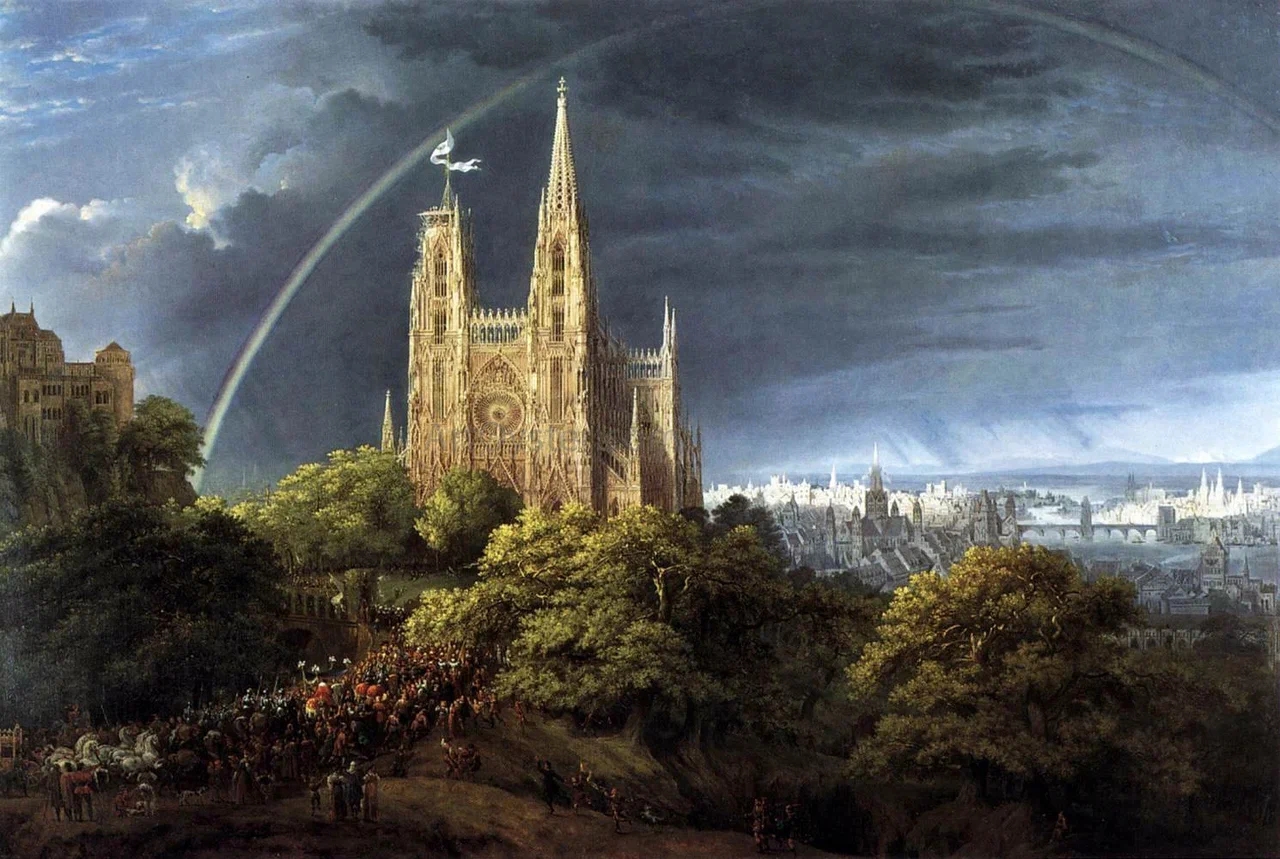
According to the Guinness Book of World Records, Havergal Brian’s Symphony No. 1, the “Gothic Symphony,” composed between 1919 and 1927, is the longest symphony ever written.
It’s certainly one of the largest, requiring multiple choirs and orchestras. The work calls for vocal soloists, two double choruses, brass bands, and a much-enlarged symphony orchestra, including 32 woodwinds, 24 brass, two timpani, assorted other percussion (requiring 17 players), celesta, two harps, organ, and a greatly expanded string section. In addition, two horns, two trumpets, two tubas, and one set of timpani combine in each of the four brass bands – a total of nearly 200 players. And that’s before factoring in the singers!
The composer had to paste multiple sheets together in the writing of the piece in order to accommodate its titanic demands. Brian dedicated the work to Richard Strauss, who declared it magnificent.
A contemporary of Ralph Vaughan Williams and Gustav Holst, Brian dropped out of school at the age of 12 and went to work in a coal mine. He also worked for timber firms and as a carpenter’s apprentice, the whole while nursing a secret desire to write music.
Though attracting early admiration from the likes of Sir Edward Elgar, Sir Thomas Beecham, and Sir Donald Francis Tovey, Brian was destined always to be a cult figure. But there were and are enough people out there who believe strongly enough in his music that most of his major works have been recorded.
Among them are 32 symphonies – 20 of them composed after the age of 80 and the last at the age of 93. Brian died in 1972, the result of a fall, two months shy of his 97th birthday.
The “Gothic” falls into two parts, subdivided into three movements each. Part One was inspired by Goethe’s “Faust,” and Part Two is a gargantuan setting of the “Te Deum” – combined they present a symphonic vision of the Gothic Age, a period of incalculable expansion in human knowledge. The music in Part Two is essentially modeled on Gothic architecture. It’s literally Brian’s conception of a cathedral in sound.
Have a couple of hours to spare? Check out Havergal Brian’s “Gothic Symphony,” on this, the 150th anniversary of the composer’s birth.
——–
IMAGE: “Medieval City on a River” (1815), by Karl Friedrich Schinkel
Leave a Reply