Tag: Piano Quintet in F Minor

  • Franck, Saint-Saëns, & Unrequited Love

    Franck, Saint-Saëns, & Unrequited Love

    Camille Saint-Saëns was not only the dedicatee of the Piano Quintet in F minor by his friend, César Franck; he also played in work’s premiere in 1879. But as he sight-read through the piano part, he became more and more agitated – angry, even. At the conclusion of the piece, he rejected Franck’s attempt to shake his hand, and stormed off without acknowledging the applause.

    He wasn’t the only one. Franck’s wife also made no secret of hating it.

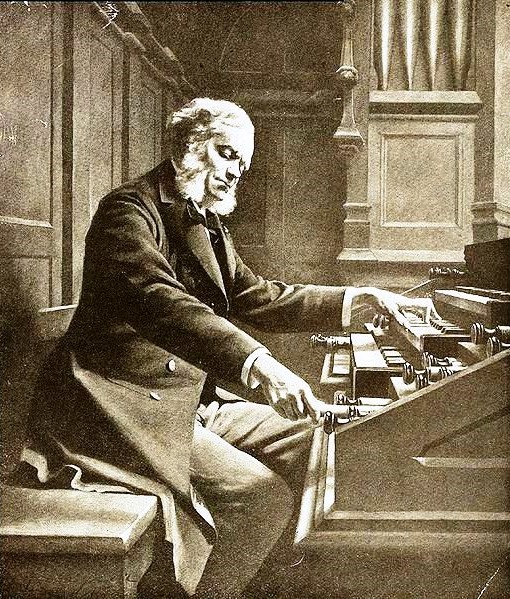
    Here was music of sublimated desire, and everyone knew the cause. Saint-Saëns knew, because he felt the same way about Franck’s pupil, Augusta Holmès. Franck tutored Holmès in organ and composition. No doubt he admired her musical talent, but equally there was no doubt his interest went beyond that of master-disciple. Don’t let those mutton chops fool you. A man is only flesh and blood. And in Franck’s case, also mutton chops.

    There must have been something about Holmès, the French composer of Irish descent, because she had the same effect on just about every man she crossed paths with. Saint-Saëns had proposed marriage to her multiple times, always without success. He would refer to her as a “beautiful pythoness.” Methinks his vines had tender sour grapes.

    I know I’ve made no secret of my struggles with the popularity of Franck’s highly-regarded Symphony in D minor. I’ve been very slow to warm to it. It’s taken decades, in fact. I never much liked the insipid theme of the last movement. But I’ve gotten to the point now where at last I’m willing to concede its overall greatest.

    Much more congenial to me are his symphonic poems and his lovely chamber music.

    No comment on the organ works – although I once attended a “Franckathon” at St. Clement’s Church in Philadelphia, back in the 1990s, at which his complete output for the instrument was presented, with two intermissions. Just to say I did. Well, that and for the free doughnuts and coffee.

    Nothing makes Franck more palatable than caffeine and fried dough.

    Happy birthday, mon vieux!


    Incendiary Piano Quintet in F minor

    Symphony in D minor

    “Le Chasseur maudit” (“The Accursed Huntsman”)

    Violin Sonata in A major

    “Grande pièce symphonique,” played by Marcel Dupré

    Prelude, Chorale and Fugue

    https://www.youtube.com/watch?v=wHftZ2-w4XE

    And, for the season, “Panis Angelicus”

  • Brahms: Beyond the Bearded Bear

    Brahms: Beyond the Bearded Bear

    It’s amusing that the most enduring image of Johannes Brahms is that of a gruff and portly, bearded old bear, incongruously disposed to writing lullabies.

    Lest we forget, Brahms was once a slender young man with piercing blue eyes, who wore his hair long and caused Clara Schumann, 17 years his senior, to confide to her diary, “He is so masterful that it seems God sent him into the world complete.”

    Also, he liked his coffee strong.

    Don’t expect anything too grandfatherly on this week’s “Music from Marlboro,” when the focus will be on Brahms’ unusually intense Piano Quintet in F minor.

    This is not music of wistful recollection. The quintet is often tempestuous and even tragic, fueled by all the passion and earnestness of an excitable young man. Brahms began his quintet in 1862, when he was 29 years-old.

    That’s not to say the composer ever teeters over into sentiment or excess of a kind common to his fin-de-siècle successors. Even in his 20s, Brahms was too much himself ever to allow that to happen.

    Instead he takes the prototype of the piano quintet – established by his friend and mentor, Robert Schumann – and fashions it into something unsettled and at times downright sublime. We are in the presence of something great, but also perhaps a little terrifying.

    This masterpiece of Brahms’ early maturity began life as a string quintet, written under the spell of Schubert’s famous Quintet in C. Brahms showed the work in this form to Clara Schumann and his friend, the violinist Joseph Joachim. Both were full of praise, at least at first, but gradually the compliments gave way to suggestions. Joachim, in particular, admired the work’s power, but confessed he found little in it to charm.

    Undaunted, Brahms took the piece and arranged it for two pianos in 1863-64, consigning the original version, for strings alone, to flames of woe. This two-piano reworking was politely rather than enthusiastically received, and Clara, thinking now it sounded more like a transcription than an original composition, begged him to recast it once more.

    The third time proved to be a charm. The resulting quintet, which achieved its final state in the summer of 1864, was met with resounding acclaim. At last, the piece had arrived at a perfect marriage of expression and form.

    While Brahms retains the classical poise for which he is so well known, he stiffens the sinews and conjures the blood, so to speak. In fact, there are times when he ratchets up the tension so effectively it seems the music might just fly off the rails.

    We’ll hear an exciting performance from the 2007 Marlboro Music Festival, featuring pianist Richard Goode, violinists Augustin Hadelich and Benjamin Beilman, violist Samuel Rhodes, and cellist Amir Eldan.

    In tandem with the whole “bearded bear” thing, Brahms is generally pigeonholed as the Classicist among Romantics. With this in mind, I’ll open the hour with a work by Walter Piston, the great American classicist, a two-time Pulitzer Prize winner, who gained esteem as one of our worthiest symphonists. These days, his symphonies are hardly ever played (more’s the pity), but we sure do hear his ballet “The Incredible Flutist” – probably his least characteristic composition.

    Piston’s 1946 “Divertimento for Nine Instruments” was performed at the Marlboro Music Festival in 1977, by violinists Young Uck Kim and Mitchell Stern, violist Karen Dreyfus, cellist Jerry Grossman, double bassist Julius Levine, flutist Julia Bogorad, oboist Roger Cole, clarinetist Stewart Newbold, and bassoonist Sol Schoenbach.

    It is, after all, called “classical music.” Tune in for worthwhile works by a pair of classicists, on the next “Music from Marlboro,” this Wednesday evening at 6:00 EDT, on WWFM – The Classical Network and wwfm.org.

    Marlboro School of Music and Festival: Official Page


    PHOTOS: Boy, Brahms… you really let yourself go!

Tag Cloud

Aaron Copland (92) Beethoven (95) Composer (114) Film Music (123) Film Score (143) Film Scores (255) Halloween (94) John Williams (187) KWAX (229) Leonard Bernstein (101) Marlboro Music Festival (125) Movie Music (138) Opera (202) Philadelphia Orchestra (89) Picture Perfect (174) Princeton Symphony Orchestra (106) Radio (87) Ralph Vaughan Williams (85) Ross Amico (244) Roy's Tie-Dye Sci-Fi Corner (290) The Classical Network (101) The Lost Chord (268) Vaughan Williams (103) WPRB (396) WWFM (881)

DON’T MISS A BEAT

Receive a weekly digest every Sunday at noon by signing up here


RECENT POSTS