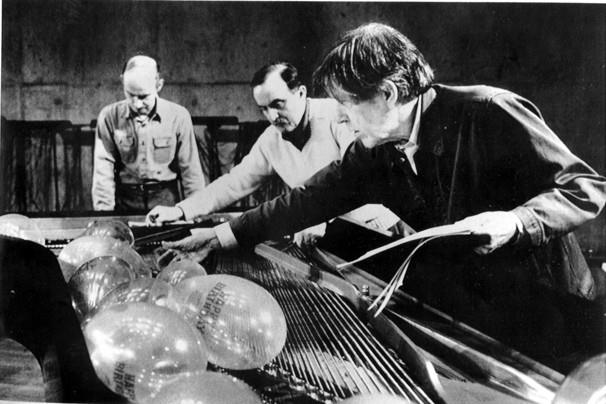
A “prepared piano” is a piano that has foreign objects laid on or inserted between its strings. These serve to alter the sound, character, timbre, and tuning of the instrument, and in the process create some rather fascinating percussive effects. It’s kind of like having your own gamelan orchestra at your fingertips. For a composer, it’s both effective and economical – if a little time consuming to get it set up.
John Cage was a pioneer of the practice. He composed “A Valentine Out of Season” for prepared piano in 1944, shortly before his separation from his wife, Xenia – which could very well account for the title. In this instance, he employed weather stripping, rubber, wood, bolts, pennies, and bamboo.
Cage’s first foray into the prepared piano came about as a solution for the writing of a dance piece, “Bacchanale,” for performance in a venue too small to accommodate a percussion ensemble, in 1938. To give an idea of how radical this was, that was the same year Aaron Copland’s “Billy the Kid” was introduced!
“A Valentine Out of Season” was choreographed by Merce Cunningham, as “Effusion avant l’heure,” for presentation in Paris in 1946. For New York, the title was changed to “Games,” and later “Trio.”
Thanks to a little ingenuity, Cage’s out-of-season Valentine turned out to be music for all seasons.
“Bacchanale”
How to prepare a piano with Stephen Drury