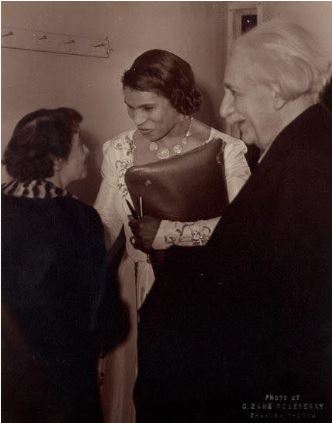
Anyone remember the time Marian Anderson spent the night with Albert Einstein?
If that sounds sordid, it absolutely is, but unfortunately in all the wrong ways.
Anderson, the contralto whose voice no less than Arturo Toscanini gushed was of a kind that comes once in a hundred years, was notoriously barred from performing at Constitution Hall in Washington, D.C., by the Daughters of the American Revolution because of the color of her skin. In the ultimate example of turning lemons into lemonade, Anderson sang instead from the steps of the Lincoln Memorial – to 750,000 people on the mall and a national radio audience estimated in the millions. That was on April 9, 1939, which, as it turned out, was Easter Sunday.
Two years earlier, after a performance at Princeton’s McCarter Theatre – a performance that drew a packed house and elicited glowing reviews – Anderson had been denied accommodations at the Nassau Inn.
Fortunately, Einstein happened to be in the audience. Learning of Anderson’s dilemma, he extended the invitation for her to stay with him in his home at 112 Mercer Street.
Anderson recollected, “I remember thanking him from the bottom of my heart and he seemed just sort of to brush it aside…. Dr. Einstein greeted one warmly and said, ‘We are very happy that you can come and welcome into our home.’”
For the next 18 years – through 1955, the same year she made her belated debut at New York’s Metropolitan Opera and the last year of Einstein’s life – Anderson made it a point to stay with Einstein whenever she was in Princeton.
In 1946, Einstein received an honorary degree from Lincoln University. In his acceptance speech, he stated, “There is a separation of colored people from white people in the United States. That separation is not a disease of colored people. It is a disease of white people. I do not intend to be quiet about it.”
Einstein himself was no stranger to racism. It was antisemitism that drove him to renounce his German citizenship, at a time it was still within his power to do so. The Nazis barred Jews from holding official positions, including professorships, they repeatedly raided his home, they sold his belongings, they burned his books and – though it seems superfluous under the circumstances – one German magazine put a $5000 bounty on his head. “Jewish intellectualism is dead,” proclaimed Goebbels.
Hitler’s loss was our gain. Though there were Jewish quotas in place at universities even here in the United States, including at Princeton University (unofficially, but understood), Einstein accepted a position at the newly-formed Institute for Advanced Study – which in its early days, kept offices on Princeton’s campus while its own facilities were under construction. Einstein would become an American citizen in 1940.
Einstein embraced America’s system of meritocracy. He extolled the “right of individuals to say and think what they pleased,” without social barriers, a right he found conducive to creativity and innovation. At the same time, he condemned America’s racism, which he found to be the country’s “worst disease… handed down from one generation to the next.”
Einstein joined the Princeton chapter of the NAACP. When he put himself forward as a character witness for civil rights activist W.E.B. Du Bois at a trial in 1951, the judge dropped the case.
In 1959, Anderson herself received an honorary degree from Princeton University. Although by then Einstein had passed, again she stayed at his home.
There are a lot of reasons to share this story, but I do so today in conjunction with Pi Day (3.14), always a big deal in Princeton. Find yourself a seat at an integrated lunch counter and order yourself a celebratory slice in honor of this extraordinary friendship.