Tag: Purim

  • On Purim, I Have Less Confidence in Area Bakeries Than I Do Princeton’s Thomas De Hartmann

    On Purim, I Have Less Confidence in Area Bakeries Than I Do Princeton’s Thomas De Hartmann

    I had to be out this morning anyway, so I’m just back from crossing off two more bakeries from the checklist on my annual search for the perfect hamantaschen on Purim. I am sorry to report, neither sample I consumed today lived up to expectations. (Of course, in my optimism, I purchased several from both shops.) In the interest of kindness, I won’t name the bakeries, as I have no animosity toward them, even though their hamantaschen suck.

    Hamantaschen, in case you don’t know, are triangular, pocket-filled pastries associated with Haman, the villain of the Purim story as related in the Book of Esther – “tash” meaning “pocket” or “pouch” in Yiddish. In Hebrew, they’re sometimes referred to as “Haman’s ears.” And what an appetizing image that is, especially when biting into the fruity center!

    The cookie is often filled with apricot, raspberry, poppy seed, or my personal favorite, prune – which may sound a little geriatric, but trust me, with a good cup of coffee, it infuses one with a ridiculous sense of well-being.

    The best hamantaschen I ever had were from Rindelaub’s Bakery, then located right across the street from one of my many Philadelphia apartments, on South 18th Street, just a few doors north of Rittenhouse Square. That was decades ago, when I was in my 20s. A prune-centered hamantasch and a large cup of coffee consumed in the square on a sunny afternoon was a recipe for pure bliss. Alas, once a Philadelphia institution, Rindelaub’s is no more.

    In the name of all that’s holy, avoid hamantaschen from the local grocery store. They’re generally pretty terrible – hard jelly in a tasteless cookie that will turn to powder as soon as you bite into it. But if you can find them at an actual bakery, give them a shot – although, I confess, I have not had a lot of luck. In the Trenton-Princeton area, so far the closest I’ve come to recapturing the unalloyed pleasure of Rindelaub’s pastries was from a vendor at Trenton Farmer’s Market, but I haven’t been back there in years and the market is only open Thursday to Sunday.

    If someone knows of a great Jewish bakery in the vicinity, please let me know. I’ve already been to Cramer’s in Yardley, a couple of years back. With all respect to Cramer, it wasn’t even close. I also experienced an epic fail at a bakery in Sea Girt last summer.

    A few years ago, I put together a post about music inspired by the Purim story. The best-known musical response is still probably George Frideric Handel’s “Esther,” from 1732. Handel’s first English oratorio recounts the events of the Biblical book, by way of an Old Testament drama by Jean Racine. The Hebrew Esther becomes Queen of Persia and thwarts the machinations of the king’s jealous vizier, which would have resulted in the extermination of her people.


    Interestingly, although Princeton doesn’t seem to have any good Jewish bakeries, it turns out the town is the final resting place of a composer who, I only just learned this week, wrote an opera based on the same Racine play.

    Thomas De Hartmann was born in Ukraine in 1885. He studied composition with Rimsky-Korsakov, Anton Arensky, and Sergei Taneyev. He was friendly with the mystic-philosopher George Gurdjieff, who acted as his spiritual adviser and with whom De Hartmann and his wife, Olga, an opera singer, departed Russia following the revolution. Eventually, in 1950, they settled in the United States. De Hartmann and Gurdjieff collaborated on a number of musical works.

    De Hartmann would die of a heart attack several weeks after performing his Violin Sonata in Princeton (with Alexander Schneider, violin, and the composer at the keyboard). He is buried next to his wife in Princeton Cemetery, his grave marked by a very distinctive headstone, which bears a quotation from his unfinished Fourth Symphony.

    I wrote about him for an article in the Princeton weekly newspaper U.S. 1, as part of a “haunted tour” of local composers’ gravesites I compiled one year for Halloween.

    https://www.communitynews.org/princetoninfo/coverstories/a-requiem-for-princeton-s-passed-composers/article_a83ca082-5487-11ed-9182-8771c220bdaf.html

    Since then, I’ve purchased two volumes of his orchestral music on the Toccata Classics label, and earlier this season heard Joshua Bell play his Violin Concerto with the New York Philharmonic. Bell’s recording of the Violin Concerto has been coupled with Matt Haimovitz’s performance of the Cello Concerto, for Pentatone Records. I wonder if we’re poised on the brink of a full-blown Thomas De Hartmann revival?

    Also imminent from Pentatone is the premiere recording of De Hartmann’s opera, “Esther,” which the label only just previewed on its YouTube channel yesterday. To learn more about it, read the description under the video at the link.


    Comparisons to Poulenc, Debussy, Strauss, and Korngold? I’m there!

    Thomas De Hartmann’s “Esther” will be released on April 24.
    Even if the bakeries let me down, I’m fairly confident De Hartmann will not.

    ———-

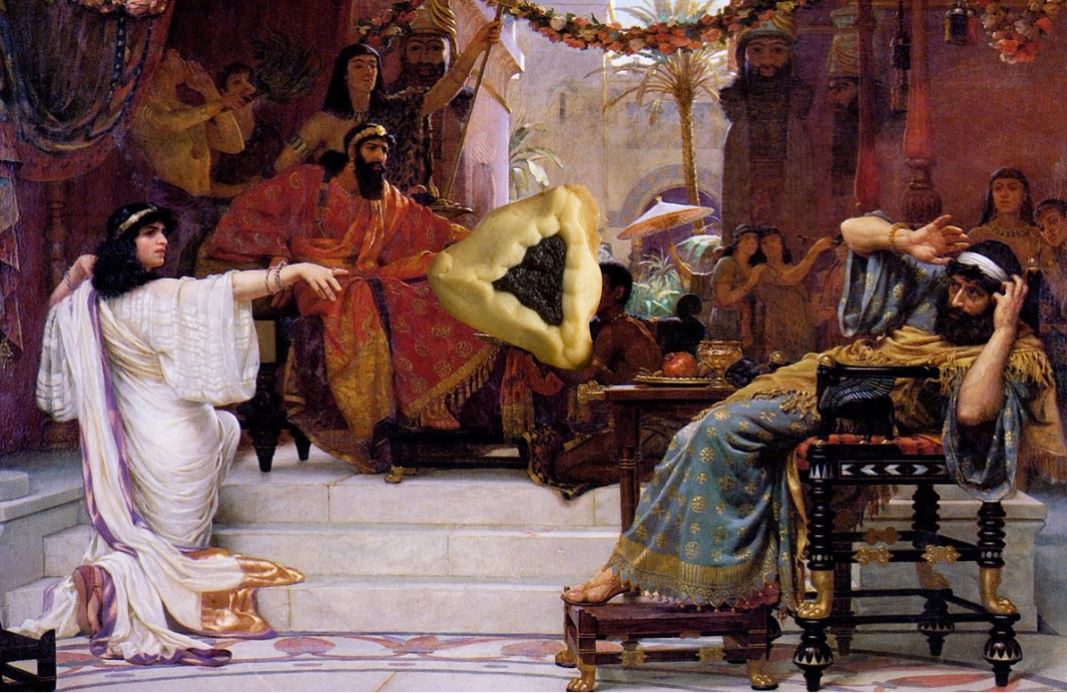
    IMAGE: “Esther Denouncing Haman to King Ahasuerus” (1888) by Ernest Norman, with hamantasch added by me

  • Hamantaschen Hunt Central Jersey Purim Music

    Hamantaschen Hunt Central Jersey Purim Music

    The Jewish festival of Purim begins at sunset. Which means tomorrow morning I will hit the road in search of Central Jersey’s tastiest hamantaschen.

    Hamantaschen, in case you don’t know, are triangular, filled-pocket pastries associated with Haman, the villain of the Purim story as related in the Book of Esther – “tash” meaning “pocket” or “pouch” in Yiddish. In Hebrew, they’re sometimes referred to as “Haman’s ears.” And what an appetizing image that is, especially when biting into the fruity center!

    The cookie is often filled with apricot, raspberry, poppy seed, or my personal favorite, prune – which may sound a little geriatric, but trust me, with a good cup of coffee, it infuses one with a ridiculous sense of well-being.

    The best hamantaschen I ever had were from Rindelaub’s Bakery, then located right across the street from one of my many Philadelphia apartments, on South 18th Street, just a few doors north of Rittenhouse Square. That was decades ago, when I was in my 20s. A prune-centered hamantasch and a large cup of coffee consumed in the square on a sunny afternoon was a recipe for pure bliss. Alas, once a Philadelphia institution, Rindelaub’s is no more.

    Or is it? I see, doing a Google search, there’s an article about it that ran in the Philadelphia Inquirer in 2008, but it’s paywalled. If someone subscribes, please let me know to what far-flung suburb the bakery has retreated.

    In the name of all that’s holy, avoid hamantaschen from the local grocery store. They’re generally pretty terrible – hard jelly in a tasteless cookie that will turn to powder as soon as you bite into it. But if you can find them at an actual bakery, give them a shot.

    In the Trenton-Princeton area, I have had mixed success trying to recapture Rindelaub’s perfection of flavor and ratio of pastry to filling. Again, if someone knows of a great Jewish bakery in the area, let me know.

    Ever hear of the whole megillah? Or Magilla Gorilla? In Hebrew, the Megillah is one of five books read on special Jewish feast days. On Purim, it’s Megillat Esther, the reading punctuated with boos and the grinding of groggers at each mention of Haman.

    The best-known musical response to Purim is still probably George Frideric Handel’s “Esther,” from 1732. Handel’s first English oratorio recounts the events of the Biblical book, by way of an Old Testament drama by Jean Racine. The Hebrew Esther becomes Queen of Persia and thwarts the machinations of the king’s jealous vizier, which would have resulted in the extermination of her people.

    In 1954, Jan Meyerowitz composed his “Symphony: Midrash Esther.” Meyerowitz’s family experienced an analogous threat in Germany in the 1930s, but their solution was the opposite of Esther’s. Rather than reveal their Jewishness, they chose to conceal it, converting to Christianity shortly before Meyerowitz’s birth. So carefully kept was the secret that the composer himself didn’t learn of his true heritage until the age of 18.

    Meyerowitz studied in Berlin, then in Rome with Ottorino Respighi and Alfredo Casella. He emigrated to the United States in 1946, where he found employment at Tanglewood, then Brooklyn College and the City College of New York. The symphony was first performed in 1957, by the New York Philharmonic under the direction of Dimitri Mitropoulos.

    You can listen to it here, on tracks 5 to 8

    As a bonus, track 1 is “Queen Esther’s Prayer” from “Four Biblical Tableaux” by Aaron Avshalomov, from 1928, .

    Cristiano Giuseppe Lidarti’s “Ester” is believed to be the first work in oratorio form to be set to a Hebrew libretto (by Rabbi Jacob Saraval). Composed in 1774, it was rediscovered only in 1997!

    Finally, here’s Eugen d’Albert’s overture after Franz Grillparzer’s “Esther.” D’Albert was a mighty pianist, who studied with Franz Liszt. He composed no less than 21 operas. He was married six times. He met his match in Teresa Carreño, “The Valkyrie of the Piano,” herself married four times. What a Ragnarok their union must have been!

    I only recently came across another piece of music inspired by Esther, somewhere in my CD collection, and it’s making me crazy, because now I can’t remember what it is! It was something from the late 19th or early 20th centuries. I’ll add it here should I remember it.

    Remember tomorrow to pour a cup of coffee and taste deeply of Haman’s ear for Purim!


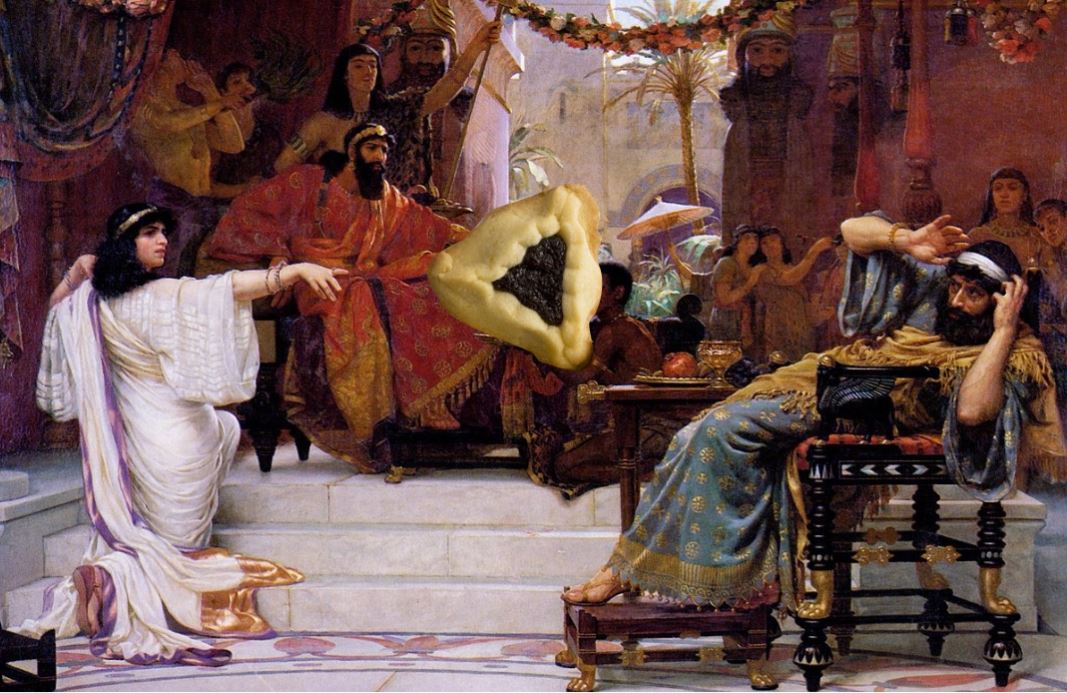
    IMAGE: “Esther Denouncing Haman to King Ahasuerus” (1888) by Ernest Norman, with hamantasch added by me
  • Spring Equinox Purim Bach & More Today!

    Spring Equinox Purim Bach & More Today!

    I hope you’ll join me this afternoon, as we anticipate the arrival of spring (at 5:58 p.m.), the Jewish festival of Purim (at sunset), and the Super Worm Equinox Moon (full at 9:43 p.m.). We’ll also celebrate the birthdays today of pianist Sviatoslav Richter and heldentenor Lauritz Melchior.

    To coincide with the vernal equinox, it will be an all-Bach hour on “Music from Marlboro” at 6 – performances from the legendary Marlboro Music Festival. Don’t forget to join the Bach 500, if you haven’t already. 500 donations IN ANY AMOUNT will allow us to unlock this year’s Bach Pot. It’s worth over $14,000 to us. Call now at 1-888-232-1212 or donate online at wwfm.org.

    Remember, it’s listeners just like you who put the spring in our step, from 4 to 7 p.m. EDT, on WWFM – The Classical Network and wwfm.org.

  • Handel’s Esther & Purim’s Story on WWFM

    Handel’s Esther & Purim’s Story on WWFM

    Following today’s Noontime Concert on WWFM, we look ahead to the Jewish festival of Purim, with a complete performance of George Frideric Handel’s “Esther.” Generally acknowledged to be Handel’s first English oratorio, “Esther” recounts the events of the Biblical book (by way of an Old Testament drama by Jean Racine), in which a Hebrew woman becomes Queen of Persia and thwarts the extermination of her people by Haman, the king’s jealous vizier.

    We’ll also hear the symphony, “Midrash Esther,” by Jan Meyerowitz. Meyerowitz’s family experienced an analogous threat in Germany in the 1930s, but their solution was the opposite of Esther’s. Rather than reveal their Jewishness, they chose to conceal it, converting to Christianity shortly before Meyerowitz’s birth. So carefully kept was the secret that the composer himself didn’t learn of his true heritage until the age of 18.

    Meyerowitz studied in Berlin, then in Rome with Ottorino Respighi and Alfredo Casella. He emigrated to the United States in 1946, where he found employment at Tanglewood, then Brooklyn College and the City College of New York. The symphony was first performed in 1957, by the New York Philharmonic under the direction of Dimitri Mitropoulos.

    Purim begins on Saturday at sunset. Enjoy the music with a cup of coffee and some hamantaschen, this afternoon, beginning around 1:00 EST, on WWFM – The Classical Network and at wwfm.org.

Tag Cloud

Aaron Copland (92) Beethoven (95) Composer (114) Film Music (119) Film Score (143) Film Scores (255) Halloween (94) John Williams (185) KWAX (229) Leonard Bernstein (99) Marlboro Music Festival (125) Movie Music (134) Opera (198) Philadelphia Orchestra (87) Picture Perfect (174) Princeton Symphony Orchestra (106) Radio (87) Ralph Vaughan Williams (85) Ross Amico (244) Roy's Tie-Dye Sci-Fi Corner (290) The Classical Network (101) The Lost Chord (268) Vaughan Williams (102) WPRB (396) WWFM (881)

DON’T MISS A BEAT

Receive a weekly digest every Sunday at noon by signing up here


RECENT POSTS