Tag: Requiem

  • Celebrating John Rutter at 80

    Celebrating John Rutter at 80

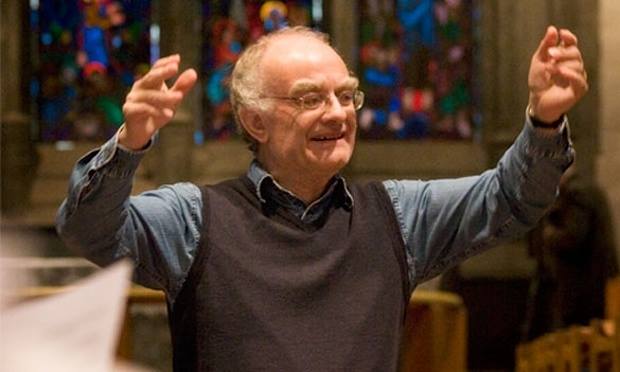
    Oh, where do the years go? It seems only yesterday that I was marking the 75th birthday of John Rutter. Now here we are, at fourscore.

    Rutter, of course, is one of England’s most successful choral composers and conductors. It’s impossible to get through the Christmas season without hearing oodles of his work. The bigger pieces can be a little hit and miss (the “Gloria” gets a little too close to Walton at times, and “big” is not really Rutter’s forte), but when he hits, as in the lovely “Requiem,” he is well-nigh irresistible – at least for someone with a cotton candy soul like myself.

    Perhaps his music is not your cup of tea, but the choir he built, the Cambridge Singers (founded in 1981), sounds like nobody else. For better or worse, like Ormandy’s Philadelphians, they bring their distinctive sound to everything they touch. The soft glow inspires contentment.

    As a young man, Rutter collaborated with the legendary Sir David Willcocks on four volumes of the extraordinarily successful “Carols for Choirs” anthology series, now the most widely used source of carols in the British Anglican tradition, and very popular among choral societies. Willcocks went so far as to describe Rutter as the most gifted composer of his generation. Certainly, his gift for melody has proven inexhaustible.

    Rutter was honored with a knighthood in February. What took so long? He’s man and an artist who’s brought a lot of beauty into the world. In today’s climate, it’s a quality that’s become even more precious. He’s the kind of person who deserves to be celebrated.

    Happy birthday, Sir John Rutter, and many happy returns.


    Rutter’s “Requiem” (1985), the perfect music for autumn, with the Cambridge Singers. Accept no substitutes.

    “Candlelight Carol” (1984)

    The composer offering insights into his “Requiem,” in 11 segments:

  • Happy 75th Birthday John Rutter

    Happy 75th Birthday John Rutter

    Oh, where do the years go? Today is the 75th birthday of John Rutter.

    Rutter, of course, is one of England’s most successful choral composers and conductors. It’s impossible to get through the Christmas season without hearing oodles of his work. The bigger pieces can be a little hit and miss (the “Gloria” gets a little too close to Walton at times, and “big” is not really Rutter’s forte), but when he hits, as in the lovely “Requiem,” he is well-nigh irresistible – at least for someone with a cotton candy soul like myself.

    Perhaps his music is not your cup of tea, but the choir he built, the Cambridge Singers (founded in 1981), sounds like nobody else. For better or worse, like Ormandy’s Philadelphians, they bring their distinctive sound to everything they touch. The soft glow inspires contentment.

    As a young man, Rutter collaborated with the legendary Sir David Willcocks on four volumes of the extraordinarily successful “Carols for Choirs” anthology series, now the most widely used source of carols in the British Anglican tradition, and very popular among choral societies. Willcocks went so far as to describe Rutter as the most gifted composer of his generation. Certainly, his gift for melody has proven inexhaustible.

    Happy birthday, John Rutter, and many happy returns.


    Rutter’s “Requiem” (1985), the perfect music for autumn, with the Cambridge Singers. Accept no substitutes.

    “Candlelight Carol” (1984):

    The composer offering insights into his “Requiem,” in 11 segments:

  • Panufnik, Nelhýbel & Rutter: Rediscovering Masters

    Panufnik, Nelhýbel & Rutter: Rediscovering Masters

    I’ve said it before, and I’ll say it again: Andrzej Panufnik (1914-1991) is the sleeping giant of Polish music. He’s one of those figures, like Bohuslav Martinu, who always seems perched on the verge of greatness, and yet never quite achieves the full degree of recognition he deserves.

    To begin with, his particular brand of modernism was eclipsed by the avant-garde experiments of his compatriot and friend, Witold Lutoslawski. Panufnik’s relationship with Lutoslawski dated back to the war years. During the German occupation, the two formed a piano duo which played in Warsaw cafes – at the time the only way to share live music in public, since there was a ban on organized gatherings.

    In the meantime, Panufnik quietly produced subversive works celebrating Polish heroism and the resistance. Following the war, he was instrumental in the re-establishment of the Warsaw Philharmonic. However, increasing friction with Poland’s communist regime led to the composer’s defection, under hair-raising circumstances, in 1954. He was granted asylum in England, where he received a knighthood in the year of his death.

    Panufnik’s “Sinfonia Rustica,” composed in 1948 and revised in 1955, as the title implies, is a work very much of the people, making use of fragmented Polish themes, meant to reflect the rustic, semi-abstract, paper-cut art of the peasantry. Not only the symphony’s framework, but also the layout of the orchestra, is meant to reflect the symmetry found in Polish folk art. Nevertheless, despite the work’s direct character, it was denounced in 1949 as “alien to the great socialist era.”

    The Czech composer Václav Nelhýbel (1919-1996) was also displaced. Nelhybel left Nazi-occupied Prague for Switzerland in 1942. Later, he settled in the United States, where he taught at Lowell State College. He also served as composer-in-residence at the University of Scranton for several years until his death. During his time in America, he oversaw many bands and youth ensembles. He is remembered as an energetic and demanding though ultimately endearing taskmaster.

    Nelhýbel was dizzyingly prolific, with 400 published works to his credit and an additional 200 left in manuscript. The “Etude Symphonique” of 1964 is as exacting and propulsive as the artist who created it, with a three-note motive exhaustively developed. The work’s churning rhythms and cross-rhythms lend it a sense of vitality, and new ideas are continually formulated and examined.

    Of a more reflective nature is John Rutter’s Requiem. Rutter (b. 1945) is best known for his all-pervasive music for Christmas. His setting of the Requiem, composed in 1985, eschews the terror and high drama of Berlioz and Verdi to offer solace and tranquility in the manner of Gabriel Fauré’s most beloved essay in the form. I think you’ll find it the perfect restorative music for an early autumn evening.

    Works by these three composers will form the loom upon which I hope to weave a compelling program for your late September satisfaction, today from 4 to 7 p.m. EDT, on WWFM – The Classical Network and wwfm.org.


    Clockwise from left: Andrzej the Giant; Vaclav the Vital; and John the Rejuvenator

  • Moran Trinity Requiem on WWFM

    Moran Trinity Requiem on WWFM

    Coming up in the 6:00 hour, we’ll hear the “Trinity Requiem” by Philadelphia composer Robert Moran. Moran’s approach to the Requiem Mass, named for Trinity Wall Street, the so-called “Ground Zero” church in Lower Manhattan, is akin to that of Gabriel Fauré. It is a work of solace and consolation. The substantial role sung by the children’s chorus only lends to the work’s innocent and ethereal qualities. Join me for this music of reflection, coming up around 6:30 EDT, on WWFM – The Classical Network and wwfm.org.

  • Happy 70th Birthday, John Rutter!

    Happy 70th Birthday, John Rutter!

    Today is the 70th birthday of John Rutter. How did that happen? Ah well, none of us are getting any younger.

    Rutter, of course, is one of England’s most successful choral composers and conductors. It’s impossible to get through the Christmas season without hearing oodles of his work. The bigger pieces can be a little hit and miss (the “Gloria” gets too close to Walton at times, and “big” is not really Rutter’s forte, if you’ll pardon the inadvertent play on words), but when he hits, as in the lovely “Requiem,” he is well nigh irresistible – at least for someone with a cotton candy soul like myself.

    Perhaps his music is not your cup of tea, but the choir he built, the Cambridge Singers (founded in 1981), sounds like nobody else. For better or worse, Like Ormandy’s Philadelphians, they bring their distinctive sound to everything they touch. The soft glow inspires contentment.

    As a young man, he collaborated with the legendary Sir David Willcocks on four volumes of the extraordinarily successful “Carols for Choirs” anthology series, now the most widely used source of carols in the British Anglican tradition, and very popular among choral societies. By coincidence, I’ll be honoring Willcocks this Sunday night on “The Lost Chord.” Willcocks died on September 17, at the age of 95. Join me for rarities by Gustav Holst and Ralph Vaughan Williams at 10 ET, at 89.1 FM or online at wwfm.org.

    Happy birthday, John Rutter, and many happy returns.


    Selections from John Rutter’s “Requiem” (1985), the perfect music for autumn, with the Cambridge Singers. Accept no substitutes!

    https://www.youtube.com/watch?v=HP7oYnXfyh0&list=PLMUnB4vc6zhWN_q7TidWNIABZaZzOnj9s

    By the 2 minute mark, after an ominous opening, you get a pretty good idea of what you’re in for.

Tag Cloud

Aaron Copland (92) Beethoven (95) Composer (114) Film Music (120) Film Score (143) Film Scores (255) Halloween (94) John Williams (185) KWAX (229) Leonard Bernstein (100) Marlboro Music Festival (125) Movie Music (135) Opera (198) Philadelphia Orchestra (88) Picture Perfect (174) Princeton Symphony Orchestra (106) Radio (87) Ralph Vaughan Williams (85) Ross Amico (244) Roy's Tie-Dye Sci-Fi Corner (290) The Classical Network (101) The Lost Chord (268) Vaughan Williams (103) WPRB (396) WWFM (881)

DON’T MISS A BEAT

Receive a weekly digest every Sunday at noon by signing up here


RECENT POSTS